NFL
Watson's Fourth-Quarter Answers Silence Early Skeptics
Two consecutive game-winning drives have reset the narrative around Deshaun Watson in Cleveland, even as the preseason booing still lingers.
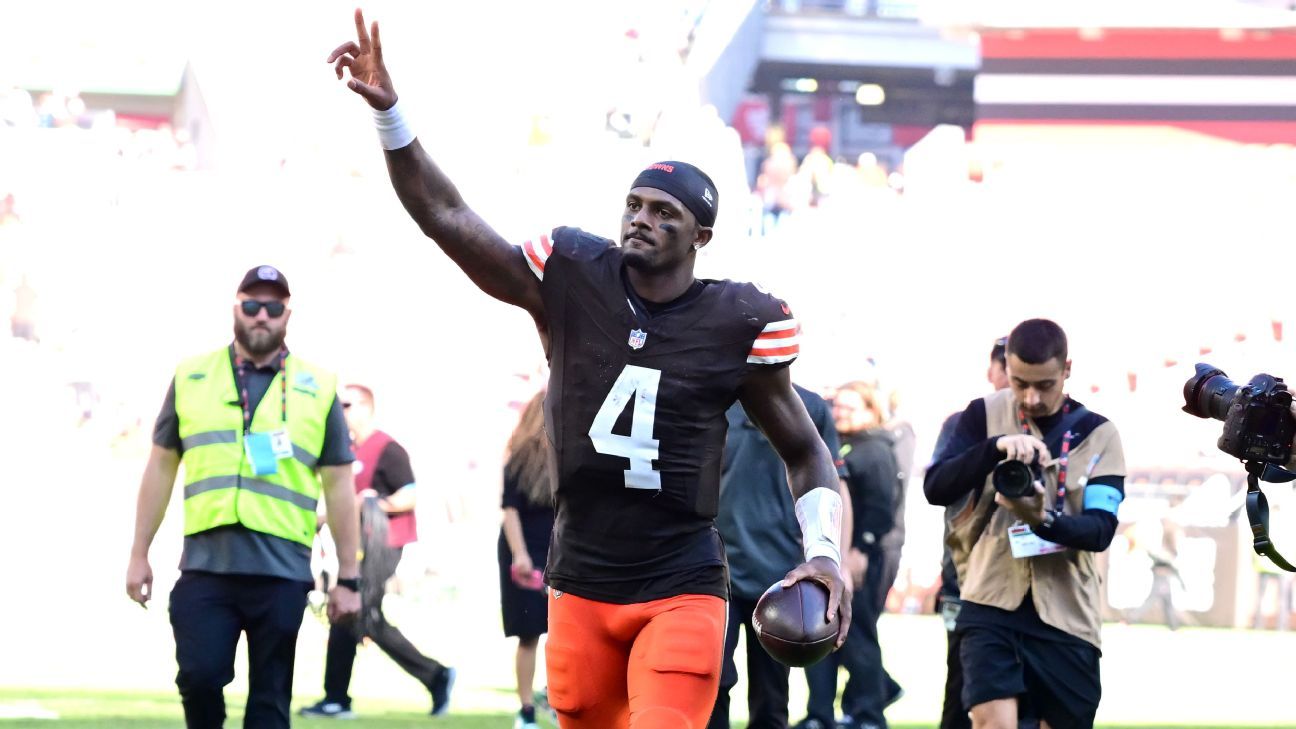
Deshaun Watson led the Browns to a 21-18 win over Carolina on Sunday with a 14-yard touchdown pass to Harold Fannin Jr. with 1:48 remaining, the second straight fourth-quarter game-winning drive he has engineered this season. The performance marked a sharp reversal from the preseason home game roughly four weeks earlier, when Cleveland fans booed Watson in the second half of a contest against Buffalo. Watson completed 16 of 30 passes for 144 yards and two touchdowns while adding 45 rushing yards on 11 carries, converting critical third downs on the final drive—a 21-yard scramble and then the decisive scoring pass—to move Cleveland to 2-1 and into first place in the AFC North.
The narrative arc matters for Watson's market perception. After calling the preseason booing "personal" and "disrespectful," and later acknowledging his emotions got the better of him, Watson arrived at Sunday's home opener facing genuine fan skepticism. The fourth-quarter execution—particularly his willingness to use his legs and the precision of his throw to Fannin—provided tangible evidence that he can deliver in high-leverage moments. A roughing-the-passer penalty briefly interrupted the drive, but Watson returned and completed a two-point conversion to rookie Denzel Boston before the touchdown strike sealed it. Cleveland's defense finished the job with Ronnie Hickman's interception of Bryce Young with nine seconds left.
Watson's slow start offset the heroics: he was 10-for-21 for 67 yards and one touchdown through three quarters, a completion rate that signals the offense labored for most of the afternoon. The late-game explosion is the headline, but it masks an underlying offense that struggled to generate rhythm until desperation forced accelerant play-calling. That split—brilliant fourth-quarter execution masking three quarters of relative stagnation—is the operative tension for Watson's prop betting profile going forward.
For the betting market, Watson's two consecutive game-winning drives carry material weight despite the small sample and preseason context. The mechanism is straightforward: when the Browns face third-quarter deficits or tight scores, Cleveland's play-calling tightens around Watson's dual-threat upside, and the opposing defense has already been fatigued by three quarters of chess. Watson's 21-yard scramble on third-and-long is not a random spike—it reflects his increased willingness to operate outside structure when the moment demands it, a trait that drives fourth-quarter passing yards and completion percentage. However, the market has likely already begun to price in Watson's late-game reliability after Week 2; any over on his passing yards or completion percentage at standard Week 3 levels is fighting recent line adjustments. The sharper angle is a FADE on his early-game passing volumes (passing yards, completions) in games where Cleveland enters as favorites or in non-deficit settings, since Sunday's data confirms his offense operates in a wholly different mode when trailing. The Browns face Pittsburgh on Thursday night as a 2-1 team tied atop the division; if the line reflects Cleveland as a slight favorite, Watson's first-half passing production should decline relative to season average.
Watson's emotional and mechanical reset in front of his home crowd is genuine and worth acknowledging in his fourth-quarter profiles, but the early-game constraint—the reality that Cleveland's offense does not require Watson's full arm talent when the team is not playing from behind—creates a durable market inefficiency. Oddsmakers have a tendency to extrapolate late-game heroics into full-game forecasts. Watson's raw passing-yard totals and completion percentages should fall in games where Cleveland enters as favorites, because the game script will not demand the fourth-quarter alchemy that produced Sunday's numbers.
NFL Intelligence — Football intelligence beyond the final score. Open NFL Intelligence →