Watson's Catastrophe and the Mayfield Mirror: How Sunk Cost Costs Cleveland Games
By Justin Erickson ·
The Browns are locked into a fully guaranteed $230 million anchor while their own rejected quarterback thrives elsewhere, and this week's matchup exposes the math of organizational decision-making.
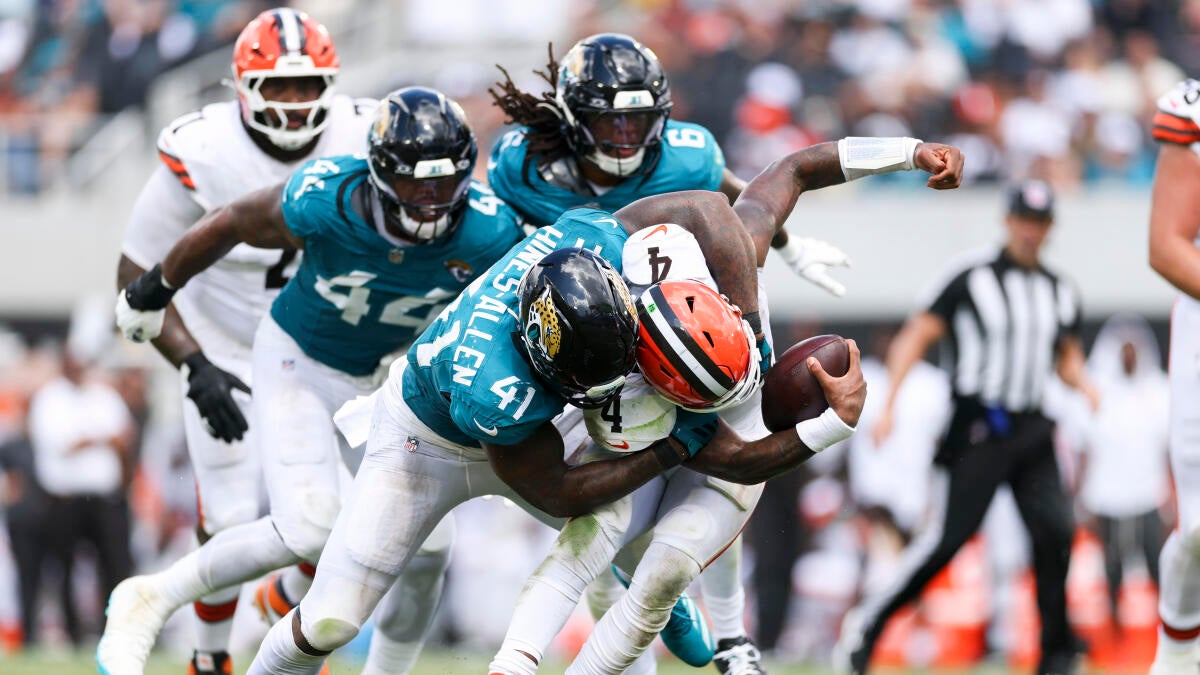
The Cleveland Browns started their 2026 season 0-1 against Jacksonville, a defeat that crystallized what the organization has been refusing to acknowledge: Deshaun Watson is functionally broken as an NFL quarterback. In Week 1, Watson was sacked five times, threw an interception, and watched his team trail 31-0 in the third quarter. By efficiency metrics—expected points added per dropback (–0.19, 50th among 51 qualified quarterbacks since 2022), yards per attempt (5.0), and sack rate (11.5%)—he ranks among the league's two worst starters. The numbers aren't close. He's not underperforming; he's confirming what his on-field play has suggested for two full seasons.
Yet the Browns keep him under center because they have no choice: Watson is owed money whether he plays or not. The franchise invested three first-round picks and a fully guaranteed five-year, $230 million extension to pry him from Houston in 2022. That commitment—the most guaranteed money ever given to an NFL player—is now a straightjacket. Head coach Todd Monken, in his first season, has already made clear that there is no debate: Watson starts because the front office's sunk cost is the only calculus that matters. Quarterback safety Ronnie Hickman's response when asked about continuity at the position—"That's above my pay grade"—was the locker room's way of saying the emperor has no clothes.
This week brings maximum irony: Cleveland faces Baker Mayfield and the Tampa Bay Buccaneers. The same organization that traded Mayfield to Carolina in 2022 to make room for Watson is now watching their old quarterback operate in a different stratosphere. In three full seasons in Tampa, Mayfield has led the Bucs to two NFC South titles, just signed a three-year, $165 million extension ($120M guaranteed), and has posted 14,616 passing yards and 105 touchdowns—seventh and fifth in the NFL since his 2022 departure. Cleveland, meanwhile, has cycled through ten different starting quarterbacks since sending him away. The contrast isn't subtle.
For prop bettors, Watson's dysfunction creates a specific mechanical edge: his inaccuracy and decision-making force the Browns to rely on their running game and short-range passing concepts, which means the early-down frequency shifts toward rushing plays and quick slants. In Week 1, Watson averaged just 5.0 yards per dropback, the second-worst mark among starting quarterbacks. That offensive poverty also suppresses the output of talented young receivers like first-rounder KC Conception (0.182 separation score, 8th among Week 1 receivers) and second-rounder Denzel Boston (0.111 separation, 15th), because Watson cannot capitalize on the windows they're creating. The Buccaneers, ranked 6th in pass defense EPA in 2025, will eat into Watson's completion percentage and yards. Expect more incompletions, more conservative play-calling, and fewer downfield attempts. Watson's passing yards total should sit at least 15-20 yards lower than his season average (likely around 220-240 yards) because the scheme and the opponent both punish vertical aggression.
The structural problem—and the betting angle—is that Watson's guarantee keeps him employed despite evidence that he's actively holding the franchise's young talent back. Every incompletion to Conception or Boston is a wasted snap that could have gone to a rhythm-based short game or run-heavy sequence. The Browns aren't a contender this year; they're a team managing an albatross while their rejected alternative thrives across the field. Back Watson unders and fade any passing prop tied to his volume, because the Buccaneers will force Cleveland into a desperate, one-dimensional gameplan.