NFL
Packers' Offensive Identity Crisis Runs Deeper Than the Line
Green Bay's 1-2 start masks a roster-wide collapse that extends well beyond pass protection and into drops, tackling, and decision-making.
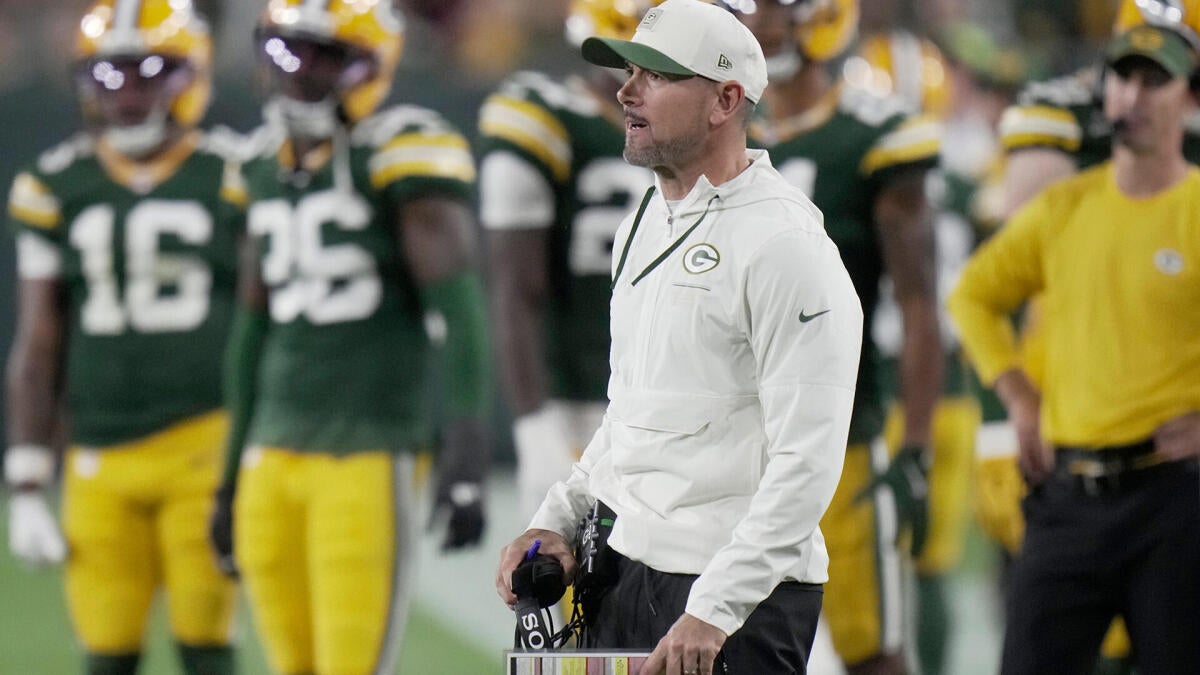
The Green Bay Packers absorbed a 35-14 drubbing at home from Atlanta on Thursday night—a team that had managed just 524 total yards through its first two games. The Falcons hung nearly 500 yards on them. Jordan Love averaged 5.8 yards per attempt. The Packers rushed nine times for 17 yards. Matt LaFleur, standing in the postgame interview, didn't mince words: "It was a butt-whooping." Three weeks in, the offensive infrastructure has fractured in ways that no single fix resolves.
The immediate culprit is the offensive line, which cannot generate push in the run game or hold its pocket. Zach Bako-Bewele and Aaron Banks both sat out Thursday due to injury. The unit now features Sean Rhyan—a career guard—at center, Jordan Morgan (primarily a guard or right tackle) at left tackle, and Jacob Monk, a 2024 fifth-round pick with just 57 career snaps heading into the season, stationed at guard. A fifth-round rookie center, Jager Burton, played guard Thursday night. This is not a stable platform. Green Bay is allowing pressure on 42.4% of Love's dropbacks—a rate that would have ranked 31st last season—and permitted 15 quick pressures alone in Thursday's loss. Their yards before contact per rush sits at 0.92, tracking toward 30th in the league. But LaFleur explicitly resisted pinning all blame on the line, and the evidence supports his resistance.
The problem map is far wider. The Packers lead the NFL with nine dropped passes through three weeks; no other team has more than five. Love has been intercepted twice and nearly picked off four additional times. Tackling has become a liability—Bijan Robinson gained 163 yards after contact despite carrying 21 times, while Drake London accumulated 108 yards after the catch on just eight receptions. These are not marginal failings. They compound. A defense that cannot wrap up turns manageable gains into explosive plays. An offense that cannot secure the ball or execute timing routes abandons any chance to sustain drives, regardless of line performance.
For prop bettors, this collapse creates a specific directional edge on Love's volume metrics. His yards-per-attempt average of 5.8 Thursday reflects not just pressure but also incompletion rate and receiver availability. With nine drops already on the season—a league-leading pace—the fundamental disconnect between ball placement and ball security is structural, not a single-game aberration. Love's passing-yards total should trade depressed, but the edge isn't just volume; it's efficiency under duress. When a team is down early and playing from behind (as Green Bay will be in most remaining matchups this season given this trajectory), Love's volume climbs but his completion percentage and yards-per-attempt typically compress further. The market may overshoot his yards line upward after a blowout loss, banking on negative game script, but the quality of receiving corps and line protection—both clearly substandard—creates a ceiling on his actual output.
LaFleur has acknowledged the identity crisis: "I don't know what we're doing well offensively." That admission from a head coach is usually the prelude to either major roster moves or a significant competitive decline. With three weeks of tape now showing offensive-line construction failures, receiving-corps hands problems, and defensive tackling breakdowns that have little to do with scheme, the Packers' 1-2 start reflects genuine capability gaps. Love's passing-yards totals and completion-percentage props should be evaluated with the understanding that this offense is not correcting these issues in the next two weeks; it will need to acquire or develop new personnel to do so.