NFL
Packers' Right Tackle Crisis Forces Run Game Overhaul; Backup Succession Now Dictates Week 4 Offensive Strategy
Zach Bako-Bewele's season-ending knee surgery removes Green Bay's anchor at right tackle and exposes a fragile offensive line that was already struggling to establish identity on the ground.
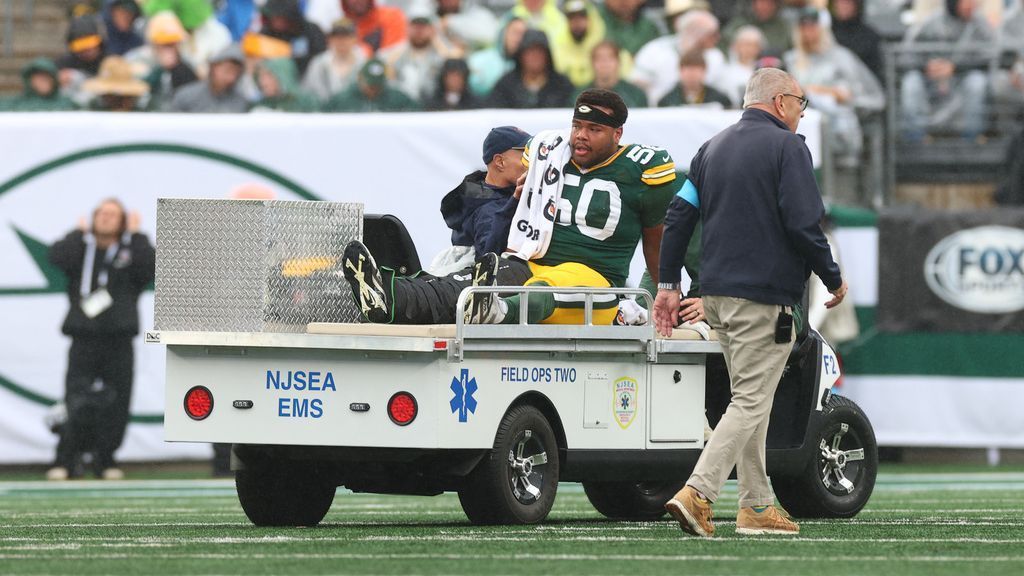
Zach Bako-Bewele's right knee gave way during the Packers' overtime win over the Jets on Sunday, and an MRI revealed a complete patellar tendon tear—the same injury that cost him most of last season in partial form. The 2022 fourth-round pick, the team's highest-paid offensive lineman on an $88 million extension signed last year, will undergo surgery Thursday and face an 8-10 month recovery window that extends well into 2027. This is not a mid-season absence the Packers can weather. It is a structural dismantling of their offensive line at its most important perimeter position.
Bako-Bewele's injury compounds an already destabilized situation. Green Bay's rushing attack is dead weight—64.5 yards per game, last in the league; 3.3 yards per carry, 29th. The Packers finished Sunday's game without left guard Aaron Banks, burned through backup Donovan Jennings to injury, and cycled a rookie (Jager Burton) into a starting role with no margin for error. When right guard Jacob Monk drew a stinger evaluation, the team was minutes away from sliding tight end Tucker Kraft into the offensive line. That level of attrition doesn't happen by accident; it happens to offenses that were already thin and now have no depth.
Second-year pro Anthony Belton will start at right tackle Thursday against Atlanta. Belton finished Sunday's game at the position after Bako-Bewele's injury but is not a plug-and-play replacement for a $22 million annual cap hit. The Packers' run game, dependent on power schemes and outside zone plays, requires a right tackle who can win laterally and create movement at point of contact. That was Bako-Bewele's function. Belton's role is to not catastrophically fail; the ceiling is significantly lower.
For prop bettors, the mechanism is clear: the Packers' ground game was already the league's worst, and now they've lost the lineman most responsible for creating running lanes. This week and beyond, Green Bay's rushing total sits as a structural fade. Aaron Jones and AJ Dillon will see work, but efficiency metrics—yards per carry, explosive runs (10+ yards)—should compress. The Falcons, a middle-tier run defense (110.4 YPG allowed, 14th in the league), will be able to key the box knowing the Packers' interior pass protection and perimeter run support are compromised. Expect the Packers to lean harder on short passes and play-action shots early to manufacturing yardage, not between the tackles. This is not a single-game spike; it's the new baseline for the rest of the season. Green Bay's offense will operate in survival mode until either Belton earns stability or the Packers make an in-season trade.
The betting angle is straightforward: fade Packers rushing props (team total and individual carries/yards by Jones/Dillon) for the foreseeable future. The line has already begun to price in the absence—Vegas typically moves quickly on line losses—but the magnitude of the downgrade from Bako-Bewele to Belton is underestimated in early adjustments. The run game will not recover to pre-injury efficiency simply because the fundamental blocking architecture has been downgraded. Unders on the Packers' team rushing total should hold value for weeks 4-6 at least, or until Belton demonstrates he can generate movement at the point of attack.