NBA
Fox's Mismatch Edge in Finals Game 3: Why the Spurs' Adjustment Opens a Scoring Window
De'Aaron Fox becomes the leverage play when San Antonio's defensive scheme shifts to stop New York's pick-and-roll attack.
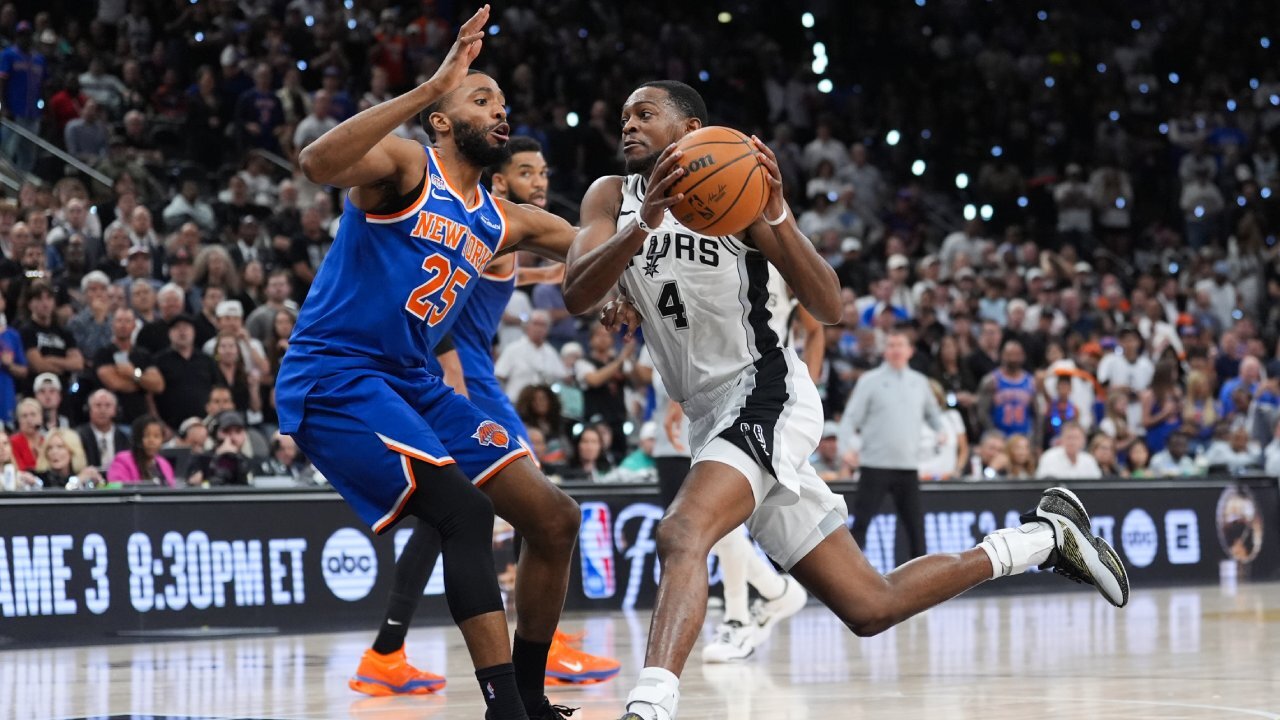
The 2026 NBA Finals have pivoted on a single defensive variable: how San Antonio handles Jalen Brunson's orchestration of the Knicks' offensive engine. Game 3 forces the Spurs' hand. After two contests in New York where Brunson's playmaking bent the perimeter, the Spurs must choose between doubling him—which hollows the interior and leaks transition opportunities—or staying attached and absorbing high-efficiency pick-and-roll scoring. Neither path closes cleanly.
De'Aaron Fox enters this equation not as a primary architect of the Finals matchup, but as the direct beneficiary of San Antonio's necessary adjustment. When the Spurs tighten their ball-screen coverage to bottle Brunson, they redistribute defensive weight toward the Knicks' guards. This compression creates space on the perimeter and in the short midrange where Fox can operate in isolation or within Sacramento's secondary actions. The Spurs' personnel—built to guard three-level wings and traditional centers—lacks the lateral agility to chase Fox through screens or recover from help-side rotations without creating offensive rebounding chances for New York's bigs.
Fox's scoring volume in the Finals has tracked lower than his regular-season average (18.2 PPG vs. his 24.7 season mark) because Sacramento's role in Games 1 and 2 was complementary—feeding off Brunson's gravity and the Knicks' half-court spacing. Game 3 reverses the script. With the Spurs committing additional resources to the Brunson pick-and-roll, Fox's isolation touches will spike. His three-point attempt rate from the wing and slot should climb as the Spurs' perimeter defenders collapse inward. Against a San Antonio team that ranks outside the top 10 in perimeter defense efficiency, Fox's 39% three-point clip from the season carries predictive weight—he's not a marginal shooter being forced into volume, but a reliable floor-spacer stepping into openings created by scheme necessity.
The prop angle hinges on San Antonio's binary choice: hemorrhage pick-and-roll efficiency (Brunson's 56% eFG when uncontested) or cede perimeter touches to Fox. The market has likely underpriced Fox's scoring because his Finals role has appeared secondary through two games. What hasn't been priced is the Spurs' adjustment forcing his elevation. His points total should reflect not his Games 1-2 workload, but his per-touch efficiency and touch-rate trajectory when the defense collapses inward. This is a single-game edge that expires if San Antonio opts for a different coverage (a switch-heavy scheme, for instance), but the personnel constraints and Brunson's proven effectiveness in Games 1 and 2 make the tighter ball-screen coverage the likeliest adjustment.
The durability of this angle depends on which defensive tool San Antonio reaches for. If they commit fully to Brunson containment, Fox's scoring edge persists across the remaining Finals games. If they pivot to switching or zone coverage, the advantage collapses within 24 hours and future lines will correct. Early Game 3 numbers, before San Antonio's adjustment film is digested, carry the highest information value.