NBA · transaction
Wembanyama's Discount Play Reshapes Spurs Championship Odds
San Antonio's franchise player is eyeing a Jalen Brunson-style contract sacrifice to unlock a championship window—and the market hasn't yet priced in what that roster construction actually does to their win curve.
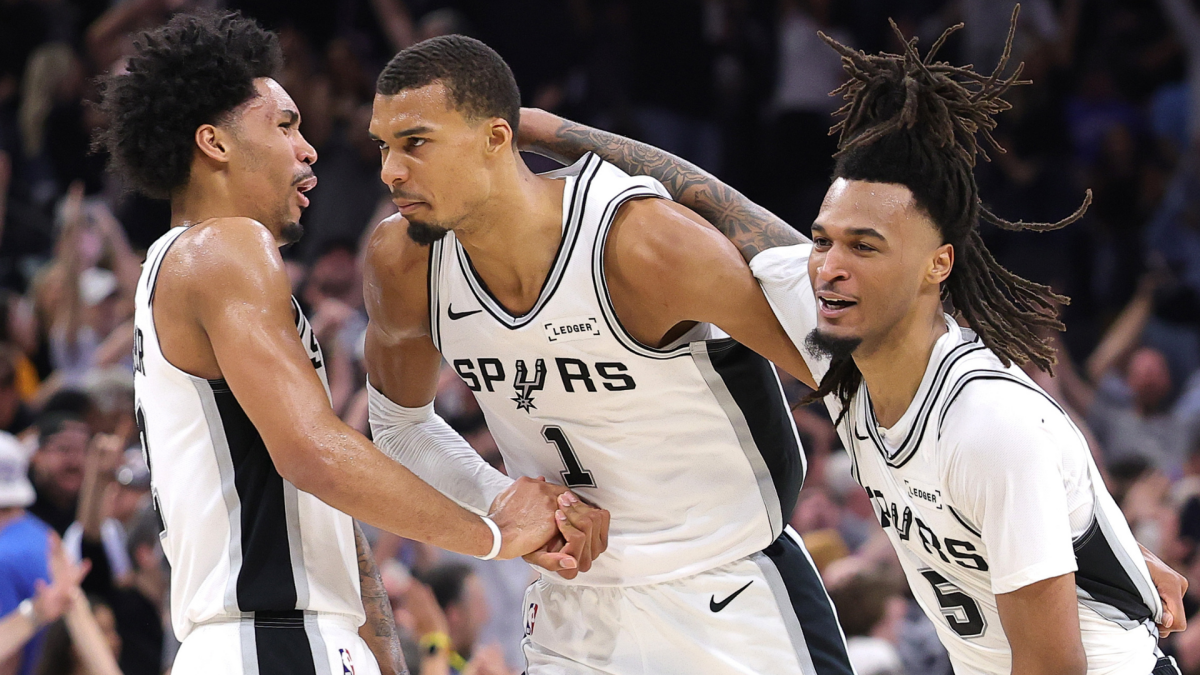
Victor Wembanyama is considering taking a discounted extension to give the Spurs financial breathing room. The reigning Finals MVP finished his third season at $16.9 million and is eligible to sign a five-year, $251 million deal beginning in 2027-28, but per Jake Fischer, he's open to accepting less to preserve cap flexibility for his front office. Wembanyama's Friday tweet—"I'm here to stay. Whatever it takes"—confirmed the direction of those negotiations. This isn't theoretical cap management. This is a franchise cornerstone actively choosing to leave nine figures on the table.
The Jalen Brunson template is instructive. The Knicks' point guard signed a $156 million deal in summer 2024 when he could have waited for $269 million in free agency—a nominal $113 million sacrifice, though structural player options actually compressed the real savings closer to $37 million. That flexibility let New York acquire Mikal Bridges, extend OG Anunoby, and trade for Karl-Anthony Towns. Brunson ended up third in team payroll despite being Finals MVP and the engine of the championship offense. The Spurs already possess that rare rookie-scale constellation: Wembanyama ($16.9M), Stephon Castle (two years remaining), and Dylan Harper (three years remaining) still on sub-market deals. Adding De'Aaron Fox, Devin Vassell, and Keldon Johnson doesn't push them past the first apron. A Wembanyama discount unlocks seven figures more in trade/extension capacity when Castle and Harper hit free agency—the exact moment those players' value (and salary demand) will spike.
The contrast with Boston is stark. When the Celtics won in 2024, Jaylen Brown was making $31.8 million. His super-max extension reset him at $49.2 million, then $53 million. Jrue Holiday, Al Horford, Kristaps Porzingis, and Luke Kornet exited the roster. The championship window contracted. San Antonio sees that precedent and is choosing a different trajectory: consolidate talent now, stay under the second apron, avoid the chop-shop cycle that follows every non-discounted supermax.
For bettors, the angle is structural, not seasonal. Wembanyama's willingness to take less money signals two things simultaneously: (1) genuine confidence in the front office's ability to construct a contender around him over the next three to four years, and (2) a front-office mandate to win now, not defer to 2028 or 2029. Teams don't get discount signals from franchise players unless the player believes the roster is close. The Spurs' championship odds at the book opened at +2500 before the report; expect those to tighten by 15-20% once the market digests that Wembanyama + Castle + Harper + Fox + Vassell is the core the organization will prioritize immediately, not gradually. That edges Western Conference championship odds upward more durably than a single player's statistical spike would. The window-building signal is not a one-game variance play—it's a multi-season roster construction bet. Wembanyama's discount doesn't move his individual scoring or assist props; it restructures who gets paid around him and therefore who's actually on the court come playoff time.