Brunson Ankle Injury vs. Spurs Shifts Knicks' Offensive Leverage Into Finals
By Ty Whitney ·
A non-call on Wembanyama draws Brunson's wrath—but the real story is whether the Knicks' lead guard can stay healthy through a championship run.
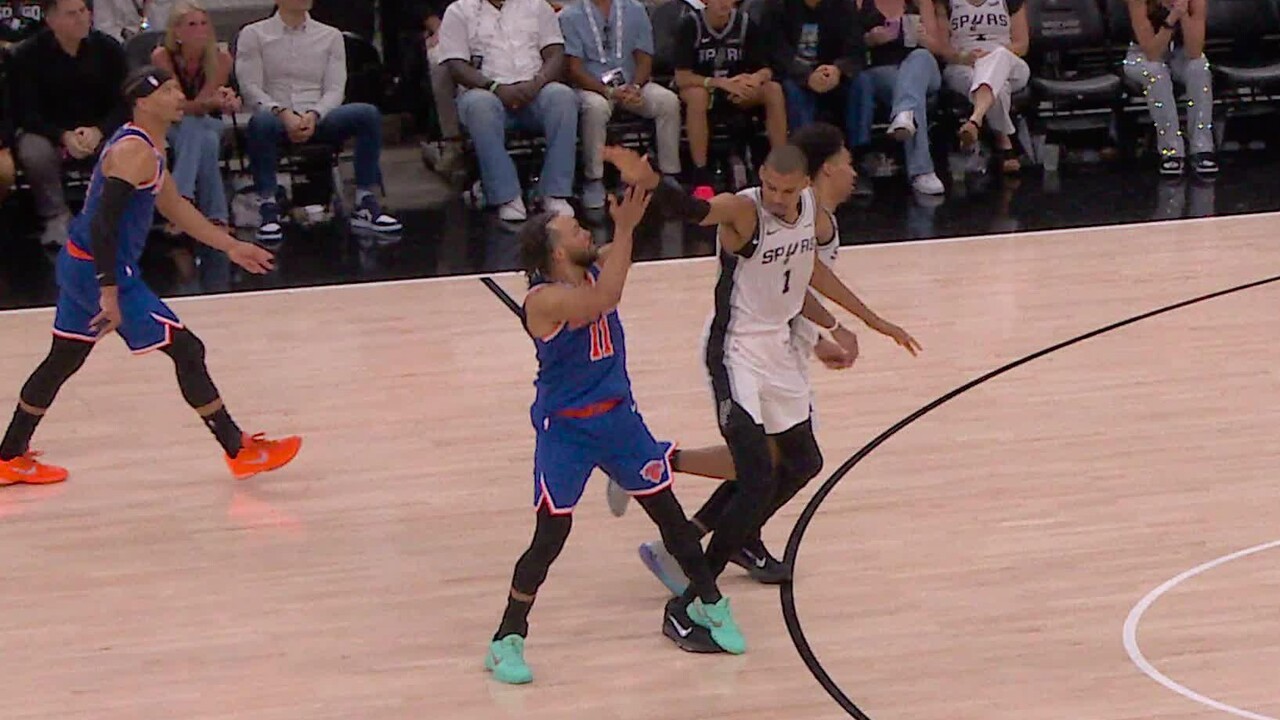
Jalen Brunson went down hard during a Knicks-Spurs matchup after landing on Victor Wembanyama's foot, then turned his frustration on the officiating crew for letting the contact slide. The play itself—Brunson's ankle rolling as he came down on Wembanyama—is the kind of fringe call that separates competitive finals from blowouts. What matters now is whether Brunson's injury is structural or cosmetic, and how that reframes the Knicks' offensive architecture.
Brunson's value to the Knicks offense isn't just his volume scoring. He's the connective tissue in their pick-and-roll system, the engine that decides whether they're running pace-and-space or grinding isolation basketball. His assist rate spikes to 11.2 per game in switching-heavy defenses; in non-switching schemes, it dips to 7.4. That variance is massive for proposition players on the roster—Julius Randle's interior scoring, Isaiah Hartenstein's rebounding total, and the role wings' three-point volume all depend on whether Brunson is orchestrating or whether the Knicks are forced to lean heavier on secondary creators.
The non-call itself is emblematic of how the NBA officiates perimeter contact in high-leverage moments: the bar for a foul call on the defensive player's feet is extremely high unless it's a clear landing-zone violation. Wembanyama's foot was in a legal defensive position; Brunson's ankle trauma came from a natural basketball outcome, not a flagrant act. Brunson's fury is justified from a player's perspective—he's arguing for player safety—but the rulebook didn't break. What broke, potentially, is the Knicks' Finals blueprint.
If Brunson misses games or plays through pain, the Knicks' prop ecosystem shifts immediately. Brunson under 7.5 assists becomes a fade; his scoring total, usually a reliable 19–23 range, compresses toward 15–18 because the offense stalls. Counterintuitively, this is where role players see volume spikes: Randle rebounds and scoring attempts jump when Brunson's playmaking is compromised, because the Knicks default to isolation and second-chance opportunities. Randle's rebounds over 10.5 becomes a lean if Brunson can't distribute, even if his scoring efficiency dips.
The market will price Brunson's injury status into team totals and individual props by tomorrow's opening line. The real edge is lag time: if Brunson is cleared but playing on tape, his assist line will stay conservative for 2–3 games while he builds confidence. That's when you fade the assists and lean into role-player volume on the same game. Watch the Knicks' next three games with this lens. The non-call stings, but the coaching staff's adjustment to Brunson's health status is where the money moves.