Wembanyama Dethrones Thunder as Spurs Punch Finals Ticket; Market Underprices San Antonio's Depth
By Erik Schwartz ·
San Antonio's road Game 7 victory over defending-champion Oklahoma City sends the Spurs to their first Finals appearance since 2014, and the early -220 series odds miss the structural advantage their balanced scoring gives them.
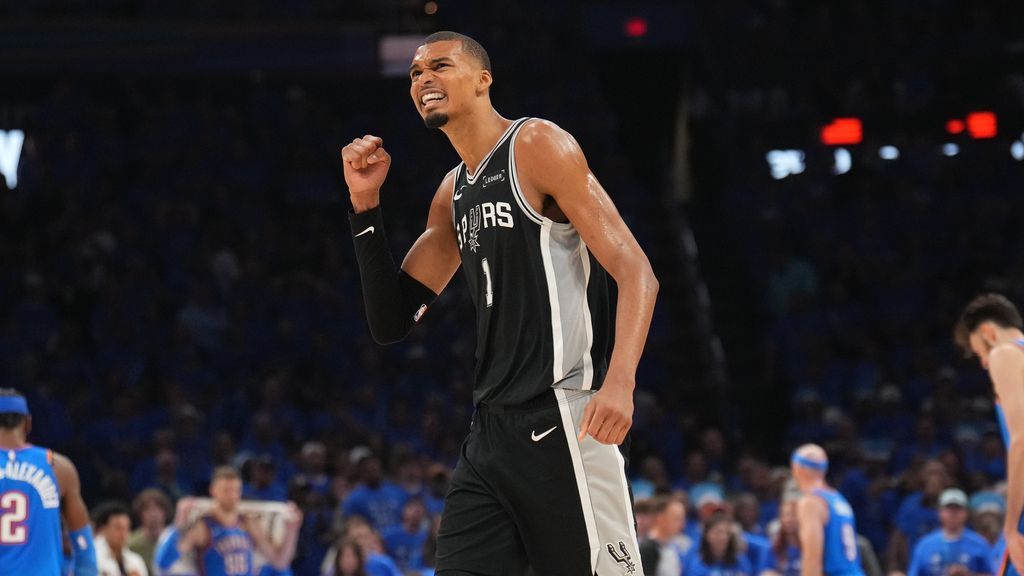
Victor Wembanyama and the San Antonio Spurs stun the Oklahoma City Thunder 111–103 on the road in Game 7 of the Western Conference Finals, clinching their first NBA Finals berth in 12 years. Wembanyama led with 22 points and the typical two-way gravitational pull that has defined his rookie season, but the story of this series—and the shape of the Finals matchup ahead—belongs to San Antonio's secondary scorers. Julian Champagnie poured in 20 points on 3-pointers, Stephon Castle added 16, and De'Aaron Fox, Dylan Harper, Keldon Johnson, and Devin Vassell all contributed in double figures. This is not a star-dependent roster. It is a committee offense that hunts matchups and distributes load.
Oklahoma City came in as defending champions with Shai Gilgeous-Alexander putting up 35 points and nine assists in a losing effort—proof that elite individual scoring no longer moves the needle as dominantly as it once did. The Thunder's complementary pieces (Cason Wallace 17, Jared McCain and Alex Caruso 12 each) couldn't hold together against San Antonio's wave approach. The deciding moment crystallized this difference: Luke Kornet, a six-minute reserve who finished 1–of–3 from the field, blocked Isaiah Hartenstein on a Thunder fast-break in the fourth quarter. The play felt structurally important—a backup center denying the Thunder's backup center rhythm at the exact moment momentum might have shifted. That's what balanced rosters do. They compress the drop-off between starters and bench.
The Spurs will face the New York Knicks in Game 1 on Wednesday night in San Antonio, with the Spurs installed as 4.5-point home favorites and -220 to win the series. The early odds reflect recency bias against San Antonio's durability. The Knicks' path to the Finals ran through easier competition (their conference was structurally weaker than the West this season), and while New York has top-tier perimeter defense and shot-making, they lack the kind of distributed scoring that survives playoff attrition. Through this Game 7, Wembanyama's team has proven it can win without a single player dominating usage. Castle, Champagnie, and Fox have all had moments where they carried offensive load. That flexibility is rarely priced into series odds because it's harder to model—bettors and books gravitate toward the narrative of star power.
The betting angle isn't about picking sides on the series at -220 (that's already well-valued). It's about Spurs total points over the course of the Finals. San Antonio's scoring will be sticky. They won't have 35-point nights from one player, but they'll have 18, 17, 16, 14, 12 nights from five different scorers. That distribution creates a floor. When you model Finals games, you're usually adjusting for the possibility that a star goes cold (think Jalen Brunson in crunch time, or Gilgeous-Alexander facing double-teams). San Antonio doesn't have that vulnerability. Expect the books to offer Spurs team totals in the 110–115 range depending on game context. Those numbers should lean under modestly—not because the Spurs are a bad offense, but because the Knicks' switching defense will force San Antonio into more ball-movement and fewer isolation conversions. The Spurs' path to efficiency runs through spacing and three-point shooting, both of which the Knicks can compress. Game-to-game variance favors the under on Spurs team totals, but the line will reflect some of that already once market participants fully digest the Finals matchup.