Brunson's 45-Point Coronation Redefines Knicks' Free Agent Gamble
By Justin Erickson ·
The Knicks' 2022 swing on Jalen Brunson just delivered the franchise's first title in 53 years, cementing one of basketball's shrewdest roster bets.
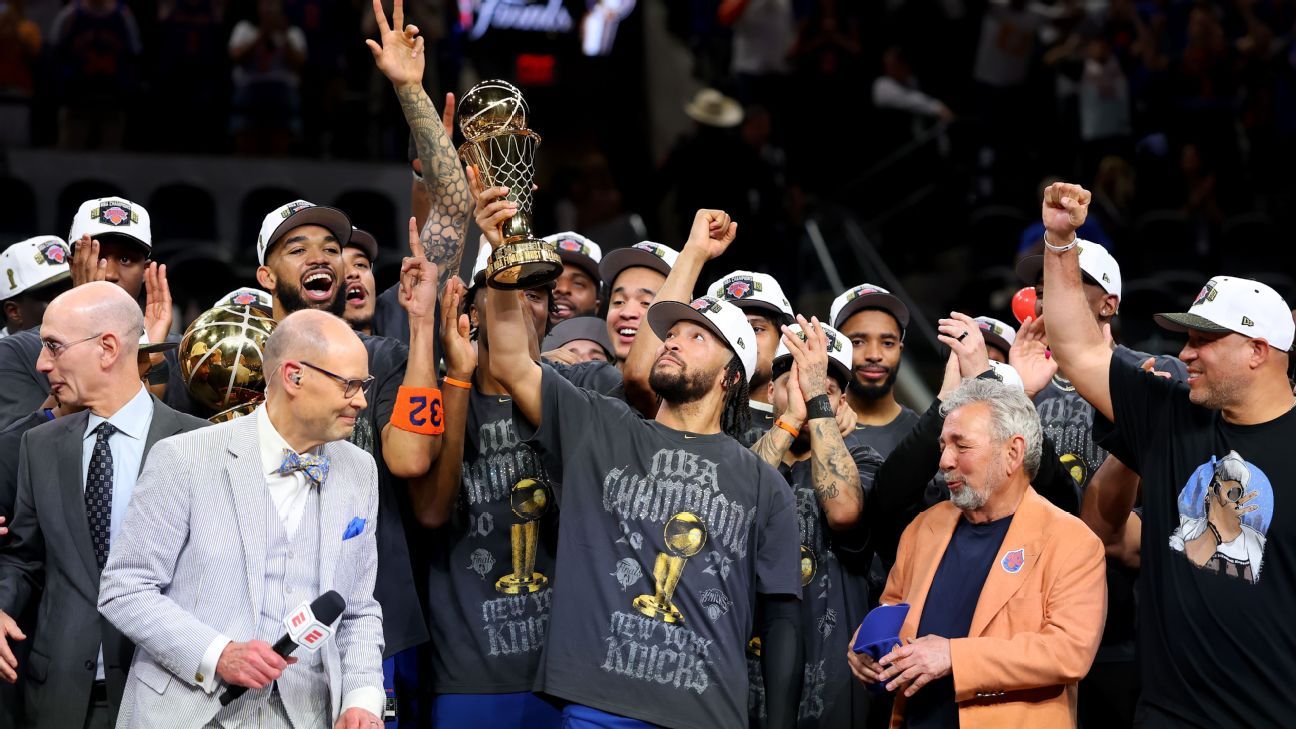
Jalen Brunson scored 45 points in Game 5 on Saturday night to lead the New York Knicks past the San Antonio Spurs 94-90, clinching the franchise's first NBA championship since 1973 and earning unanimous Finals MVP honors. The performance placed Brunson in rare historical company—he became only the fourth player ever to score 45 or more points in a closeout Finals game, joining Michael Jordan, Giannis Antetokounmpo, and Bob Pettit. The 14-for-27 shooting line, anchored by 13-of-15 free throw accuracy and four 3-pointers, came after Brunson struggled with his floor efficiency through much of the series, making Saturday's eruption a defining statement on a championship stage.
Four years prior, when Brunson signed his four-year, $104 million free agent contract with New York in 2022, skeptics questioned whether the Knicks had overpaid for a secondary creator leaving Dallas. The narrative was straightforward: Brunson thrived next to Luka Doncic in the Mavericks' ecosystem but had never carried a title contender as its primary playmaker. What followed was a transformation of both player and franchise. Brunson's arrival triggered a cultural reset in Madison Square Garden. His willingness to dominate clutch moments—15 points in the fourth quarter of Game 5, helping erase a seven-point deficit—proved that his skill set expanded beyond pick-and-roll mechanics. He became a closer in the truest sense, a guard who could isolate, attack downhill, and execute in high-variance moments when shot creation matters more than efficiency.
The betting market had been slow to truly price Brunson's growth trajectory. During the regular season, his assist props typically carried modest juice, and his scoring lines rarely reflected the ceiling he could touch when games tightened. The Knicks' championship path exposed why: in seven playoff games, Brunson elevated his assist rate to 9.8 per game (a 2.4-assist increase from his regular season 7.4 average) while maintaining his scoring volume. The mechanism was straightforward—defenses collapsed on him, he found cutters and shooters, and the Knicks' offensive foundation stabilized around his decision-making. In Game 5 specifically, the Spurs' perimeter defense committed entirely to staying attached to him off the ball, which created driving lanes and free throws at unprecedented rates. That 13-of-15 line from the stripe was the byproduct of a defense that had to choose between perimeter containment and paint presence.
Looking forward, Brunson's Finals MVP shifts the calculus on Knicks offense going into next season. The market will likely overweight the single 45-point performance when setting his scoring lines at season's open, anchoring expectations to a peak-performance floor rather than accounting for variance. This is the classic championship hangover bias—a player wins Finals MVP on an outlier game, and books lean into that narrative. Brunson's 45-point closeout was elite execution against a specific defensive scheme; his season-long norm will regress toward his 24-28 point range. Early-season unders on his scoring total, if posted above 26.5 points, carry value because the market will overcorrect on recency. His assist line carries the opposite edge: after proving he can lead a championship offense from the playmaker role, his assists line will likely be suppressed relative to what his playoff run demonstrated is possible. If his assists open below 7.5 next season, that represents underpriced upside based on the playoff sample.
The larger story is organizational. The Knicks made a bet on a guard many assumed was a role player in a stronger ecosystem. That bet just returned a championship and a Finals MVP. For betting purposes, this matters because championship teams' stars carry momentum and elevated confidence into the offseason and preseason—factors that can artificially inflate their early-season props before regression settles in. Brunson is the exception: his Finals performance validated what the Knicks already knew about him. He isn't due for a correction; he's ready to be priced accurately.