NBA
Knicks' Dominant Start Exposes Market Mispricing of Towns and Brunson Props
New York has won 13 straight and carries a 2-0 Finals lead into Madison Square Garden, but the real betting story is how Karl-Anthony Towns has weaponized Wembanyama's length while Brunson's shooting slump masks his playmaking value.
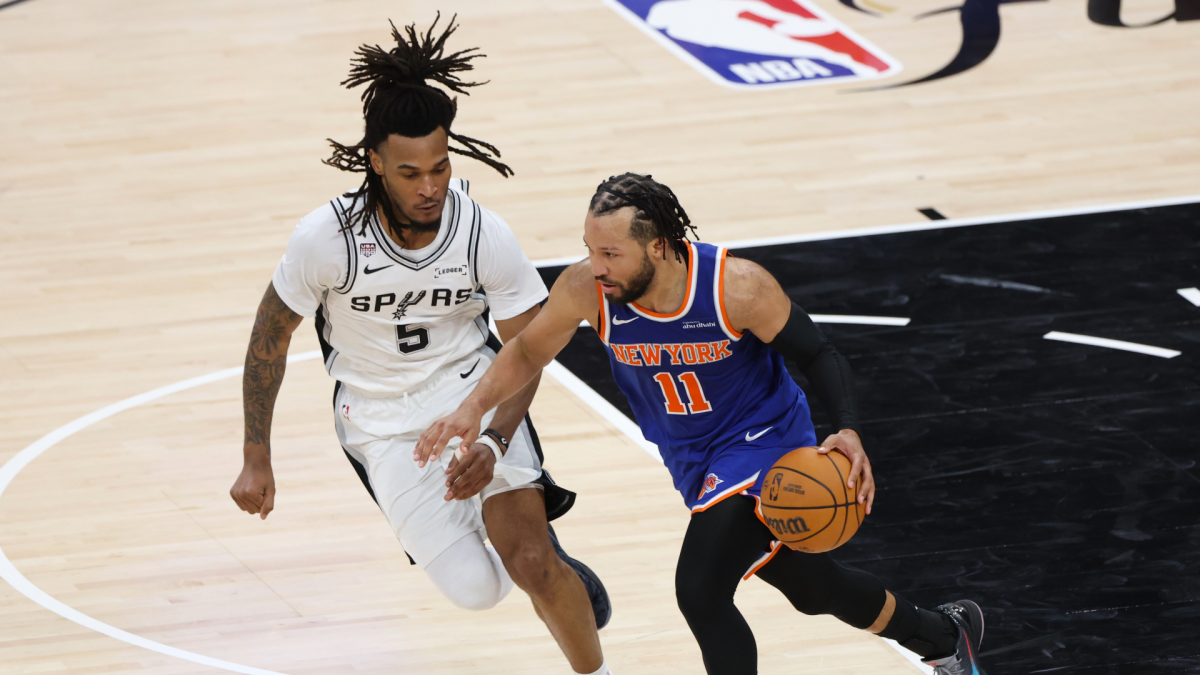
The Knicks boarded a flight to New York on Friday night with the NBA Finals firmly in their grip. Down 2-0 against the defending Western Conference champions, San Antonio faces an elimination timetable that started the moment Game 2 tipped off—and the Spurs could not answer. This wasn't supposed to happen. New York struggled against winning teams during the regular season, posting a .500 record against teams with matching records, the worst mark among the top seeds in either conference. The Knicks were good, not great. Then the playoffs arrived, and everything inverted.
The mechanical shift is worth isolating: the Knicks have posted the best offensive and defensive ratings in the postseason, a feat that no serious observer predicted in April. The streak now stands at 13 consecutive wins, the last defeat coming April 23—45 days before this Finals series opened. That longevity across two months eliminates flukes. This is a team executing a system at an elite level against playoff competition that includes the reigning champion.
But the statistical foundation supporting this run contradicts conventional narrative. Jalen Brunson has shot 33.9% from the field and 23.5% from three in the first two Finals games, putrid numbers that would typically signal offensive collapse. Yet the Knicks won both contests, meaning the burden shifted elsewhere. Karl-Anthony Towns has seized it entirely. Through two games, Towns is averaging 19.5 points, 12.5 rebounds, and 4 assists on 55.6/42.9/100 splits—elite efficiency against a defense headlined by Victor Wembanyama, a 7'4" wing who dismantled Chet Holmgren in the West Finals. Towns welcomed the assignment rather than hide from it, and the Spurs have had no counter. Unlike Holmgren, a plus-defender, Towns has historically been a liability on that end. This season, especially in the playoffs, that calculus has shifted. Against Wembanyama's length, he is playing with precision and spacing awareness that catches the market flat-footed because the narrative was cemented years ago: Towns can score but cannot defend.
The betting consequence flows directly from this mechanism. Brunson's poor shooting is structural noise—the Knicks won anyway, which means his assist rate and playmaking touches remain elevated. His near-4-assist average in the Finals, combined with a system that uses him as the primary ball-handler in pick-and-roll action, suggests that traditional point totals underweight his overall offensive impact. More immediately, Towns is the Finals MVP favorite at this juncture not because he won two games; Wembanyama should render him a matchup problem on paper. The edge exists because the market initially priced Towns as a defender in over-his-head, then failed to adjust when film contradicted that premise. His 19.5 PPG average against elite perimeter and interior length, combined with 12.5 RPG in a Finals series where rebounds dictate pace and second-chance opportunities, suggests his scoring line has room to expand as the Knicks remain aggressive and the Spurs chase points from behind.
This is a durable pattern, not a one-game spike. Towns' playoff shooting and rebounding efficiency have been elite for five weeks. The Spurs have no viable alternative assignment for him because Wembanyama has other responsibilities. If the series extends, the Knicks play at home—currently a +2.5 favorite in Game 3—where their offensive rating has been historically elite. Any prop bet on Towns or Brunson assist totals reflects a Finals narrative that shifted 48 hours ago but hasn't fully repriced at the book yet.