The Knicks' 29-Point Finals Comeback Rewrites Defensive Leverage in Closing Moments
By Ty Whitney ·
OG Anunoby's game-winner defined Game 4, but Karl-Anthony Towns' fingertip deflection on the final inbound reveals how positioning and wingspan dominate when margins disappear.
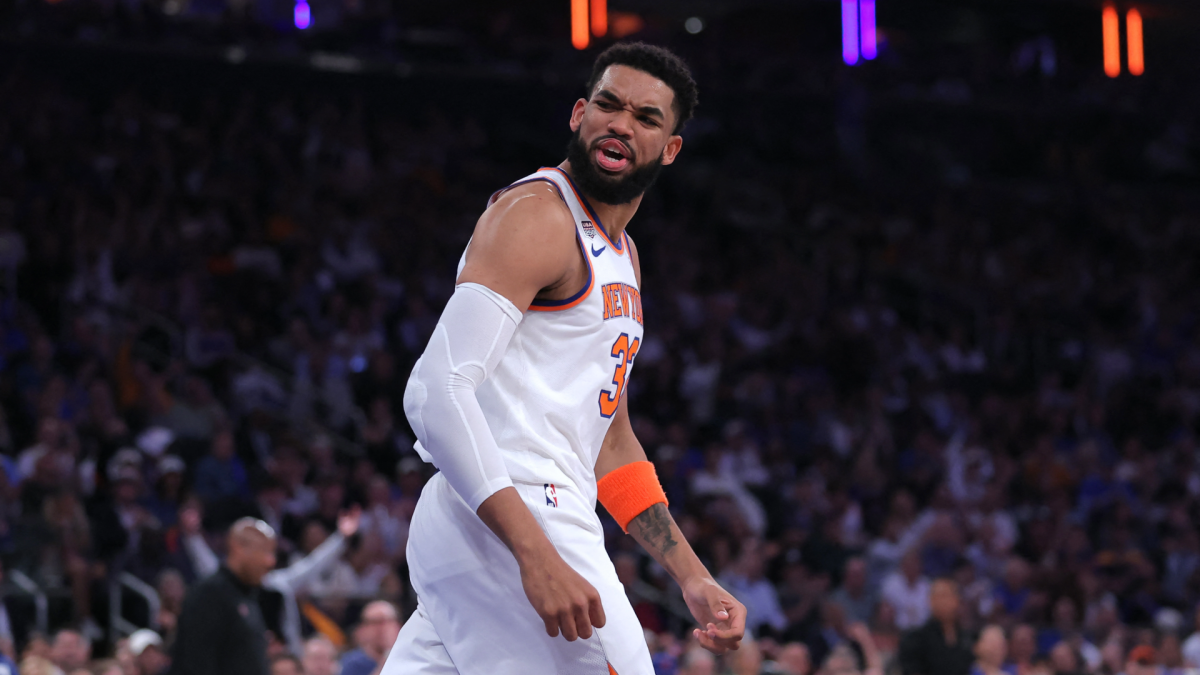
The Knicks completed the largest comeback in NBA Finals history Wednesday night, erasing a 29-point deficit to beat San Antonio 121–120 and seize a 3–1 series lead. OG Anunoby authored the closing act—a block on De'Aaron Fox's layup with 12 seconds remaining, followed by a tip-in at the rim with 1.2 seconds left. But the play that decided everything happened a possession earlier, when Karl-Anthony Towns extended his seven-foot wingspan to deflect Stephon Castle's inbound lob with his fingertips, canceling what would have been San Antonio's game-winning dunk.
The Spurs' final offensive sequence was structurally sound. They ran a back-pick action involving Victor Wembanyama and Castle, designed to free Castle for a lob finish while New York's defense collapsed on the perimeter scorer. Dylan Harper's inbound pass was the execution point—and it arrived short. Not because of a hurried throw, but because Towns positioned himself on the ball, used his length to interrupt the angle, and changed the trajectory enough that Castle never got his hands on it. This wasn't a lucky deflection. Towns read the play, moved to the passing lane, and used his physical tools to eliminate the Spurs' best closing option.
What makes Towns' play analytically instructive is the contrast with San Antonio's final-possession defense. The Spurs chose not to guard Anunoby at the inbound, instead double-teaming Jalen Brunson's catch. That gamble failed because Brunson's deep three went up over the double, Fox committed to that contest, and Anunoby—unguarded and now free as a rebounder—crashed the glass. San Antonio prioritized denying a three-pointer over controlling the rim position. Towns, meanwhile, did the opposite: he stayed attached to the ball handler and leveraged his physical dimensions to deny space. One defensive choice created a 3-point attempt and offensive rebound opportunity for New York. The other created a turnover on what should have been a layup line.
For prop bettors, this moment underscores why late-game defensive effectiveness cannot be divorced from roster construction. Towns' ability to guard the ball on an inbound—a skill that doesn't appear in conventional stat lines—becomes currency in Finals closeouts. His season-long three-point shooting (40.2% on high volume) already priced him as a spacing threat, but his versatility as a rim protector and passing-lane disruptor in high-leverage moments adds depth to team-total projections that rely on closure execution. The Knicks' defensive personnel, anchored by Anunoby, Brunson's positioning, and Towns' length, converted desperation into a series-altering win not because they outshot the Spurs, but because they controlled space when possessions mattered most.
Looking ahead, San Antonio's inability to execute the fundamental reads—recognizing that Towns could deflect, adjusting the inbound angle, or previewing the unguarded Anunoby risk on their own possession—suggests fatigue or miscommunication in a series that has now tilted decisively. For Game 5 betting, Knicks' spreads and team-total overs will price in this momentum and execution advantage, but the underlying edge lies in San Antonio's defensive communication breaking down under pressure. Take unders on Spurs team totals in upcoming games; their offense will not recapture this efficiency if their defensive reads remain this blunt.