Wembanyama's Dominance Breaks Knicks' Streak, But the Market's Overreacting to San Antonio's Single Win
By PropBetEdge Editorial Team ·
The Spurs' Game 3 Finals victory ended New York's 13-game playoff run on the back of career-best Wembanyama performance, but one win against a team still carrying a 2-1 series lead doesn't signal a momentum shift—it signals a vulnerable Knicks offense that the line hasn't fully priced in.
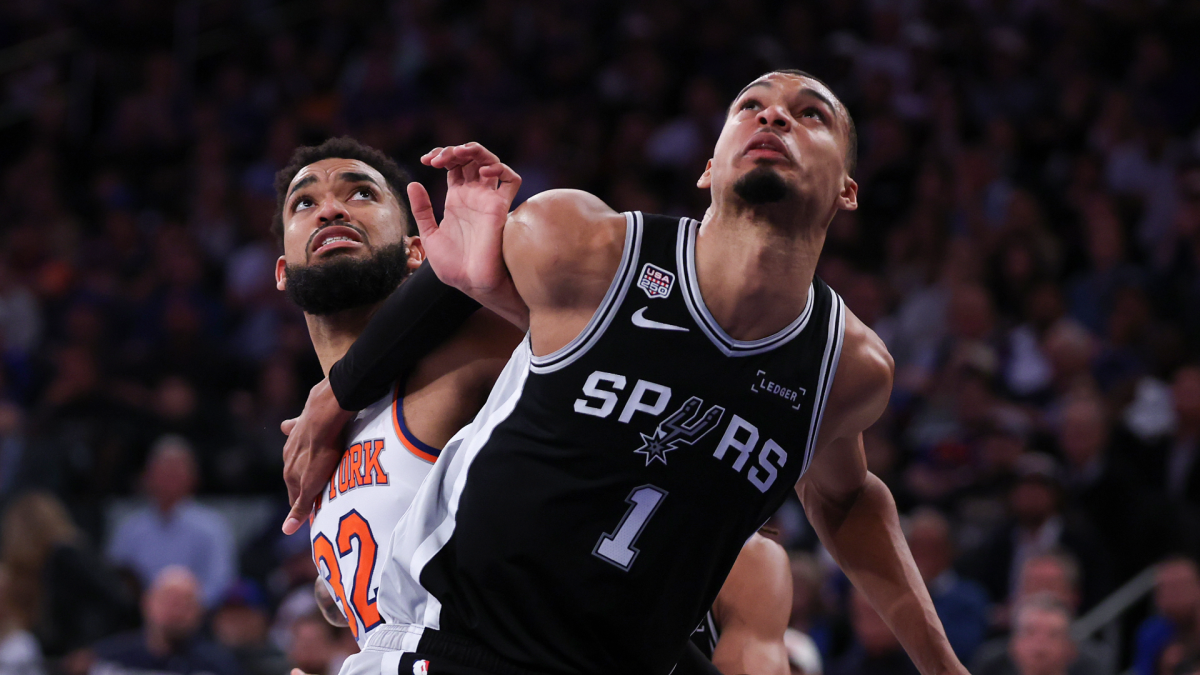
The Knicks' 13-game postseason win streak—a run so dominant it produced a +272 point differential—ended Monday night in San Antonio, 115-111, when the Spurs finally assembled the perfect storm: Victor Wembanyama operating at peak efficiency near the rim, Stephon Castle finishing tough looks through contact, and Karl-Anthony Towns misfiring on jumpers while offering little resistance in the paint. The Game 3 loss matters, but not for the reason the overnight narrative suggests. New York still holds home-court advantage and a 2-1 series lead heading into Game 4 on Wednesday. San Antonio did not suddenly become the favorite. What happened instead was a single-event outlier that exposed a specific structural weakness in the Knicks' offense—and that weakness has been hiding in plain sight.
Wembanyama's 32 points on 61% shooting, combined with six assists and three blocks, wasn't luck. The Spurs deliberately engineered floor spacing to give him early position and lob opportunities, two things the first two games didn't afford him at this volume. That scheme adjustment works because Towns, the Knicks' rim protector and interior defensive anchor, is also their primary scoring option on the perimeter. When Towns goes cold—11 points on 10 shots in Game 3—the Knicks lack a secondary paint presence. More damaging: Brunson's 32 points came on 11-for-25 shooting, continuing a Finals pattern that should alarm any sharp bettor tracking aggregate offensive efficiency. Brunson is now 37% from the field on 27 shots per game in this series. Even more revealing: the Knicks have been outscored by 13 points across 110 Brunson minutes. In Game 2, they were -10 with him on court and +11 without. Game 3 repeated the pattern: -9 with Brunson, +5 without. The rotation players are out-producing the star in his own Finals run.
This isn't a referendum on Brunson's pedigree or heart—he remains the Finals MVP favorite for his fourth-quarter scoring against physical defense. It's a statement about what happens when the Knicks' offense runs through iso-heavy playmaking against a Spurs team that commits bodies to the perimeter and dares other creators to beat them. Brunson and Towns together shot 21-for-35 in Game 3; the rest of the roster went 18-for-42. That 15-point swing between star and role player is the actual story. The Spurs won because they forced the Knicks to live and die by shot quality rather than pace, and on this particular night, the shot quality was below average. Game 3 was not a referendum on the Knicks' six-week dominance. It was a single adjustment by San Antonio's defense that temporarily worked. The market, however, will treat this as a series-altering moment, and that's where the angle emerges.
Bettor attention will migrate toward Spurs team totals and point spreads as if San Antonio has discovered a repeatable formula. That's premature. The Spurs did not suddenly become a different team; they simply executed one game plan perfectly against an opponent that had been winning via superior personnel rather than superior decision-making. Game 4 returns to Madison Square Garden, where the Knicks' role-player depth and perimeter shooting become asset rather than liability—the Garden's sightlines and home-court rhythm favor pace and ball movement, the Knicks' actual comparative advantage. What the smart side already knows: one five-point road win doesn't negate a 272-point differential earned over 13 games. The line will overweight Game 3; sharp bettors should fade the market's Spurs enthusiasm early and often. Lean Knicks at home on a line that has likely moved 1.5 to 2.5 points post-Game 3. The structural weakness the Spurs exposed—Brunson's iso-heavy approach and Towns' cold shooting—is not a permanent condition. One outlier game in a five-game series is noise with directional clarity, not signal.