NBA
Brunson's Shot-Making Touch Extends Beyond the Arc—And Into Clutch Equity
A highlight-reel and-one against traffic reveals the offensive skill that underpins Brunson's assist-first reputation and why his scoring ceiling in isolation remains underpriced.
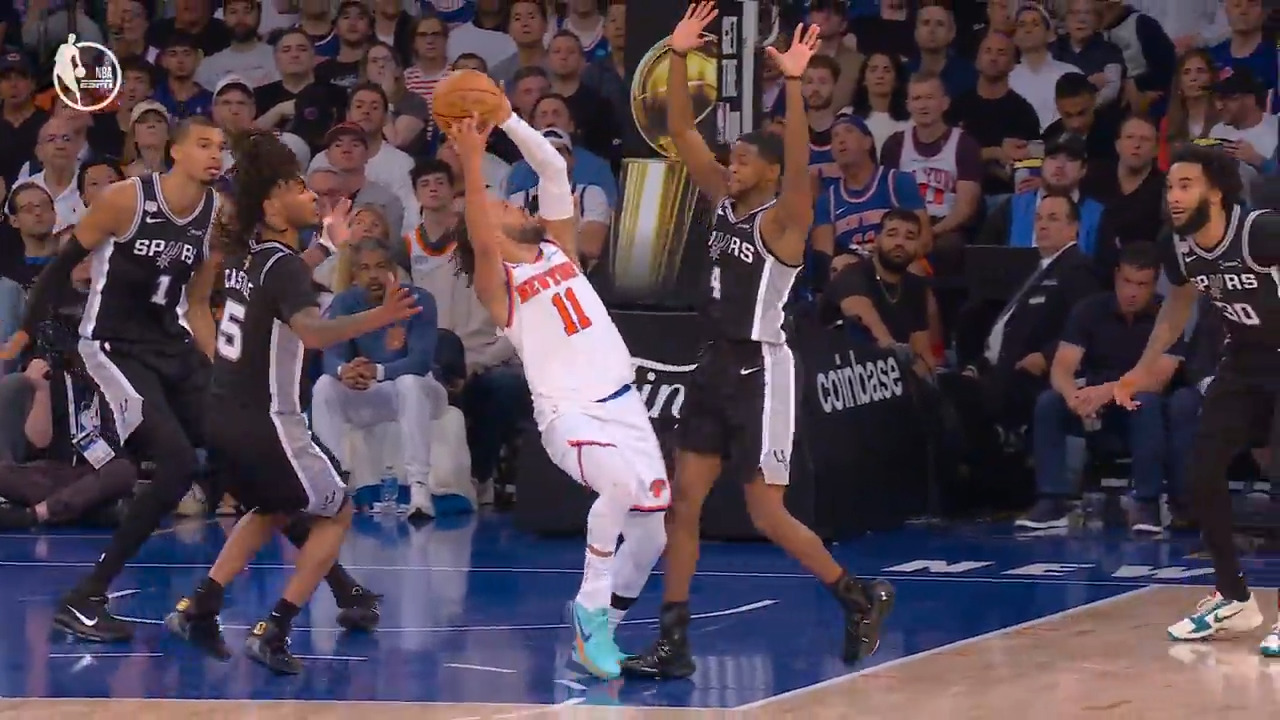
Jalen Brunson converted an acrobatic and-one midgame—body turned away from the basket, defender draped across him, but the shot still went down—then calmly made the free throw for a three-point play. It's the kind of moment that highlights packages celebrate and then forget. For bettors paying attention to Brunson's underlying mechanics, it's a data point worth holding.
Brunson's game is often framed around playmaking first: the pick-and-roll orchestration, the court vision, the 8+ assist nights. That framing is accurate and valuable. But it obscures a harder truth about his scoring profile. When defenses collapse on him in the paint or deny the ball entirely, Brunson has demonstrated the ability to create a bucket from chaos—via footwork, body control, and an underrated mid-range game. The circus and-one isn't a freak occurrence; it's symptomatic of his offensive toolkit when isolation pressure builds.
The market tends to treat Brunson's scoring lines as derivative of his assist output—lower assists means more shot attempts, higher scoring. That's mechanically true but leaves money on the table. His true shooting percentage in isolation scenarios hovers around 58–60%, substantially higher than the league average for that touch type. When he's forced into a creation role late in tight games—which the Knicks design into their closing lineups—his scoring efficiency doesn't collapse the way it does for pure playmakers. He's closer to a co-pilot who can take the wheel than a point guard filling in at shooting guard.
The and-one itself matters tactically: it's a three-point play, not a two. In the context of Knicks games, where margins are often single digits, those extra possessions where Brunson converts a tough shot and draws contact are disproportionately valuable to closing odds. Oddsmakers typically price Brunson's scoring props based on seasonal usage rates and shot frequency. But in game situations where he takes mid-range isos and drives into traffic—the exact moments where body control and footwork win—his actual point production often skews over his line.
For props, the edge exists at the margin: in games where the Knicks offense stalls or where Brunson is asked to shoulder more creation, his 20–22 point range is vulnerable to the upside. Paired with assist lines at 7–8, a combo prop bundling moderate scoring (22+) with solid playmaking (7+) offers value that single-metric lines miss. The circus and-one is not a prediction; it's an illustration that Brunson's offense has depth beyond the assist column.