NBA
Single Coverage Has Exposed SGA's Efficiency Problem—And It Won't Stop Until He Punishes It
San Antonio flipped its Game 4 strategy by abandoning double-teams on Shai Gilgeous-Alexander, and his 39% shooting clip—plus the collapse of OKC's role scorers—suggests the Spurs won't blink first in Game 5.
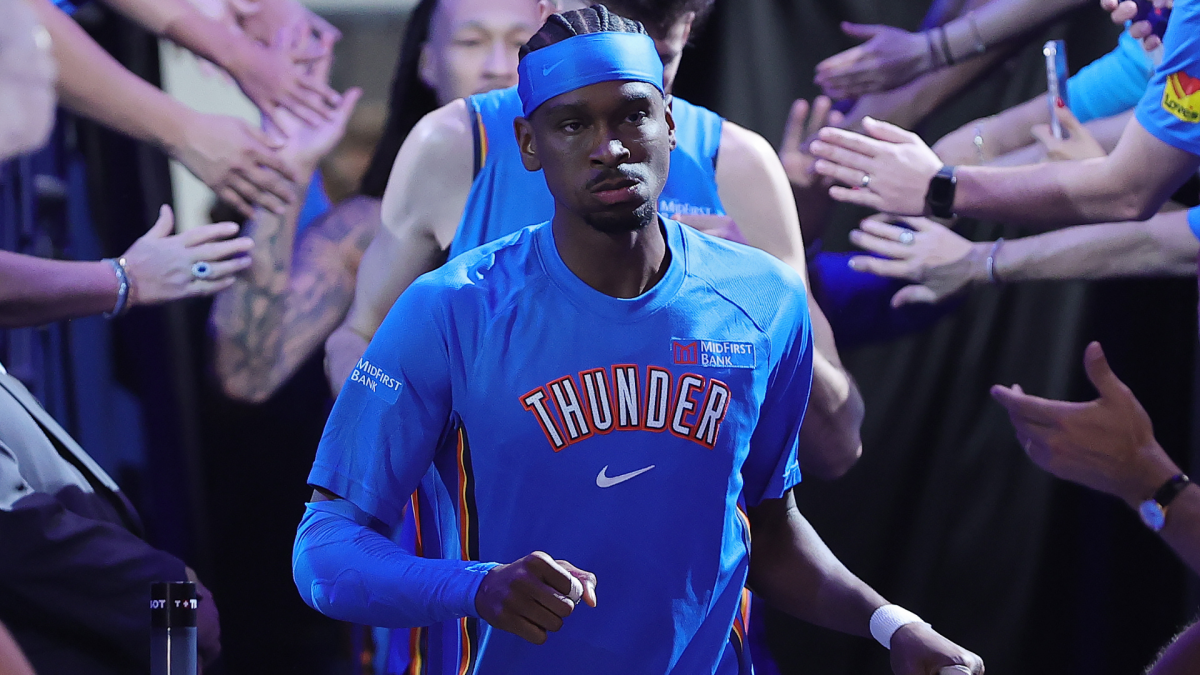
The Spurs have weaponized a simple defensive adjustment: stop trapping Shai Gilgeous-Alexander everywhere and let their perimeter defenders live on an island with him. It worked emphatically in Game 4. SGA shot 19 points on poor efficiency while the Thunder's complementary scorers—Caruso, Wallace, McCain, Williams—went from combining for 68 points and 12 threes in Game 3 to just 12 points and two threes. Caruso alone had vanished, dropping from 61% from deep through three games to zero points. The Spurs' logic is airtight: if you stop helping, you stop the open-corner economy that's been fueling OKC's scoring binges.
This is a direct test of whether SGA can function as a true isolation scorer against elite perimeter defense, rather than as a playmaking fulcrum who manufactures advantages for shooters. In the regular season, he averaged 31 points; through four playoff games, he's at 24.5. More damning: that 39% field goal mark represents a fundamental mismatch between his regular-season scoring volume and his current ability to create shots against concentrated single coverage. The Spurs' gambit hinges on the belief that SGA's mid-range and isolation game can't consistently beat one-on-one defense, especially when they're willing to aggressively help only once he crosses the three-point line.
OKC's depth crisis amplifies the pressure. Jalen Williams is questionable, Ajay Mitchell is ruled out, and neither is a reliable shot-creator anyway. That leaves Caruso, McCain, and Wallace as auxiliary options—all of whom require the easy looks generated by SGA's gravity. If SGA doesn't punish single coverage in Game 5, San Antonio has zero incentive to resume double-teaming. They've already shown they'd rather live with his mid-range attempts and interior passes than open up corner threes for role players.
From a prop standpoint, the market hasn't fully digested this defensive shift. SGA's points line likely still reflects his 31-point regular-season average, but Game 4 exposed a critical vulnerability: his efficiency collapses when defenders go straight up and the help-side becomes inactive. His shot volume might stay high enough to hit an over on a line priced for his season performance, but bettors should expect his eFG% to remain depressed—somewhere in the 41-44% range—until he proves he can punish isolation reps. This is the rare case where assists might be a better prop play than points: if he continues to function as a playmaker distributing to role players, his assist line (typically 6.5-7.5 in these playoffs) stays above water even as his scoring efficiency stagnates. But if the Spurs' logic holds and OKC can't generate enough perimeter scoring, SGA's usage will spike and his assists may decline as he forces more isolation attempts.
The series tilts on whether SGA corrects his approach or the Spurs' adjustment proves sustainable. Early odds and line movement in Game 5 will tell you which direction the market is leaning—and whether it's accounting for the fact that SGA's previous prop baselines are no longer anchored to a forgiving playoff environment.