Holmgren's Game 7 Collapse Exposes a Fragility the Thunder Can't Repeat
By PropBetEdge Editorial Team ·
OKC's max-contract center went invisible when it mattered most, raising hard questions about whether he can shoulder offensive load in future playoff moments.
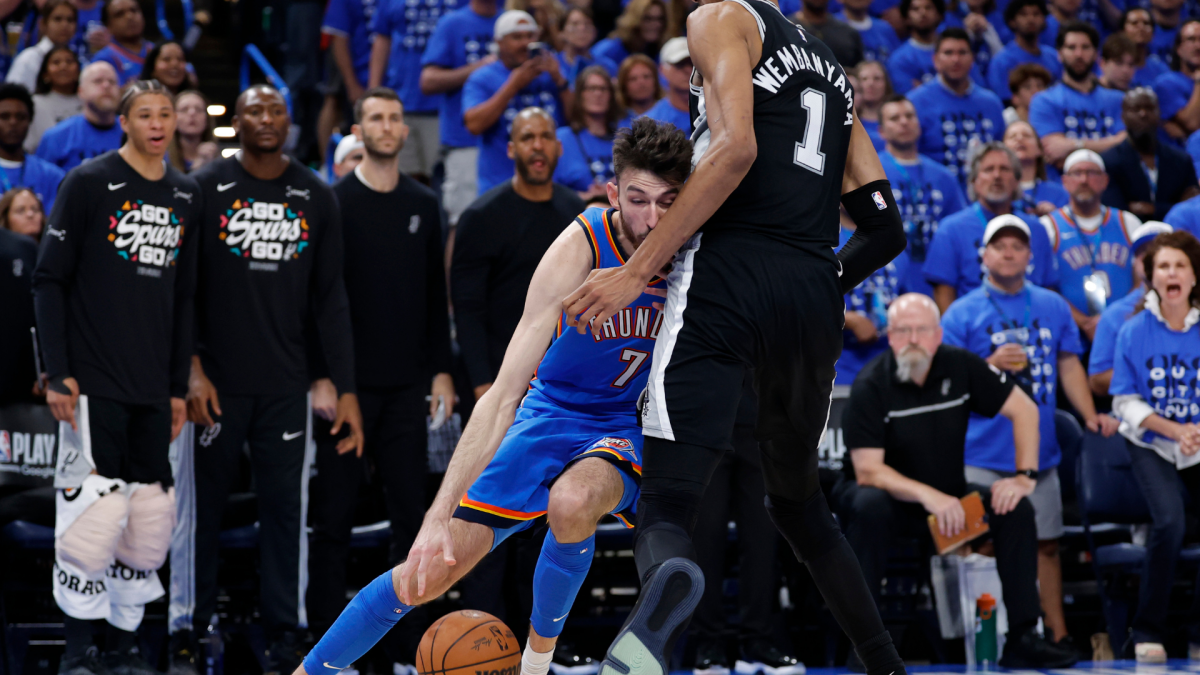
The Thunder's bid to become the first back-to-back NBA champions since 2018 died Saturday night in San Antonio, but the series death came from a source OKC brass won't easily reconcile: Chet Holmgren scoring four points on two shot attempts in 33 minutes of Game 7 basketball. This wasn't a case of aggressive defense shutting down a player trying to create; this was a seven-footer actively avoiding his own offensive opportunities, refusing to engage with the ball, and checking out mentally when his team needed floor spacing and rim pressure most. The Spurs' younger core—Victor Wembanyama, Stephon Castle, and Dylan Harper—made monster plays down the stretch. Holmgren made none. He took zero shots in the second half.
Context sharpens the indictment. Jalen Williams (hamstring) and Ajay Mitchell (calf strain) were unavailable, meaning Shai Gilgeous-Alexander was carrying the entire offensive load without relief. In that vacuum, a max-contract third star is supposed to hunt touches, force mismatches, and relieve pressure on the ball handler. Instead, Holmgren did the opposite—he became a drain on spacing and playmaking, a passive 7-footer who'd rather dump the ball than face a 7'4" shot-blocker. Even the framing matters: Wembanyama wasn't even his primary defender for most of the series; Spurs wings like Devin Vassell and Julian Champagnie handled direct coverage while Wemby roamed as a paint anchor. That tactical setup was designed to dare Holmgren to beat them from mid-range or in small-space situations. He refused the invitation.
This moment will ripple through OKC's offseason and beyond. Holmgren is about to sign a five-year, $239 million extension—money that assumes he'll eventually mature into a player who initiates offense, stays engaged under pressure, and doesn't shrink in elimination games. His Third Team All-NBA selection this season looks premature if Saturday's tape is any indicator of his playoff ceiling. The real question isn't whether Wembanyama got in his head; it's whether Holmgren has the competitive instinct to play through adversity or whether he'll repeat this pattern when the stakes climb.
From a betting perspective, this performance creates a durable pattern worth tracking. Holmgren's season-long points prop (averaged 16.8 PPG in the regular season) will almost certainly be managed by Thunder coaching staff going forward—expect them to set his number conservatively in early-season lines to avoid the publicity hit of another quiet playoff performance. More importantly, any future series against teams with rim-protection depth (Denver, Boston, New Orleans when healthy) will see Holmgren's scoring props move sharply downward in early action, because the market will now price in a non-zero probability that he disappears again. That's a structural overlay that wasn't present before Saturday. If you're fading Holmgren props in the playoffs next year, the mechanism isn't that Wembanyama is uniquely terrifying—it's that Holmgren demonstrated he'll opt out of high-leverage moments rather than work through them. That's the guy the line will reflect.
The Thunder's championship window just narrowed, and not because they lacked talent. They lacked the will to use it when it was needed most.