NBA
How Mike Brown's Film Session Transformed Towns Into the Knicks' Offensive Engine
A single accountability moment in Atlanta unlocked Karl-Anthony Towns as a playmaking hub, turning New York's offense from one-dimensional to lethal.
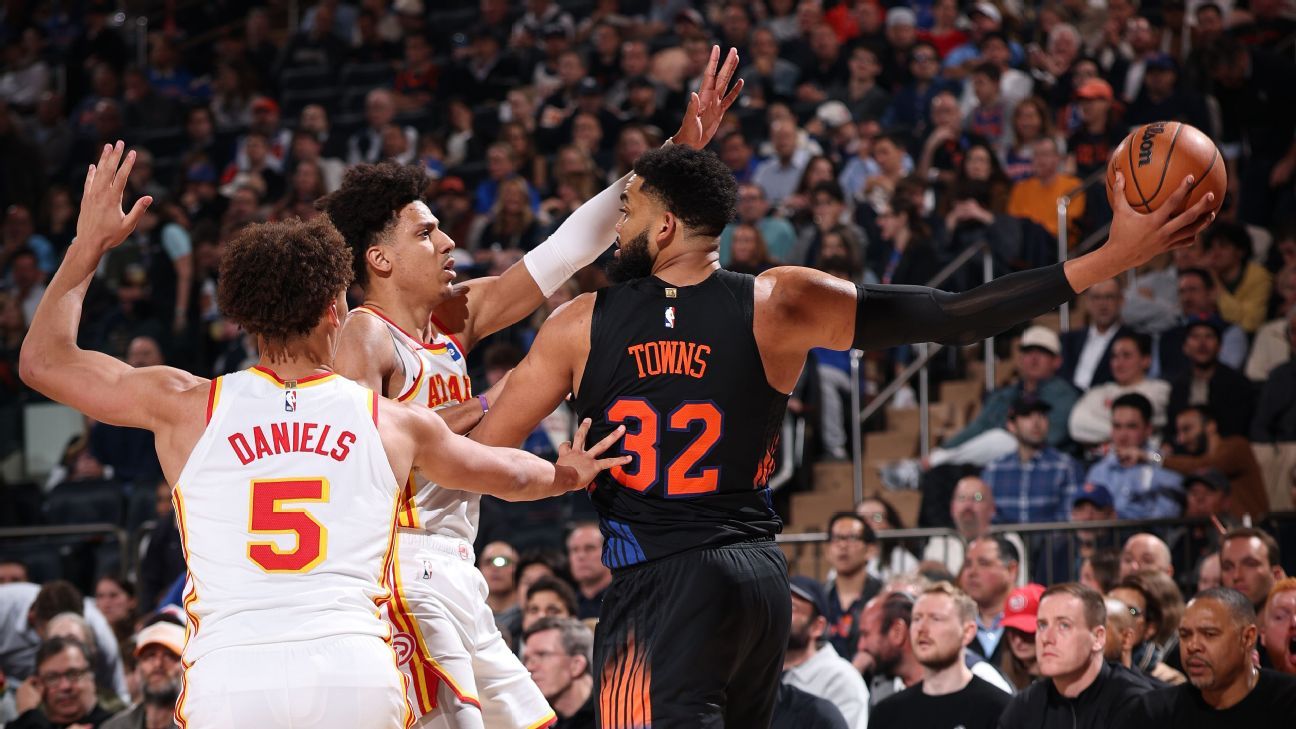
The Knicks were drowning. Down 2-1 to Atlanta in the first round, they faced a Hawks defense specifically built to suffocate Jalen Brunson—switching everything, forcing the ball out of their undersized guard's hands, and daring Karl-Anthony Towns to beat them on the perimeter. After three games of this script, New York's season teetered. Coach Mike Brown had inherited a roster built around Brunson's isolation excellence but had yet to find the architectural shift that would make Towns a complimentary force rather than a sidecar.
Then came the film session between Games 3 and 4. Brown, typically measured in public, went direct in the darkness of the Knicks' Atlanta hotel: Towns was supposed to be screening for Brunson but was standing idle in the corner instead. "You want the ball? What are you doing here?" Brown's message wasn't subtle—and it wasn't about positioning. It was permission. Brown was telling Towns to stop waiting and start commanding the offense's shape.
What followed was seismic. The Knicks dismantled the Hawks 59 points in Game 6, then won seven straight into the Eastern Conference Finals against Cleveland. The change wasn't tactical refinement—it was philosophical. Towns moved into the short-roll pocket as a true facilitator and decision-maker, no longer a catch-and-shoot satellite. His screen-and-roll reads with Brunson inverted the Hawks' switching scheme. When defenders collapsed on Towns, Brunson had room. When they gave Towns space, he'd find cutters or reset the offense through intermediate passing lanes. Over the next seven games, Towns' assist rate spiked measurably; he became the offense's third eye, not its third option.
For prop players, this inversion matters because it reframes Towns' scoring ceiling and floor within a higher-usage, higher-variance system. When Towns operated as pure perimeter floor-spacer, his 18-20 point floor was predictable—catch, shoot, move. Now, as a ball-mover running short-roll actions, his point total depends on whether the offense requires him to score or distribute on any given night. Against Cleveland's more disciplined switching (they don't sell out on single players the way Atlanta did), Towns' assists should remain elevated, but his scoring could compress if the Cavs elect to live with his shooting and crowd Brunson. This is the prop angle: Towns' assists line (likely sitting 4.5-5.5 given his recent usage) carries more consistent edge than his scoring props, because his offensive role—facilitating in the short roll—is now structural, not circumstantial. His scoring, by contrast, is residual.
The Knicks have won because Towns stopped being underutilized and started being differently utilized. That's a durable edge in the series, not a short-term momentum read. If Cleveland respects the short-roll threat the way Atlanta eventually did not, New York's entire offensive geometry functions. If they don't, Towns' scoring will rise but his assist rate will fall—a swing that matters for any prop combining his usage metrics.