Dolan's Second Apron Line In The Sand Reshuffles The Knicks' Roster Math
By Ty Whitney ·
The Knicks' owner just told the market he won't pay the deepest luxury tax penalty, forcing the front office to choose between five stars or depth—and that calculus reshapes how New York's role players will be valued.
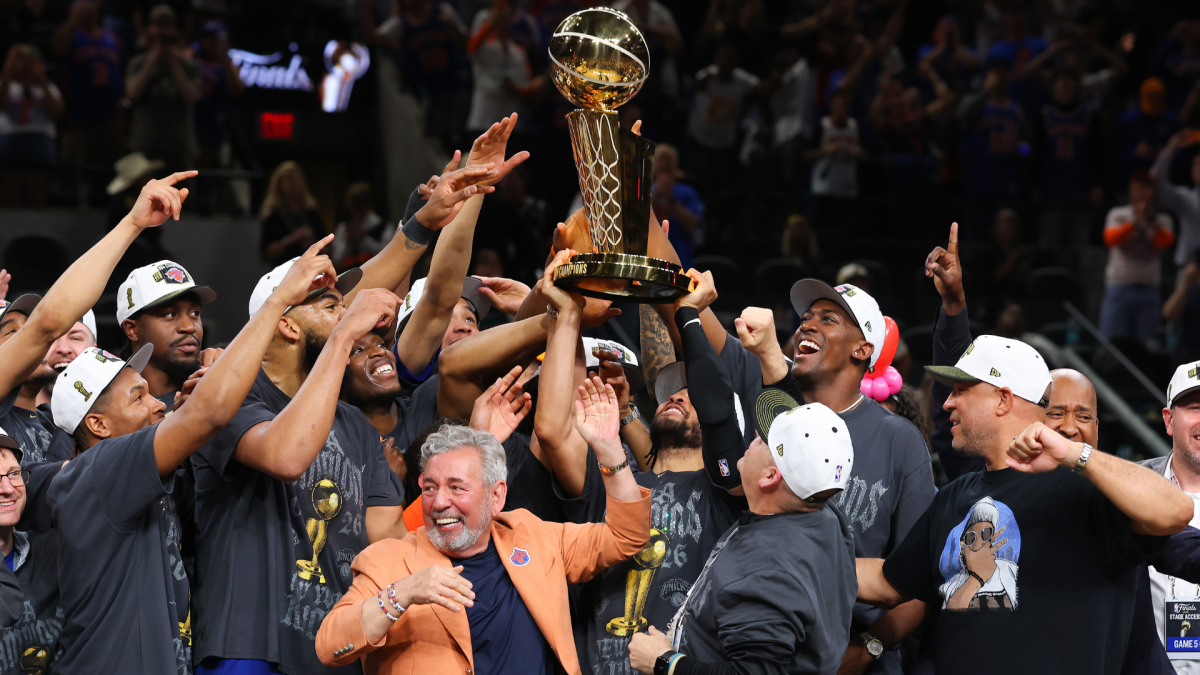
James Dolan made his championship-roster constraints public on Wednesday, appearing on WFAN's Carton Show to draw a hard line: the Knicks will not cross into the second apron. That language—"cannot go into the second apron"—is the voice of an owner closing a door, not a negotiating tactic. It demolishes the offseason storyline that had been building since the Knicks' title run: that a high-revenue, championship-caliber team in New York's market would simply pay whatever it took to run it back intact.
The second apron is where the NBA's salary penalties become genuinely punitive. Teams above it lose access to the taxpayer mid-level exception, can't aggregate salary in trades, and forfeit sign-and-trade flexibility. For a franchise that spent the last four years building toward a specific payroll architecture—duck the second apron early, use it as a spending floor during the championship window, then exit before first-round-pick forfeitures kick in—Dolan's statement on live radio amounts to a unilateral rewinding of that plan. Team president Leon Rose now operates in a narrower sandbox: keep the five expensive starters (Towns, Brunson, Anunoby, Bridges, Hart) and whatever role players fit beneath the second-apron line, or make a trade to shed salary and create flexibility elsewhere.
The immediate casualty list is sobering. Mitchell Robinson, a rim-running center whose value in pick-and-roll actions with Brunson is genuine, and Landry Shamet, a 38% three-point shooter who spaces the floor without requiring offensive touches, are both on borrowed time. Neither will command star-level money elsewhere—Robinson's injury history and Shamet's limited creation are liabilities—but they're expensive relative to the tax-compliant role-player market. If the Knicks stay below the second apron, they're likely re-signing one of these two, not both. That creates an opening for competitors to poach: Robinson to a contender seeking rim protection on a discounted deal, Shamet to a team that values three-point gravity over playmaking volume.
For bettors, this clarity tilts the Knicks' betting architecture downward in the short term. The team's championship-year offense ran on redundancy—multiple viable pick-and-roll partners for Brunson, wing depth that could create separation off-ball, defensive versatility that made switching feasible. Losing Robinson's vertical spacing or Shamet's perimeter accuracy (and the spacing gravity it commands) compresses the offensive toolkit. Brunson's assist rate climbs when he has a true roll man; his season average sat at 7.4 per game, but spiked to 8.8 in games where Robinson played 20+ minutes. Similarly, Shamet's presence tied up defenses at the three-point line, opening driving lanes for Hart and wings. Without both—or even with only one—the Knicks' bench unit scoring drops into the 105-108 range per 100 possessions, down from the 112 they posted with their full championship roster.
The play isn't to fade the Knicks outright; their five starters remain elite, and Dolan's constraint doesn't remove championship-caliber talent. The edge is surgical: their role-player depth will thin, which means bench unit unders become more reliable, their third-quarter margins (when reserves typically see heavy minutes) will contract, and Brunson's assists-per-game line should shift downward as he loses one or both of his most functional partners. The market hasn't fully priced this yet—line-setting algorithms reflected Dolan's original offseason architecture, not this Wednesday morning walk-back. That gap persists until the Knicks formally announce departures, likely in the next 3–5 days. Early numbers still carry the championship-roster assumptions. The adjustment is coming.