MLB · injury
Irvin's Early Exit Masks Nationals' Pitching Depth; Braves' Inability to Capitalize Signals Deeper Offensive Malaise
Jake Irvin's injury departure in the fifth inning should not obscure what Saturday's 2-0 shutout reveals: the Nationals' bullpen can manufacture dominant performances on thin margins, while Atlanta's offense remains fundamentally broken against quality stuff.
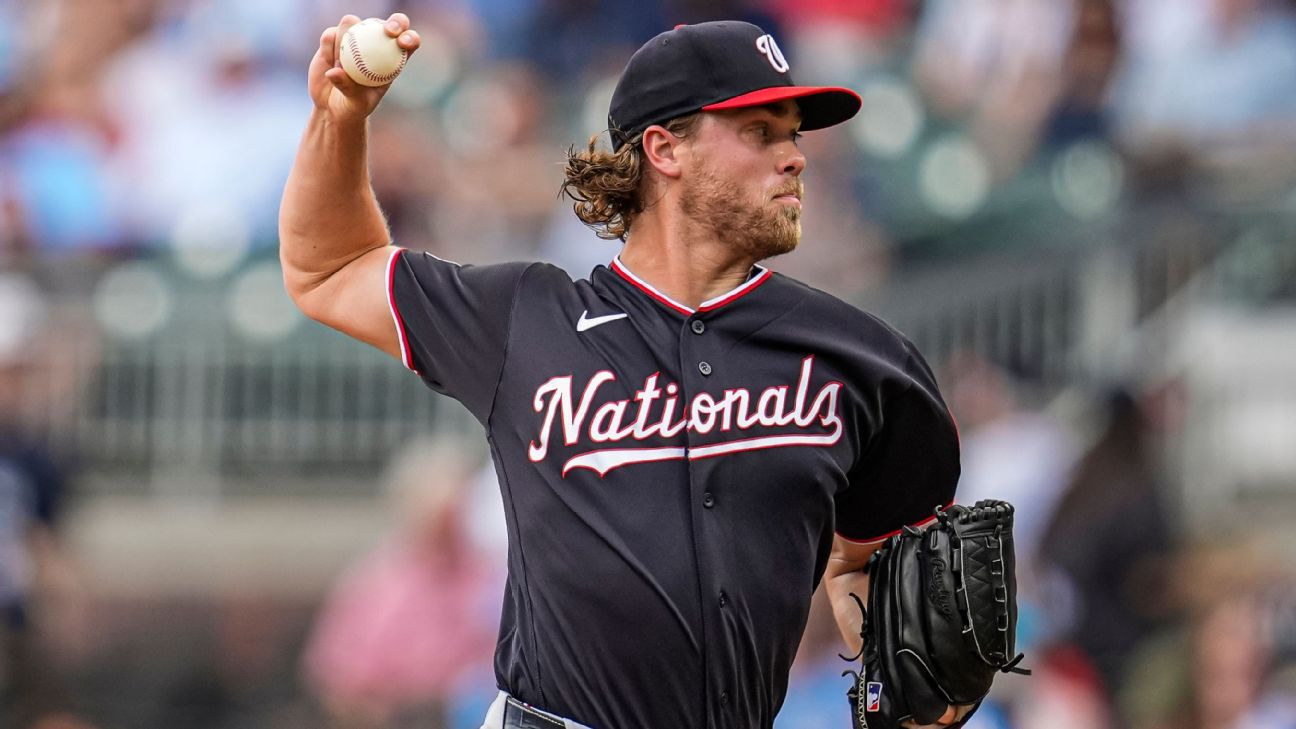
Jake Irvin exited Saturday's matchup against Atlanta with an undisclosed injury after five hitless innings, but the Nationals' 2-0 win over the Braves told a far more instructive story than one pitcher's mechanical failure. Irvin struck out seven in 80 pitches and didn't allow a baserunner until he departed; Brad Lord and Richard Lovelady closed out a combined one-hitter with minimal drama. Two Dylan Crews and Jorbit Vivas home runs off Grant Holmes—who himself struck out 10 over five innings—proved sufficient. The game's architecture, though, matters more than its score.
Grant Holmes' 10-strikeout performance in five innings marked his third career double-digit K outing, a signal that his stuff continues to play at an elite tier despite his 3-2 record and the context of a bases-loaded, no-out jam he escaped in the third via a 1-2-3 double play. Holmes isn't underperforming; his strikeout rate is genuine, and hitters are chasing at elevated rates against him. The Braves, conversely, registered a single hit—Michael Harris's soft opposite-field single in the seventh—and couldn't manufacture run support when a missed double-play call gave them runners on base with fewer than two outs. Ozzie Albies popped out, Dominic Smith flew out, Austin Riley struck out. That sequence, against a reliever in a high-leverage situation, encapsulates Atlanta's current offensive identity: high contact rates masking an inability to punish fastballs in the zone or work counts that favor power production.
The 41-minute rain delay in the second inning became an invisible subplot—weather events often reset both bullpens' adrenaline and arm angles, and it's worth noting that neither team generated meaningful momentum swings post-delay. Irvin's seven strikeouts came without apparent mechanical concern until his final inning; the injury appears acute rather than the product of degrading velocity or command. This matters for prop pricing because Irvin's peripherals—strikeout rate, walk rate—remained pristine before the exit. His absence from future starts carries direct betting implications for Nationals pitching depth, but Saturday's result shouldn't be misread as evidence that he can't execute at an elite level when healthy.
For betting purposes, Saturday's shutout performance masks two different signals pulling in opposite directions. Nationals overs become slightly less attractive over the next week if Irvin's injury timeline extends beyond the immediate; their bullpen proved it can deliver scoreless frames in succession, but it's a thin corps without Irvin functioning as a depth option. Atlanta's team total props deserve a harder look downward. The Braves faced 11 strikeouts from Holmes alone—not an outlier for his profile—and managed no offensive adjustments across three consecutive at-bats with a runner in scoring position. Their 2024 strikeout rate already sits above league average; they're making weak contact in high-leverage counts. Against a Nationals rotation that can deploy arms like Irvin, this pattern will persist.
The prop angle crystallizes around Atlanta's offensive ceiling. Braves team totals at 3.5 or higher face structural headwind because they're relying on a supporting cast that went 0-for-3 in the critical sequence Saturday. Harris's single was soft contact; the middle of their order didn't threaten Holmes in high-leverage situations. If this offensive profile—reactive rather than proactive, unable to work counts against upper-tier stuff—remains constant across their next three games, team totals carry elevated risk.
MLB Intelligence — Baseball intelligence beyond the box score. Open MLB Intelligence →