NFL · transaction
Tight End Market Reset Is Coming—What It Means for Your Props
Sam LaPorta and Tucker Kraft are about to reset the TE salary floor, and that contract pressure is already changing how offenses deploy the position.
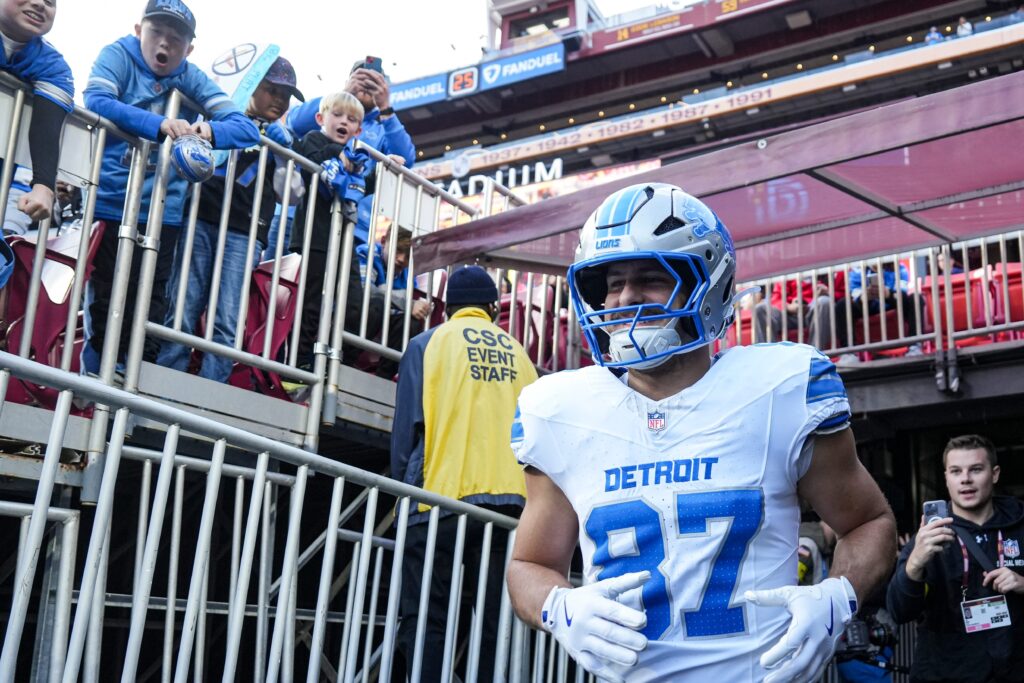
The tight end market is entering a recalibration window. Per ESPN's reporting, both the Lions' Sam LaPorta and Packers' Tucker Kraft are candidates for lucrative second contracts as soon as this offseason, with each player carrying just $2MM or less in cash obligations for 2026. LaPorta emerged as Detroit's focal point as a rookie with Pro Bowl and second-team All-Pro honors; Kraft averaged over 61 receiving yards per game through eight contests in 2025 before an ACL tear ended his season. Neither player is in immediate free agency, but extension conversations are already underway—a signal that teams view both as franchise-caliber talents worth locking down early.
The baseline for TE compensation has shifted dramatically. Trey McBride's four-year, $76MM deal (roughly $19MM AAV) set a ceiling last offseason; Kyle Pitts' current franchise tag sits just above $15MM. The active multiyear TE market clusters between $10MM and $19.1MM annually across 13 contracts. Rising salary caps and increased league-wide emphasis on multiple tight-end deployments have accelerated the timeline for the next tier of extensions. LaPorta and Kraft will both command deals in the $15MM–$20MM range, possibly higher. That cost inflation matters because it forces roster construction decisions downstream.
For Detroit, the math is brutal. LaPorta's extension would compete directly with keepable pieces from the 2022 draft class: Jahmyr Gibbs (RB), Jack Campbell (LB), and Brian Branch (S) are all due new contracts or restructures. The Lions will likely choose between retaining LaPorta or both Campbell and Branch—a zero-sum game that hints at how expensive top-tier tight ends have become relative to even elite defensive talent. Green Bay has more cap flexibility but faces a similar calculus: locking in Kraft before a potential post-ACL recovery discount expires means deprioritizing other investments. Teams signing these deals are betting production resumes at 2024-2025 volume and efficiency.
The prop-betting angle hinges on how offenses respond to the tight end salary environment. When teams commit $15MM+ to a position, usage patterns normalize upward. LaPorta's 2024 production (791 receiving yards, 8 TDs on 86 targets) may not repeat after missing nine games last year, but a contract extension locks in an offensive identity centered on TE involvement. If Detroit extends him, expect his target share to stabilize near 22–24% of passing attempts—well above his 2025 rate. That translates to a baseline of 7.2–8.1 targets per game (assuming 37–39 pass attempts). His receiving yards over/under lines at 65–70 per game in 2026 become exploitable undervalues if the market prices in lingering injury concerns rather than role normalization. Similarly, if Kraft returns healthy in Green Bay and inks an extension, his elevated target volume from the first two months of 2025 (9.1 targets per game in that eight-game span) becomes the structural norm, not an outlier. Kraft receiving yards lines in the 60–65 range carry value if bettors conflate post-injury recovery risk with role uncertainty—a distinction the market often blurs.
The broader TE market lift also creates derivative angles. Brock Bowers (Raiders) is tracking toward a 2027 extension conversation if his production trajectory continues; his receiving yards and anytime TD props will face upward pressure as the market reprices his deal potential and Las Vegas increases intended usage. Charlie Kolar's $8.1MM deal despite 30 career catches signals that blocking/role-flexibility tight ends are now priced as premium position contributors, not specialty packages. That means volume for established receiving tight ends compresses slightly as teams diversify tight end responsibilities—another mechanism depressing second-tier TE yards and reception props, even as the market's collective attention fixes on the LaPorta–Kraft reset.