NFL · transaction
LaPorta Contract Impasse Opens Receiver Role Questions for Lions Offense
Detroit's star tight end walks away from extension talks with weeks to play, forcing the offense to function without a long-term security blanket and reshaping target distribution.
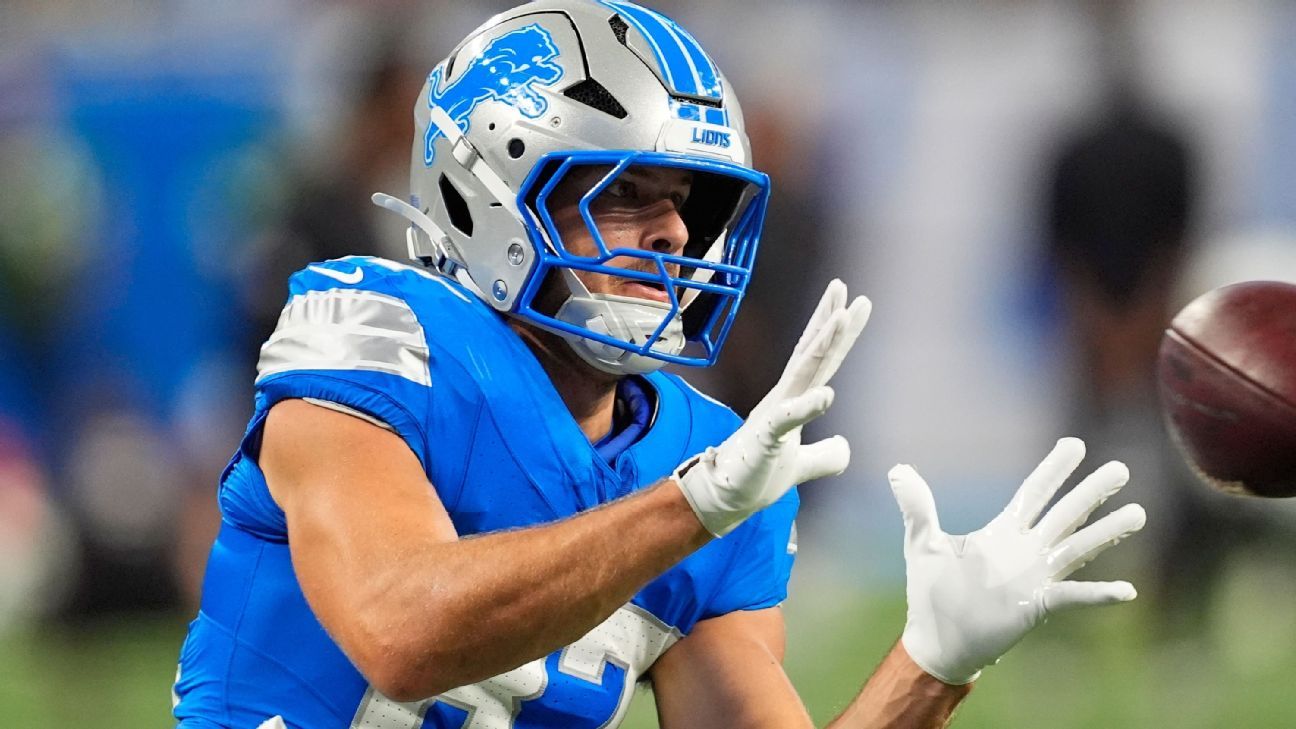
Sam LaPorta and the Detroit Lions have ended contract negotiations after a four-week push failed to produce agreement, sources told NFL Network on October 4. The impasse means LaPorta will test free agency in 2027, barring a sudden reversal during the offseason. Detroit retains the franchise tag as a fallback but has signaled no urgency to revisit terms before the season concludes.
The decision to pause reflects mutual calculation. LaPorta, 25, has logged 14 receptions for 144 yards across three games while shouldering roughly 90% of Detroit's offensive snaps—a workload that validates his health after back surgery sidelined him for the final eight games last season. The Lions, meanwhile, have already committed eight-figure extensions to Jahmyr Gibbs, Aidan Hutchinson, Jameson Williams, and Kerby Joseph in the past two years. Another massive deal at the tight end position, at a moment when LaPorta's leverage peaked (he had hoped to follow Tucker Kraft's four-year, $75 million agreement with Green Bay), created friction. With LaPorta wanting to focus exclusively on performance and the Lions unwilling to match Kraft's market-setting rate before the season, both sides agreed to table the conversation until spring.
For bettors, the deadlock has immediate prop implications. LaPorta's snap rate and target share remain elevated because he remains the offense's primary coverage option, but the absence of a contract floor now creates volatility in his weekly usage patterns. A healthy rotation could emerge if the Lions draft or sign depth at tight end during the offseason—something they'll likely explore aggressively given the uncertainty. More immediately, in-game leverage shifts: LaPorta has less reason to hold back on contact or load-management decisions, and the Lions have no contractual incentive to protect him from heavy late-game snap counts. His receiving totals (currently 4.8 yards per game across the first three contests) should stabilize around 40-50 yards per game if target volume holds, but expect volatility week to week as the team tests alternative route structures and younger pass catchers to hedge against his pending departure.
The real edge for prop players lies in recognizing that Detroit's offense now operates with implicit uncertainty baked into its design. Coordinator schemes will continue to feature LaPorta in high-leverage situations, but the lack of a long-term tether means the team may compress his snaps in non-critical moments or rest him earlier in blowouts. Target floors that looked reliable in September now carry execution risk. Conversely, if LaPorta enters any game-critical stretch drive in the final weeks, his snap rate and target floor will spike as the team maximizes his production to build his free-agent case. Betting his receiving props on a week-to-week basis requires parsing the strength of the opponent's secondary and the Lions' playoff positioning at that moment—single-game variance will be higher than his season-long pace suggests.
NFL Intelligence — Football intelligence beyond the final score. Open NFL Intelligence →