NFL
Jaguars-Bengals is a Legitimate Playoff Barometer—And the Receiving Battle Holds the Prop Edge
Two 2-1 AFC teams collide Sunday with divergent QB efficiency and a wide receiver mismatch that the market hasn't fully priced.
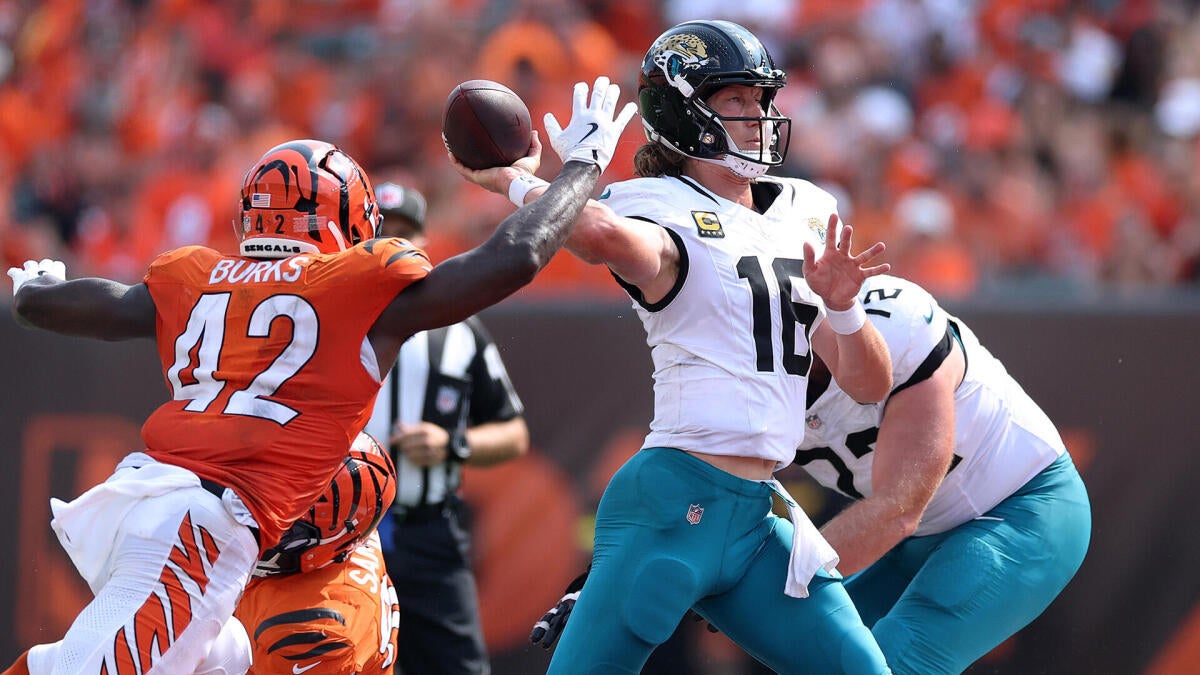
Cincinnati travels to Jacksonville on Sunday for a game that will either validate or deflate both teams' early-season momentum. The Bengals are 2-1 after a 30-27 loss to Pittsburgh that came down to the final moments, while the Jaguars beat New England 35-6 last week—a statement win against a flatlined opponent. Both teams boast winning records in their divisions (the AFC North and South, respectively), but the quality of that competition differs sharply: Cincinnati's wins came against Tampa Bay and Houston, both winless; Jacksonville's only loss came to Denver, a genuine playoff contender.
The quarterback duel carries historical weight—Burrow's LSU beat Lawrence's Clemson in the 2020 National Championship—but the statistical split reveals the real story. Burrow sits at 70.9% completion with 743 yards, six touchdowns, and one interception through three games. Lawrence trails at 66.7% completion and 616 yards, though he's thrown seven touchdowns against two interceptions. Burrow is running the offense with precision; Lawrence is producing volume but with higher volatility. That efficiency gap matters when asking which offense can sustain drives against a defense playing to defend its turf.
Jacksonville's pass rush is generating four sacks per game through Week 3—lower than elite, but enough to disrupt Burrow's rhythm if Cincinnati's offensive line gives ground early. More important: the Jaguars' secondary got caught for 100 receiving yards by Miami's Jaylen Waddle last week, then held the Patriots' receivers to 178 yards and zero touchdowns. They're not consistent. Cincinnati's passing game, meanwhile, is anchored by Tee Higgins (244 receiving yards, ninth in the league) and Ja'Marr Chase (185 yards, 27th). Higgins is a legitimate red-zone threat; Chase has underperformed relative to draft capital and preseason projections. The Jaguars' defensive inconsistency creates an opening for Higgins to exploit coverage lapses, especially on vertical routes where Jacksonville showed vulnerability to Waddle's size-speed combination.
The prop market has Burrow at roughly 255-260 passing yards for the game—a number built on his season average of 248 yards per start and the assumption that Jacksonville's defense will tighten post-Waddle tape. But here's the mechanism: Burrow's completion percentage (70.9%) is the sixth-best in football, and when he faces defensive schemes that rely on zone coverage to contain Higgins and Chase, his short-to-intermediate accuracy creates volume without requiring explosive plays. Jacksonville's secondary depth took a hit in pass coverage assignments last week; expect Burrow to attack underneath and accumulate yardage through precision rather than boom-bust throws. The market has already adjusted for Jacksonville as a playoff-quality defense, but hasn't accounted for the Bengals' specific strength—controlled, efficient passing that exploits zone spacing. Higgins receiving yards (listed around 65-70) offers value if Jacksonville's corners are tasked with top-down coverage of Chase.
Cincinnati's defensive weakness—its worst performance came against Pittsburgh last week—creates risk on Burrow's total if Jacksonville's run game exploits soft coverage over the middle. The Jaguars possess a materially stronger ground game than Cincinnati, and if they establish early success running between the tackles, Burrow will be forced to play from behind. The line at Bengals -2.5 is thin, reflecting the genuine quality matchup. For prop purposes, the edge lives in Higgins receiving yards and Burrow completion percentage overs—angles that survive line movement because they're rooted in defensive scheme vulnerability, not single-game noise.
NFL Intelligence — Football intelligence beyond the final score. Open NFL Intelligence →