NFL
Dart's Season Ends, Winston's Chaos Begins: Giants Turn Over Quarterback and Playoff Odds in One Monday Night
New York's injury-ravaged pivot from a dual-threat rookie to an interception machine reshapes the team's win total and fundamentally changes how to bet their passing game.
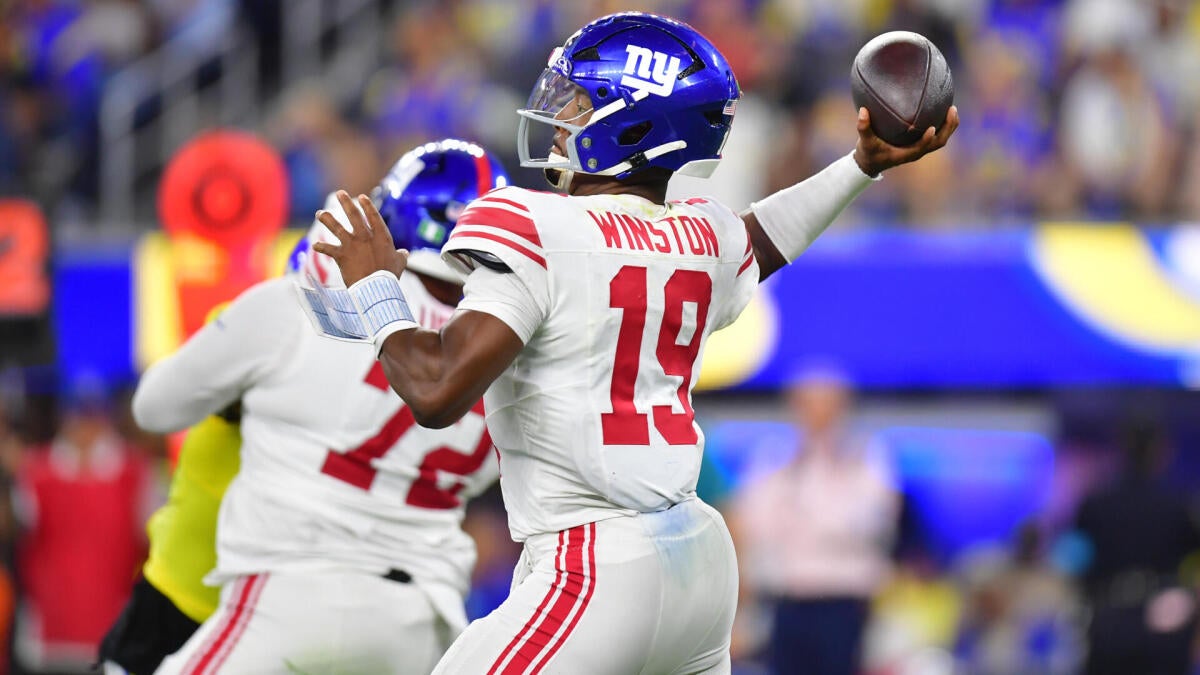
Jaxson Dart's season ended in the first quarter of Monday night's 28-6 loss to the Rams, and with it, the Giants' playoff hopes took a structural collapse. The rookie had meniscus and MCL damage that requires surgery—not catastrophic enough to avoid the initial spin that he was "OK," but severe enough that GM Joe Schoen's post-game reassurance now reads as either misinformation or malpractice. Dart was the rare first-year starter who produced both passing and rushing touchdowns at elite volume: 18 passing TDs and nine rushing TDs in his first 14 starts, a combination no quarterback in league history has matched. The Giants were 5-9 with him over the past two seasons; without him, they are 0-5.
Enter Jameis Winston, a 36-53 career starter carrying 114 interceptions across 109 games played. His resume reads like a cautionary tale dressed up as an opportunity: high-volume passing yards (270.0 per game as a starter, sixth-most in NFL history with 25+ starts) paired with turnover volatility that has burned every team that's trusted him as a full-time franchise player. His relief appearance against the Rams—11 of 27 for 111 yards and an interception—came in shock circumstances, but it hinted at what's coming: a pass-heavy offense without the mobility or decision-making discipline that made Dart playable on limited experience.
The sportsbooks didn't hesitate to recalibrate. New York's season win total, which had climbed to 8.5 after a 28-20 Week 1 win over Dallas, collapsed to 6.5 with the Under at -125 following the Dart injury. The Giants' playoff probability, per the SportsLine Projection Model, sits at 2.4%—dropping further to 1.1% if they lose Sunday to Tennessee. That shift is not gradual; it is a cliff, and it reflects a hard truth: the team's path forward depends entirely on how much the defense can prop up a backup quarterback whose career interception rate suggests he will find ways to self-destruct.
For bettors, the angle sharpens around passing volume and turnover risk. Winston's 114 career interceptions came in 109 games: a 1.05 interception rate per contest, well above the modern median of 0.80. The Giants' opponent this week, Tennessee, ranked 15th in interception rate (1.01 per game) last season; they are not a turnover-generating engine. However, Winston's volatility in confined space—especially in his first start under New York's play-calling, with a hobbled receiving corps and windy, rainy conditions forecast for Sunday—tilts the probability of at least two interceptions well over his season average. Conversely, his passing yardage prop will likely be inflated at the book level because of his per-start average, but that average was compiled across multiple teams and play-calling systems. Early in a first start, in a storm, against a middling pass defense, Winston is more likely to take sacks and dump passes than launch deep patterns. The Giants' team passing yards under a line set for 250+ is sharper than the over-under on Winston's personal yardage, where recency bias and career averages have pushed numbers too high for a single-game sample in this context.
Weather, urgency, and scheme mismatch also compress the total. The forecast calls for sustained winds (20-30 mph), 90% rain chance, and nearly half an inch of accumulation—conditions that historically depress passing attempts and completions across both teams. Tennessee's Cam Ward (the other former No. 1 overall pick in this matchup) is not a game-manager; he too will feel the pressure to extend plays in messy conditions. The sportsbooks have already begun pricing this in: the over-under dropped to 38.5, with 90% of sharp handle on the Under. That signal reflects the books' own risk models; bettors are not yet fully accounting for how much Winston's indecision compounds weather risk.