NFL
Darnold's Glute Heals Faster Than Expected—Lock's Hot Hand Won't Keep the Job
Seattle's starting quarterback is on track to play Sunday against Washington, but a backup with a 86.4 QBR has already reset the market's baseline for the Seahawks offense.
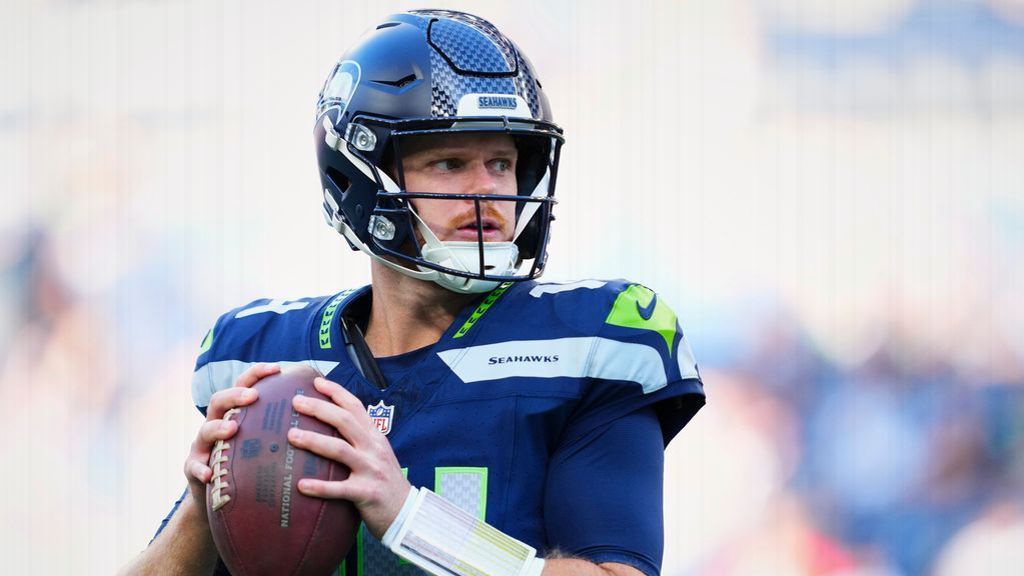
Sam Darnold will return to practice Wednesday, 12 days after a glute injury ended his debut with the Seahawks on the fifth play of their season opener. Coach Mike Macdonald confirmed Monday that Darnold's recovery is ahead of the original schedule—a significant development that also opens the door to his possible appearance in Sunday's game at Washington. The Seahawks have won both games without him, improving to 2-0, but the decision architecture is already clear: if Darnold can go, he starts.
The magnitude of this shift matters more than the headline suggests. Darnold missed a full week of practice and nearly all game action, yet he's tracking for deployment in Week 3. This isn't a tentative maybe. Macdonald's language—"there is a chance" he plays this week—is measured, but his broader framing ("ahead of schedule," "shifted quite drastically") signals a quarterback moving faster through rehab protocols than expected. For a glute injury, that usually means the tissue is responding, inflammation is controlled, and the risk-benefit calculus has tipped toward activation.
Meanwhile, Drew Lock has given the Seahawks' front office a problem. In two games replacing Darnold, Lock has completed 73% of passes, thrown four touchdowns with zero interceptions, and posted a Total QBR of 86.4—fourth-best among all quarterbacks through Week 2. By any surface metric, Lock is playing at a level that would normally invite serious debate about the starter's role. Macdonald preempted that conversation entirely. "If Sam can play, he's going to play," the coach said. That statement is not uncertainty; it's organizational commitment overriding on-field performance.
For betting purposes, this matters because it reshapes Seahawks passing volume and distribution. Lock's two games featured conservative game scripts (blowout wins) that masked underlying efficiency. The Arizona game was 31-7—a game where Seattle controlled pace and didn't need to air it out. Lock's 4:0 TD:INT ratio and 73% completion rate emerged in a context where the defense was dominant and the offense game-managed rather than drove. Darnold's return against a Washington defense ranked middle-of-the-pack in pass pressure will test whether Lock's trajectory holds or whether the baseline drops back toward Darnold's ceiling, which remains unproven in this system. The line already implies Darnold plays: Seahawks passing totals and QB props should hold steady unless news confirms he's medically cleared. If he's ruled out, expect immediate compression of Seattle's team total and passing-yard lines—Lock's efficiency won't sustain in a non-blowout spot.
One secondary thread: Jadarian Price's shoulder injury appears minor (Macdonald called it non-serious), which protects Seattle's rushing volume. Zach Charbonnet, the co-starter from 2025, could open his 21-day PUP practice window as soon as Wednesday. That timeline is fluid, and if Darnold returns at full load, Seattle may accelerate Charbonnet's rehab to restore committee balance. For now, Price should suit up, keeping rushing-yards props stable.