NFL · injury
Purdy's Fundamental Overhaul Sets Up Cleaner Passing Volume in 2026
The 49ers QB has weaponized his fifth-year film study to eliminate mechanical inefficiency—meaning higher completion rates and fewer throwaways at the same yardage volume.
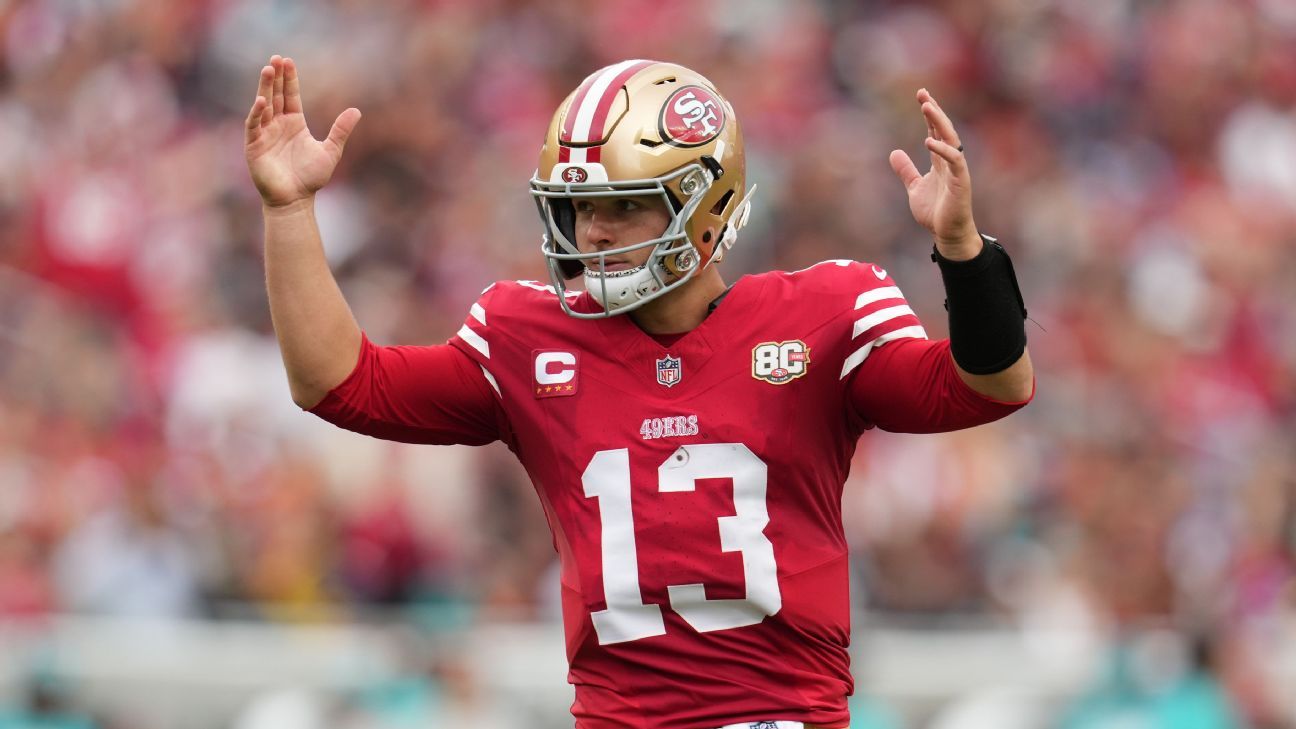
Brock Purdy enters Week 3 with a 95.0 Total QBR, an 80.4% completion rate, and zero sacks taken across two games. Those numbers follow what Purdy describes as his most intentional offseason yet: a deep rewatch of the Super Bowl LVIII season that surfaced gaps in footwork consistency and decision timing that he's spent the spring systematizing with quarterbacks coach Mick Lombardi. The 49ers are counting on that architectural work to compound into his best statistical season, even as injuries ravage the receiving room—Ricky Pearsall, De'Zhaun Stribling, Christian Kirk, and Demarcus Robinson are all sidelined or limited.
The mechanical story matters because it doesn't require elite target talent to materialize. Purdy has already demonstrated last season that he can manufacture production from a thin receiving corps; what's changed is the efficiency layer underneath. His 11.1% completion percentage over expectation (CPOE) ranks first in the league. He has yet to throw a pass off-target. This isn't higher volume masking inconsistency—it's cleaner execution at the same volume. DraftKings has positioned him as a +800 MVP bet, and Fred Warner's locker-room endorsement reflects an internal valuation that Purdy has genuinely leveled up, not just benefited from early-season schedule softness.
The Rams and Dolphins defenses rank outside the top 15 in pass efficiency allowed, so there's surface-level schedule noise to account for. But Purdy's improvement traces a specific mechanism: footwork discipline and pre-snap reads that reduce the need for scramble improvisation or checkdown tosses. That translates to more downfield completion attempts and fewer wasted dropbacks. Against defenses that force him to hold the ball longer, his sack rate will inevitably rise from this 2-game baseline, but the completion accuracy—his true technical gain—should persist.
For prop bettors, the edge resides in completion-based lines. Purdy's trajectory suggests completions over 27.5 becomes underpriced once books acknowledge the CPOE pattern is structural, not luck. His per-game completion volume has held steady in the 24–30 range across his career; the 80.4% rate is the real outlier and it's tied to mechanical refinement that won't evaporate against Tampa Bay or Kansas City. Passing yards remain volatile based on game script and receiver availability, but completion props absorb the efficiency gain without the volume noise.
The injury toll at receiver is real and will cap ceiling games, but it also tests whether Purdy's processing gains translate to shorter, more accurate routes rather than wasted air. If they do, completion percentages will hold. If they don't, the MVP narrative collapses fast.