NBA · lineup
Edwards' Ball-Handling Pivot Reshapes Timberwolves' Offensive Identity
Coach Chris Finch's decision to move Anthony Edwards into the primary playmaking role ahead of the season has fundamentally altered Minnesota's offensive structure—and the prop markets haven't fully recalibrated.
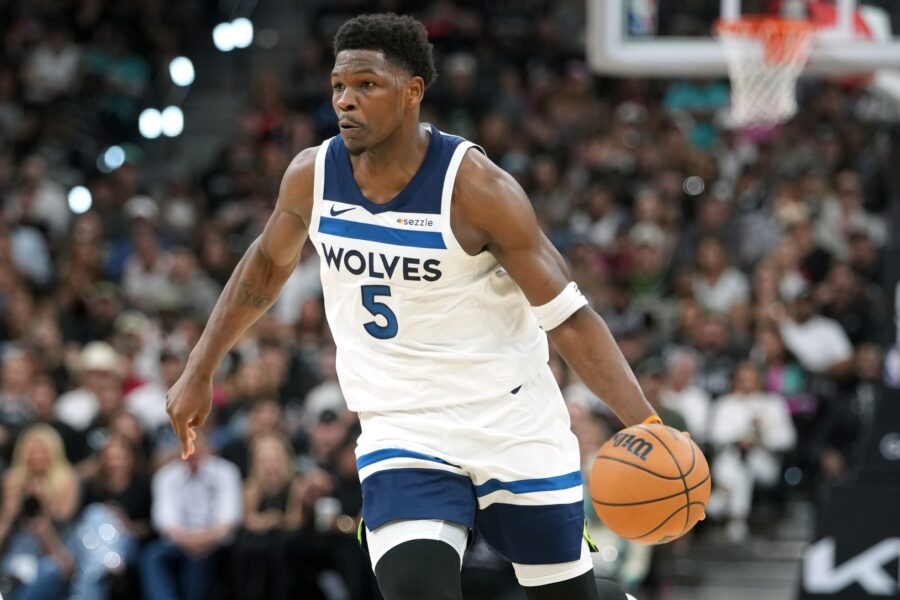
Chris Finch made a pivotal lineup change before the Timberwolves' season opened: he benched veteran point guard Mike Conley and inserted Donte DiVincenzo into the starting five, elevating Anthony Edwards into the role of primary ball-handler. The move was strategic rather than reactive, a deliberate architectural shift that transformed how the offense flows through its star wing rather than a traditional point guard. Per reporting from the Minnesota Star-Tribune, this framework became the throughline for Minnesota's entire campaign.
What Finch was solving for isn't immediately obvious in a box score. By anchoring offensive initiation on Edwards—a 6'2" guard who can beat defenders off the bounce and create advantages in the half-court—the Timberwolves gained a weapon that conventional ball-handling doesn't provide: the ability to generate scoring and playmaking from the same position. DiVincenzo's insertion into the starting lineup wasn't about adding another creator; it was about spacing, off-ball movement, and letting Edwards orchestrate from secondary positions. This structure reduced reliance on Conley's aging legs while maximizing Edwards' versatility in an era where wing-initiated offenses have become increasingly valuable.
The seasonal context matters. Team morale fractured at points, with several players acknowledging that internal "moodiness" dampened cohesion. Finch's structural pivot—positioning Edwards as the engine rather than a pure scorer—appeared designed to give the offense a clearer identity and reduce the offensive load on any single traditional playmaker. Yet Minnesota's inability to close on championship-tier teams like OKC and San Antonio suggests the offensive adjustment, while intellectually sound, didn't produce the spacing or efficiency gains necessary to contend at the highest level.
For prop bettors, Edwards' expanded ball-handling duties create a specific edge: his assist volume should have climbed materially once Finch made the lineup change. If you're reviewing lines on Edwards' assists in the 5.5–7.5 range for next season, you need to distinguish between his pre-pivot assist average (likely 4.5–5.5) and his new baseline as primary creator. The market may still be pricing him as a secondary facilitator rather than a lead playmaker. His true assists per game in this role should trend toward 6.5–7.5 depending on usage distribution. The edge is durable—it's not a single outlier performance but a coaching-directed role reassignment that persists across the entire season structure.
Looking ahead, if the Timberwolves make meaningful roster moves or return to a more traditional point guard deployment, that assists baseline resets downward sharply. But if Finch doubles down on the Edwards-as-creator framework for next season, his assist props offer value at modest overs because public perception hasn't fully absorbed the structural permanence of the change.