Castle's Breakout Carries Spurs Past Wolves; OKC Awaits a Backcourt Built for Switching
By PropBetEdge Editorial Team ·
San Antonio's guard depth and defensive flexibility proved too much for Minnesota's isolation-heavy attack, setting up a West Finals clash between two contrasting philosophies.
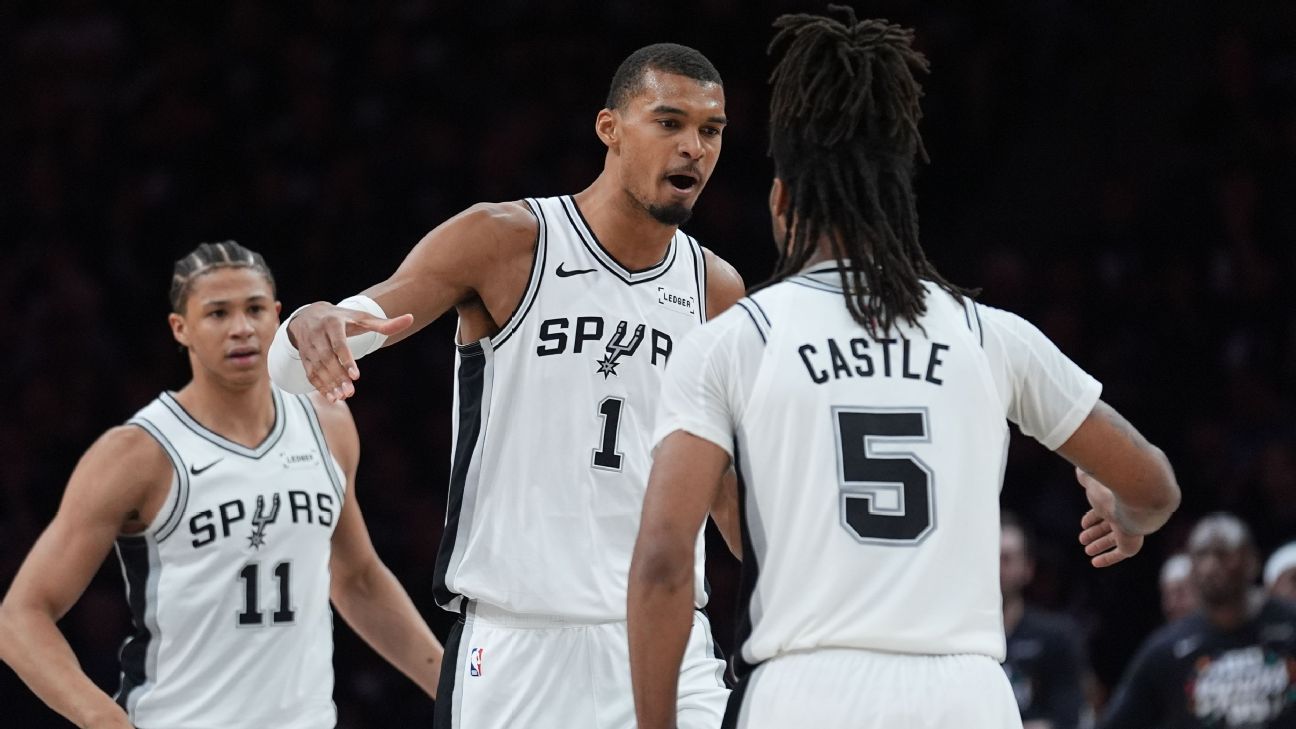
The Spurs closed out the Timberwolves 139-109 in Game 6 Friday night, with Stephon Castle posting 32 points and 11 rebounds to punctuate a series San Antonio dominated from start to finish. De'Aaron Fox added 21 points and nine assists, while Victor Wembanyama anchored the defense with 19 points, five assists, and three blocks in a controlled 27-minute outing. The Spurs outscored Minnesota by 97 points across the six-game series and never trailed by double digits—a margin that speaks less to variance than to structural mismatch.
That mismatch centers on perimeter skill and defensive switching. Castle was surgical, hitting his first five three-pointers and finishing 11-for-16 from the floor; Fox went 3-for-3 from deep; Julian Champagnie buried four threes among his 18 points. Minnesota, built around Edwards' creation and Randle's mid-range work, had no answer for how the Spurs' backcourt could guard multiple positions simultaneously. The Wolves' big-heavy roster—Randle, Karl-Anthony Towns, and Jrue Holiday—struggled to generate rhythm against San Antonio's switch-everything scheme. Randle's three-point, one-for-eight elimination game was the final punctuation on a series where Minnesota's halfcourt offense became predictable and exploitable. Anthony Edwards finished with 24 points on 9-for-26 shooting, a line that masks how often he was forced into isolation against switching defenders who didn't flinch.
The Spurs' dominance carries obvious implications for the Thunder matchup beginning Monday. Oklahoma City swept both its first-round and second-round opponents—a cleaner run, but against defenses that don't defend the way San Antonio does. The Thunder live in pick-and-roll coverage and screening action; they thrive when defenders have to commit to schemes rather than react to them. Wembanyama's presence in the paint and the Spurs' guard switching will create a different calculus for Shai Gilgeous-Alexander and Chet Holmgren's rim-running. The size-and-switching framework that suffocated Minnesota—a team that ranked in the bottom half of three-point makes per game—may pressure OKC to take more volume from distance than they prefer.
For bettors, the lesson from this series is that versatility in the perimeter grouping becomes a pricing edge when faced with isolation-dependent offenses. Castle's emergence as a reliable three-level scorer (he hit 40% from three in the regular season) was discounted relative to his playoff performance because the market had not yet processed how much switching defenses would weaponize his range and size. He's 6-foot-3, handles the ball, and doesn't flinch at closing out on stretch fours—a profile that plays in up-tempo series finishes. Looking ahead, the Spurs' next opponent (OKC) does not rely on isolation the way Minnesota did, which means Castle's scoring floor ticks down slightly. Fox's assist rate spiked against Minnesota's switching scheme; in a Thunder series where pace slows and pick-and-roll dominates, expect his playmaking volume to regress toward his 6.8 assists-per-game season average. The Spurs' backcourt was built to dismantle what Minnesota was trying to do. Against Oklahoma City, they're facing a team that doesn't need to do what Minnesota was doing.
Wembanyama's quiet Game 6 (19 points, 27 minutes) is worth parsing too. He wasn't defending poorly; he was being defended well—the Wolves used size and discipline to keep him out of rhythm without fouling. That's a template OKC can mimic with Holmgren and Jaylin Williams. In the Finals preview odds, the Spurs are structural favorites because of depth and switching. But Castle's single-series breakout is unlikely to sustain; the market will recalibrate his scoring props upward for Game 1 based on his 32-point/11-rebound Game 6, then normalize once OKC's pick-and-roll pace reduces his offensive touches. The edge lives in fading the overcorrection on Castle's individual scoring volume in Game 1, and in recognizing that Fox's assist volume will compress from what we saw against Minnesota.