NBA
SGA's Game 2 Eruption Masks Deeper Thunder Vulnerability in Series Reset
Gilgeous-Alexander's 30-point response stabilized Oklahoma City's Western Conference Finals grip, but bench depth and fourth-quarter execution aren't guarantees in San Antonio.
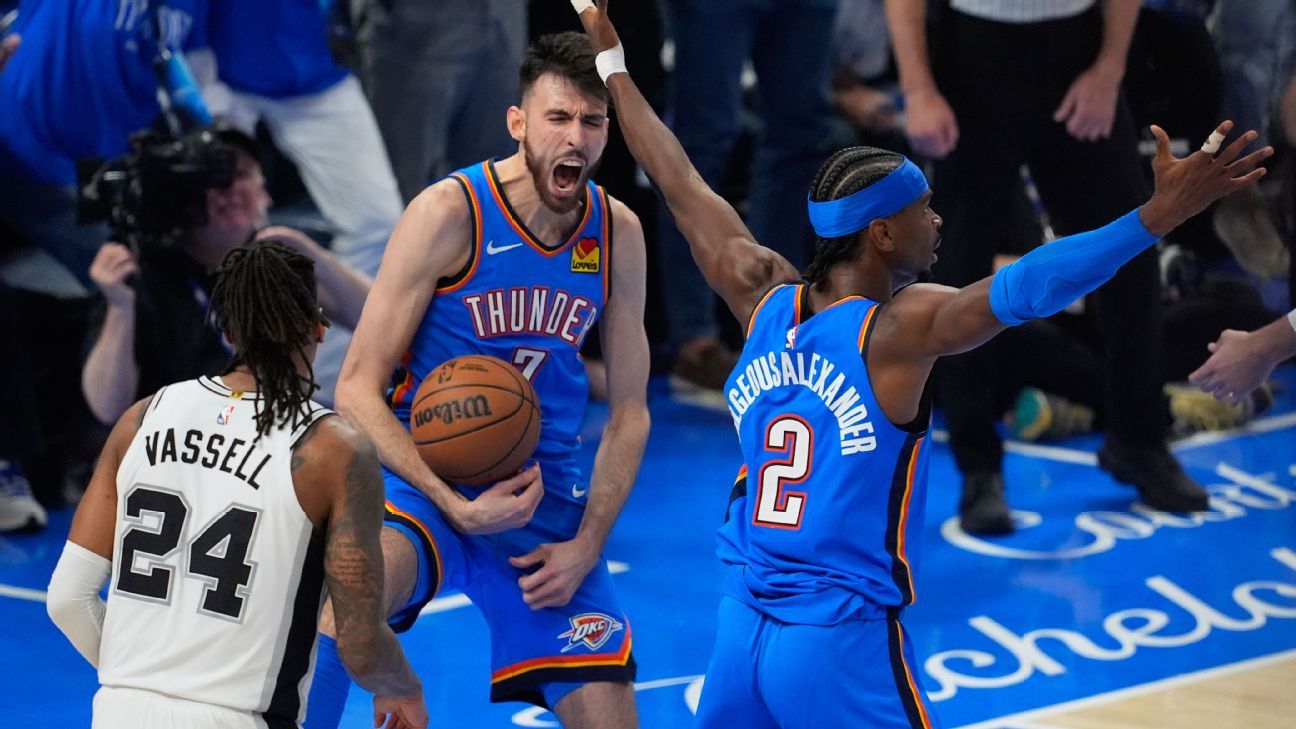
Shai Gilgeous-Alexander scored 30 points Wednesday night to lead the Thunder past the Spurs 122-113 in Game 2, evening the Western Conference Finals at 1-1. After a subpar series opener, the MVP responded with efficient scoring and decision-making, anchoring OKC's largest advantage—a bench unit that outscored San Antonio's reserves 57-25 and generated a 27-10 edge in points off turnovers. The defending champions' reserve production, powered by Alex Caruso (17 points) and role-fill contributions from Jared McCain and Cason Wallace, created enough separation to weather a Spurs comeback attempt that cut a 13-point fourth-quarter cushion to five with 1:25 remaining.
What's worth examining beyond the surface scoreline: Oklahoma City's forward rotation showed brittleness. Jalen Williams exited with a tight hamstring, and the Thunder's non-SGA perimeter creation went dormant during San Antonio's run. Isaiah Hartenstein's 10 points and 13 rebounds were stabilizing—he barely played in Game 1—but his box score masks the fact that OKC needed bench reserves to do heavy lifting rather than its starting four creating secondary offense. Victor Wembanyama's 21-17-6-4 statline on reasonable efficiency demonstrates that when the Spurs' defense tightens around pick-and-roll actions, Gilgeous-Alexander's role-mates (particularly Williams at full strength) become responsible for secondary creation. Wednesday's bench explosion won't replicate on the road, where spacing tightens and fatigue accumulates.
The prop mechanics here turn on Gilgeous-Alexander's scoring volume and the Thunder's fourth-quarter separation. SGA's 30-point night was efficient but not aberrational—he's hit 28+ points in six of his last nine playoff games. The meaningful number is his assists: 6 dimes on 27 field goal attempts suggests he spent the night as a pure scorer rather than a playmaker, which tracks with Game 1 (subpar) and suggests San Antonio's defense is successfully overplaying pick-and-roll reads. Going to Game 3 in San Antonio, where the Spurs' switching defense is more cohesive at home, Gilgeous-Alexander's assist total (currently 6.5 for the series) becomes a leverage point. If San Antonio's switches continue to compress his options, his assists could flatten even if his scoring stays elevated—a divergence that prop markets haven't fully priced. Conversely, the Spurs' fourth-quarter discipline collapsed in the final 2:30 (allowing 11 unanswered points), a pattern built more on execution variance than defensive schematic failure. That bleeding won't persist in a best-of-seven; San Antonio will adjust bench rotations and tighten execution windows.
For bettors, the bounce-back narrative is a trap. Gilgeous-Alexander did what an MVP is supposed to do after a poor Game 1, but the series doesn't hinge on his 30-point ceiling—it hinges on whether Williams returns healthy and whether OKC's bench stays productive away from home. The Thunder's 57-25 bench advantage is a single-game spike; regression toward the mean is baked in. Monitor Williams' status obsessively heading into Friday; if he's limited, SGA's assist floor drops sharply and his points ceiling rises, inverting the combo prop landscape. The line move at the sportsbooks will likely favor the Thunder after a dominating home victory, but Game 3 in San Antonio with potential injury concerns to OKC's depth should tighten that edge considerably.