NBA
SGA's Shot Drought Against San Antonio Masks a Deeper Game 7 Problem for Oklahoma City
Shai Gilgeous-Alexander's 18-point shooting collapse in the Western Conference finals isn't random variance—it's proof that San Antonio's defense has found a repeatable formula, and Game 7 will test whether the Thunder can adjust before their season ends.
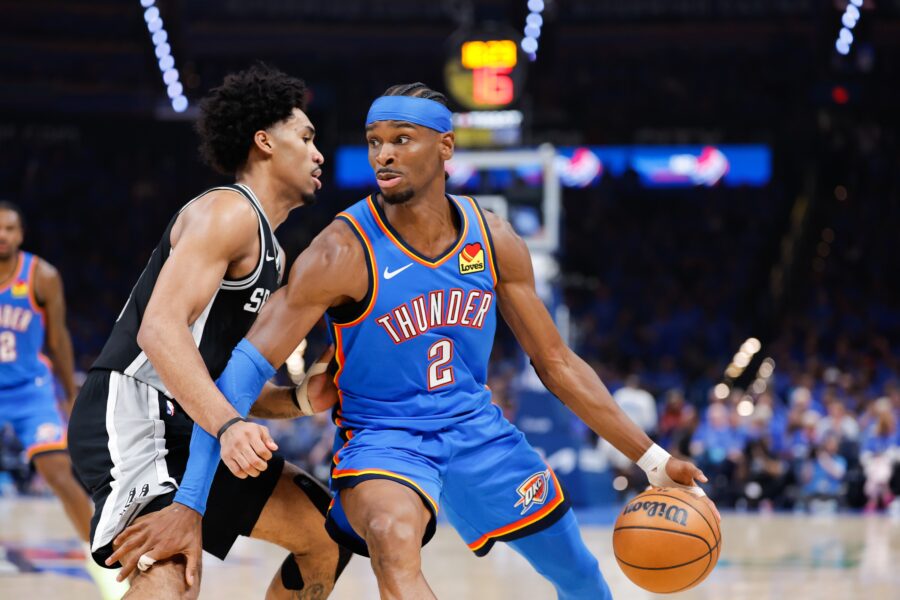
Shai Gilgeous-Alexander is converting 37% of open looks against San Antonio in the Western Conference finals. During the regular season, he made 55% of shots with 4-6 feet of space. That's an 18-percentage-point gap, and it's not happenstance—it's a defensive blueprint working as designed. The Spurs have smothered the back-to-back MVP for six games, and while Gilgeous-Alexander insists he's "trusting his work," the numbers tell a story of systematic execution: San Antonio's switching defense and perimeter pressure have forced him into difficult rhythm and scrambled his shot mechanics enough that even open looks aren't dropping. Game 7 in Oklahoma City becomes a referendum on whether the Thunder can break the pattern or whether the Spurs' scheme has permanently altered his effectiveness for this series.
What makes the Spurs' approach particularly damaging is that it's survived without requiring perfection. Five of the six games have been lopsided (average margin: 17 points), meaning San Antonio doesn't need to suffocate Gilgeous-Alexander's teammates equally—just enough to keep the game manageable. That's where Alex Caruso's playoff eruption becomes the most dangerous variable the Thunder have in Game 7. The 32-year-old is averaging 15.3 PPG while shooting 55.6% from three against the Spurs, a stark reversal from his 29.3% three-point mark during the regular season. For Caruso, this isn't a micro-sample fluke. His career three-point rate sits at 36.5%, meaning he's overperforming his established baseline by nearly 20 percentage points in this series. That kind of variance typically triggers market regression, but Caruso's efficiency has been authentic—catch-and-shoot opportunities in a playoff setting often deviate from regular-season movement patterns, especially when a defense is locked into shutting down the primary scorer.
The prop mechanics of Game 7 hinge on whether San Antonio can maintain dual-focus intensity: continue to shadow Gilgeous-Alexander while preventing Caruso's three-point onslaught. Historically, defenses that overcommit to shutting down a superstar leave shooters open, and Caruso has weaponized that gap. If the Spurs adjust and send more bodies toward Caruso's corner-three spots, Gilgeous-Alexander gets easier penetration and kick-out opportunities—potentially unlocking his assist rate and mid-range game. If they stay tight on Caruso, Gilgeous-Alexander faces the same stifling defense that held him to 37% on open looks. That's a zero-sum defensive allocation problem, and it's where the Thunder's playmaking depth (or lack thereof) becomes the tipping point. Gilgeous-Alexander's assist line in Game 7 becomes critical: if the Spurs load up on Caruso, OKC's offense flows through pick-and-roll creation and secondary scorers. Gilgeous-Alexander's assist rate tends to spike when defenses collapse hard on the perimeter, so a lean toward his over on assists carries more conviction than chasing his points total after six games of offensive struggle.
For bettors, the emotional narrative—Gilgeous-Alexander "bouncing back" with a monster Game 7 to carry OKC to the Finals—is the obvious contrarian fade. The Spurs' defense has proven repeatable, not luck-based. His shooting regression isn't variable; it's a system working. Instead, the edge lies in Caruso's assists and potential increased usage if the Thunder are forced to diversify their offensive creation to counter San Antonio's SGA-centric pressure. Caruso's assist line has likely moved down or stayed stale relative to his actual on-court role expansion in this series, making his playmaking prop undervalued relative to a Game 7 scenario where the ball is forced into non-traditional hands. The market is waiting for Gilgeous-Alexander to explode and carry OKC. That's the chalk narrative. The sharper angle is exploiting the secondary scorer who's already proven he can execute in this specific defensive environment.