NBA
Wembanyama vs. Brunson: The 2026 Finals Exposes Everything the Modern NBA Values
The Spurs and Knicks rematch 27 years later, but the matchups—Wemby's two-way dominance against New York's guard-centric offense—will define what actually wins in today's league.
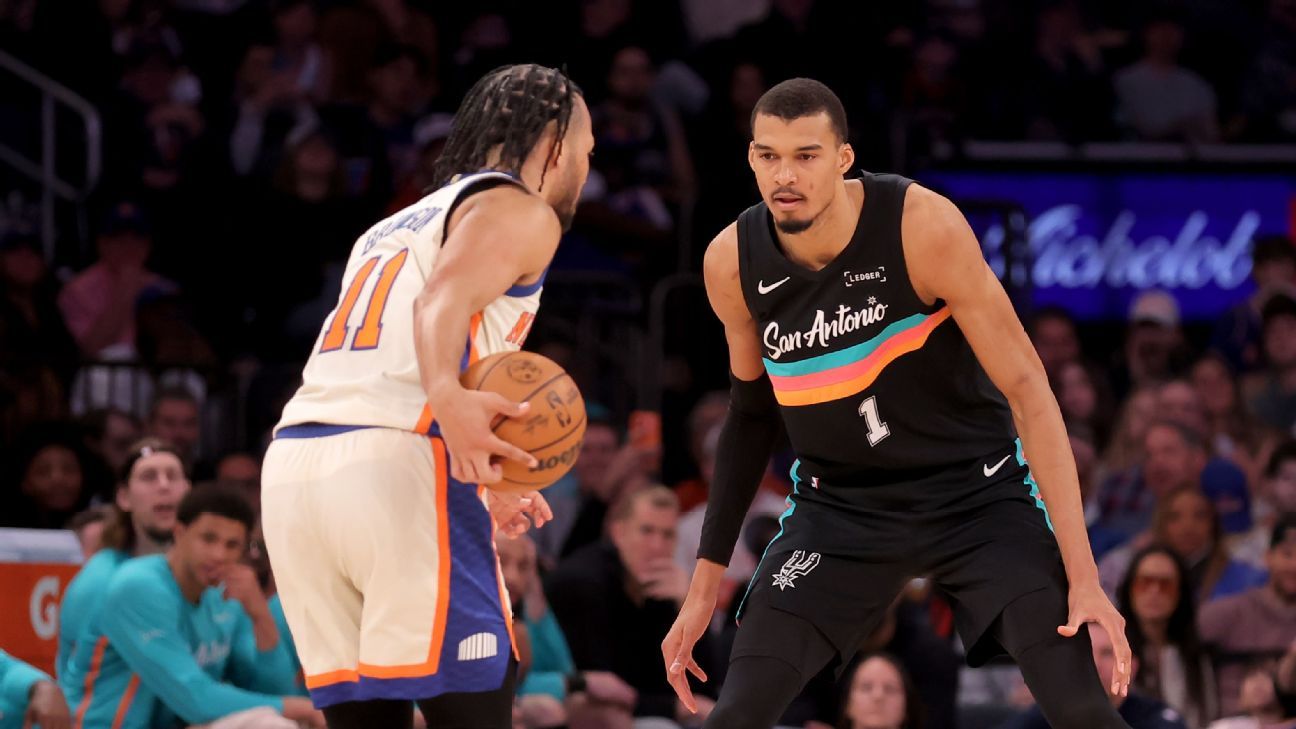
The Knicks and Spurs tip off the 2026 NBA Finals Wednesday night in a structural mirror of their 1999 matchup: San Antonio is building a dynasty around a 22-year-old generational talent in the frontcourt, while New York chases its first title since 1973. But the parallels end there. The 1999 Finals averaged 85 points per team and featured a combined 6.4 three-pointers per game. This spring, the Knicks alone have eclipsed 80 points in the first half of two playoff contests. Julian Champagnie made more threes in a single Game 7 than both teams combined in the entire '99 series. The league has fundamentally transformed, and these Finals will expose whether that transformation favors San Antonio's vertically dominant structure or New York's perimeter-first tempo.
Wembanyama's profile is the centerpiece of this collision. At seven feet four inches with a 7'9" wingspan, lateral mobility, and shot-blocking instincts that register at elite volume across switching scenarios, he exists as a defensive variable the league didn't have in 1999. The Knicks' solution—slowing him on both ends—is not a stylistic choice but a mathematical necessity. New York's offense runs through Jalen Brunson's pick-and-roll operations, which generate 1.18 points per possession when he gets switches onto smaller defenders. Against drop coverage, that number craters to 0.94 ppp. Wembanyama doesn't drop—he hedges vertically, compressing the floor on three-point shooters while maintaining the ability to recover and contest at the rim in a single vertical line. That forces Brunson into secondary actions: either re-screening or attacking a five-out alignment where Spurs shooters are spaced to the perimeter.
The Knicks' counterargument rests on Brunson's historical defiance of guard-centric ceiling effects. A player listed at six feet two inches operating in the NBA Finals against an elite switching defense is supposed to see his assist rate crater, his turnover rate spike, and his shot efficiency decline under pressure. Brunson's season numbers—7.4 assists per game, 13.2% true turnover rate, 60.1% true shooting—don't suggest a player whose production dissolves in high-leverage moments. Against Oklahoma City's switching scheme in the Eastern Conference Finals, he averaged 8.6 assists per game, suggesting that speed and decision-making can outpace size when the floor is calibrated correctly. The Knicks have constructed their entire offensive architecture to enable this thesis. If Brunson sustains 8-plus assists while holding his turnover rate below 12%, the Knicks' half-court spacing wins the possession battle. If he regresses to 6.5 assists with turnovers climbing above 14%, San Antonio's rim protection and perimeter shooters create a long-range two-on-one advantage on every possession.
For prop wagerers, this creates a durable edge in Brunson's assist line and a corresponding fade on Wembanyama's total rebounds. Brunson's assists have traded within a 7.5–8.5 range throughout the playoffs; the market will likely open his Finals line at 7.5 or 8.0. The mechanism that drives his higher volume—the Knicks' inability to generate easy mid-range buckets against drop coverage, forcing re-screens and secondary actions—persists regardless of game score. Wembanyama's rebound line will trade higher than his season 9.2 per game, likely opening at 10.5 or 11.0, because narrative inflation around his two-way impact inflates the market's expectation. However, his actual rebound volume depends on offensive rebounding opportunities and box-out assignment, neither of which has dramatically improved in the Finals matchup. Take the over on Brunson assists at 7.5 or 8.0 if you can find it early; fade the over on Wembanyama rebounds at 10.5 or above, as the edge erodes if the market correctly calibrates his defensive rebounding to season rates.
Both teams rank first and second in playoff net rating, which explains why the Finals arrived despite the league's parity. But Finals are decided by matchup specificity, not overall quality. The Knicks' guard-first motion offense and New York's ability to generate offensive rebounds through secondary actions (both Brunson strengths) will test whether Wembanyama's defensive profile can compress the floor tightly enough to prevent Brunson from reaching 8 assists per game. That is the question these Finals will answer, and the prop markets will price it as noise.