NBA · transaction
Nurkic's Jazz Return Stabilizes Utah's Center Position and Tilts Team Scoring Distribution
Nurkic's two-year, $22 million deal with Utah locks in a high-usage passing big who averaged near triple-double rates—a structural shift that will compress backcourt scoring props and inflate frontcourt assist floors.
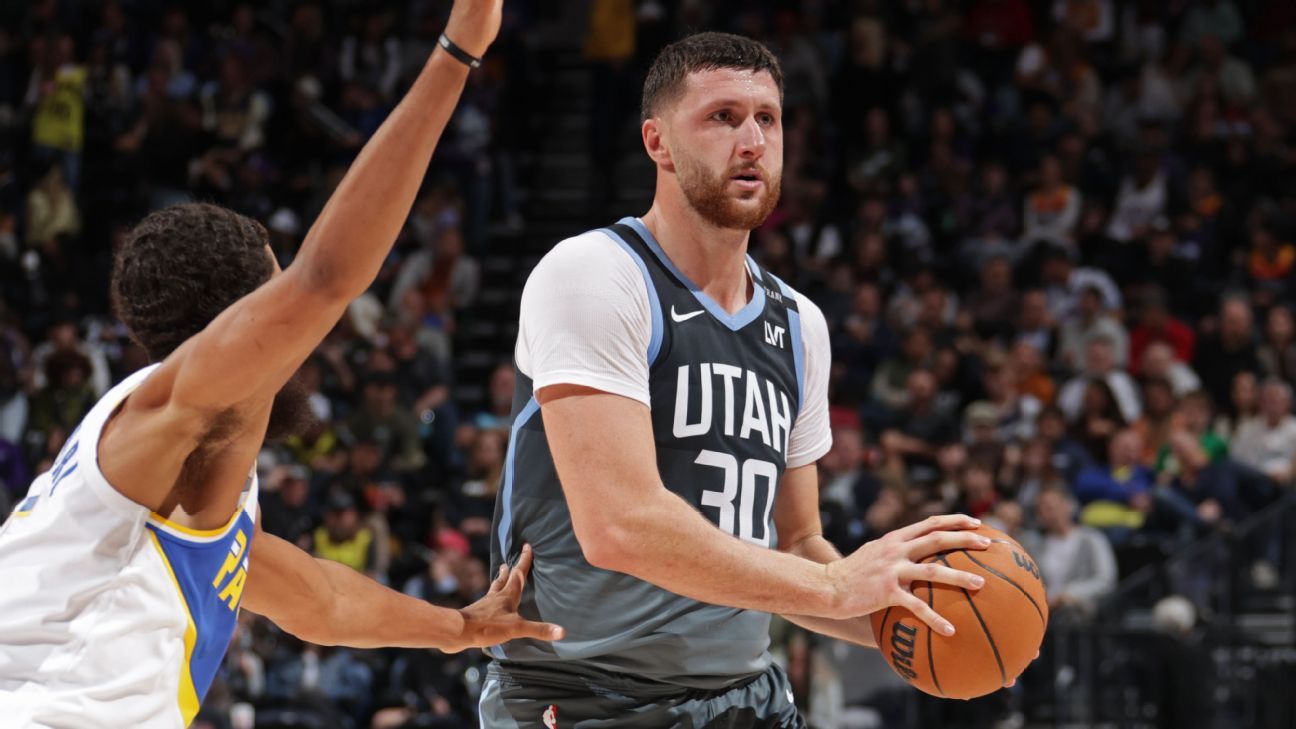
Jusuf Nurkic and the Utah Jazz agreed to terms on a two-year, $22 million contract Monday, reuniting the 12-year veteran with coach Will Hardy's system after a career-reviving 2024-25 season. Nurkic stepped into the starting center role when Walker Kessler went down to injury and emerged as one of the league's most versatile big-man scorers, averaging 10.9 points, 10.4 rebounds, and 4.8 assists across a minimum 20-game sample. That statistical footprint—positioned alongside Jokic and Jalen Johnson as the only three players to hit that threshold last season—signals a player who operates differently than traditional rim-runners or isolation centers.
Nurkic's value to Utah hinges on his willingness to function as a secondary playmaker and pick-and-roll fulcrum rather than a volume scorer. His assist average of 4.8 per game sits well above league-average for centers (3.1) and represents a structural choice by Hardy's offense: use the big to execute entry passes and short-roll decisions, not to hunt post-ups. This role aligns cleanly with Utah's perimeter-heavy roster construction. When Kessler returns from injury—expected sometime in the 2026-27 season—Utah will have a choice between two distinct center archetypes: Kessler's defensive rim-anchoring profile versus Nurkic's playmaking and secondary scoring.
For prop bettors, Nurkic's role stability matters more than his raw volume. His 4.8 assist floor is durable because it flows from offensive design, not from usage swings or hot shooting. Teams that generate 4+ assists per night from their center typically see that number hold within a 0.5-assist band across 10+ games, provided personnel around him stay healthy. Conversely, his 10.9 PPG sits in a narrower volatility window—centers who score between 9 and 12 per game in specific systems tend to spike toward 13-14 when defenses load on perimeter threats, then drop to 8-9 when spacing tightens. Utah's acquisition of Nurkic signals they view him as durable insurance and a long-term complement to Kessler, not a stop-gap. That contract size ($11 million per year) places him in the mid-tier backup-center pay band, reflecting his actual role: reliable depth with playmaking chops, not a max-salary caliber starter.
The Jazz's willingness to commit two years and $22 million immediately after a solid half-season suggests internal confidence in Nurkic's sustainability in Hardy's system. Klutch Sports and the Jazz negotiated the deal in a single business day, indicating no competitive bidding—a sign that other teams either had lower interest or that Nurkic prioritized fit over maximum salary. His past tenure in Portland with Lillard and McCollum is relevant: he thrived in that corner-three-heavy spacing, which Utah's current roster also emphasizes. Bettors should expect his assists line (currently likely in the 4.0-4.5 range for full-season props) to remain sticky above 4.0 throughout the 2026-27 campaign, assuming continued health and Hardy's play-calling consistency. Points props at 10.5 or higher carry more variance and warrant caution; lean toward overs in games where Utah's perimeter shot-makers face explicit defensive pressure, as that creates more short-roll dump-offs and secondary scoring for Nurkic.