Lakers' Kessler Gamble Hinges on Health and Fit in a Crowded West
By Ty Whitney ·
Los Angeles doubled down on defense by trading for Walker Kessler, but availability and role overlap with DeAndre Ayton create durability questions that will determine whether the move actually shores up a mid-tier roster.
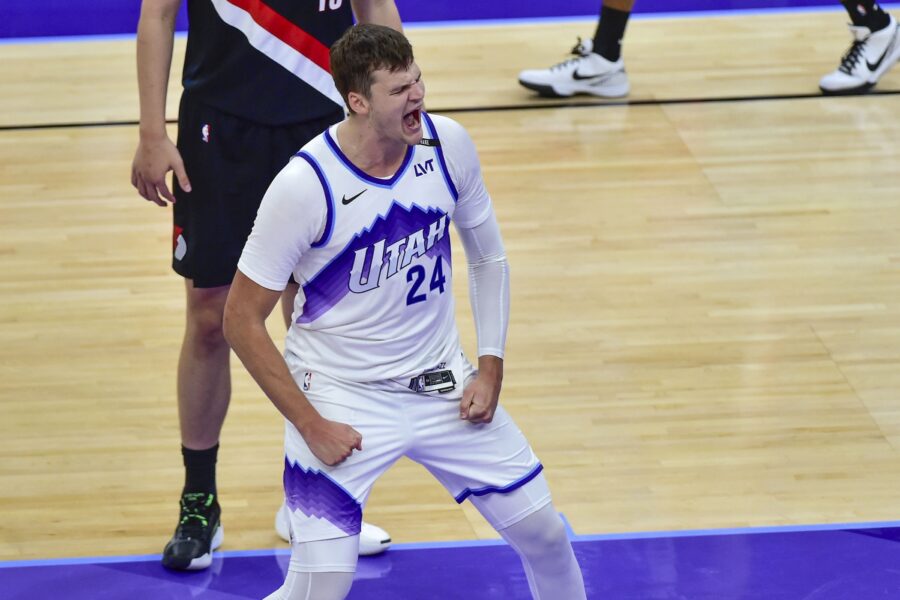
The Lakers executed a sign-and-trade with Utah to acquire restricted free agent center Walker Kessler, channeling resources into defensive infrastructure alongside their offensive-first backcourt of Luka Doncic and Austin Reaves. On paper, it's a reasonable strategic pivot—a big who can anchor a pick-and-roll defense, protect the rim, and operate in space on the other end. The problem is execution risk, both literal and architectural.
Kessler's value proposition is built almost entirely on defensive versatility and shot-blocking. He's elite in drop coverage, can recover on perimeter actions, and doesn't foul excessively for a rim protector. But that profile only matters if he stays on the floor. The Lakers have wrestled with center availability for years—Anthony Davis has missed time regularly, and any new addition in that position operates under the assumption that their star frontcourt player will eat into minutes. Add in the acquisition of DeAndre Ayton, who the Lakers also brought into the fold in the same window, and you're looking at potential role compression that could limit Kessler's upside and justify his inclusion in a swap rather than a straight acquisition.
The cap implications of both moves matter too. Ayton carries a larger salary than a typical third-option center, and if the team expects to compete immediately, the bench depth behind Doncic-Reaves-Davis-Kessler-Ayton becomes historically thin. The Jazz got value out of this deal by shedding Kessler's contract and receiving asset return; the Lakers are betting that Kessler's elite-level rim protection—his 4.1 blocks per 36 minutes last season placed him in the 92nd percentile league-wide—justifies the investment even if he plays 25-28 minutes per night instead of 32.
For prop purposes, Kessler's impact props should be discount-priced early if the market doesn't fully factor in that minute reduction and the uncertainty around Davis's durability. His rebounds and blocks rates are elite per-possession, but per-game volume is intrinsically tied to games played and minutes available. If Kessler opens the season with block totals or rebound floors that assume 32 minutes and full health from the entire frontcourt, sharps should target unders early. The injury history across this team's center rotation is well-documented; the Lakers' trade pattern suggests they know something about availability constraints. Monitor the roster's opening-week health reports closely. Any sign that Davis is dealing with the usual aches-and-pains issues could actually elevate Kessler's per-game production lines, making overs suddenly live again.
The broader contention question is harder to solve. Doncic and Reaves give the Lakers two reliable creation sources, but without a third star-level contributor or a deep rotation, mid-tier performance feels like the ceiling, not the floor. Kessler is the right type of player to pair with that backcourt, but one defensive acquisition doesn't fix structural roster imbalance. Watch how the team uses training camp and preseason to structure offensive flow. If Kessler becomes a frequent screener and pop option, his scoring volume could surprise to the upside; if he's pigeonholed into drop coverage and corner spacing, his per-game scoring will stay depressed and his overall value becomes entirely dependent on blocks and boards.