NBA · transaction
76ers Futures Surge on Brown Trade While Celtics Market Pricing Reflects Path Uncertainty
Philadelphia's acquisition of Jaylen Brown has already shortened its championship odds by 60% in two hours, but the trade's depth—and the Celtics' pivot to an aging All-Star—creates asymmetric risk in East and division futures that the public hasn't fully priced.
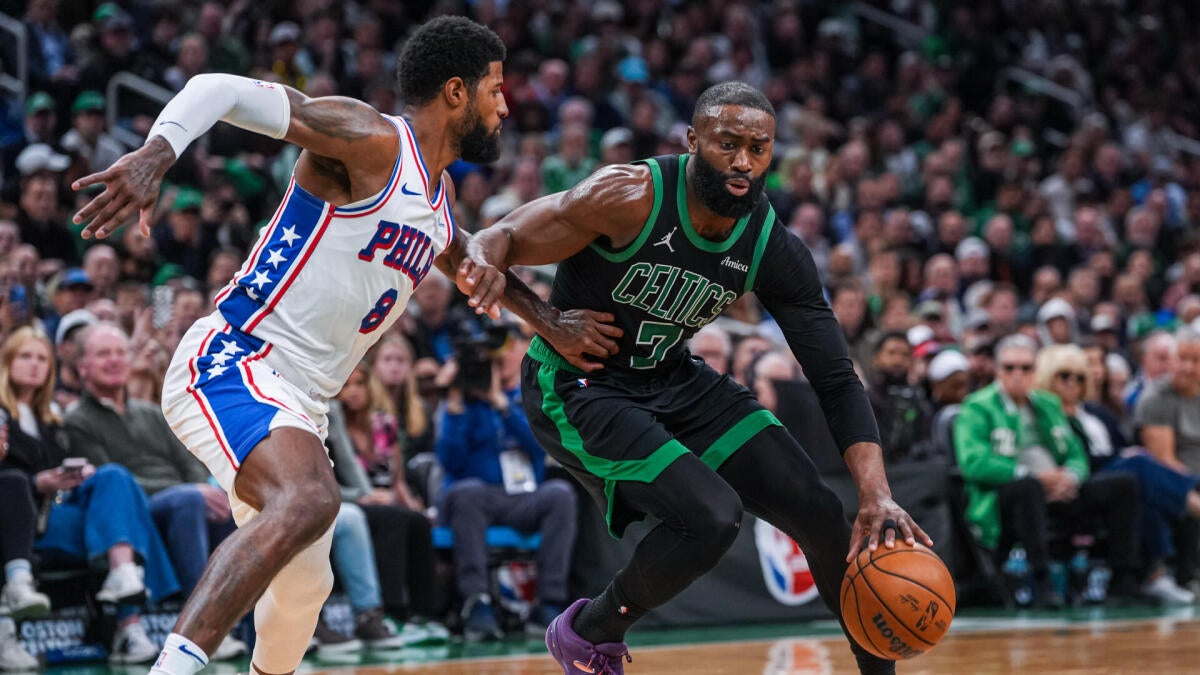
The 76ers' futures market reaction was immediate and substantial. Within hours of ESPN reporting the blockbuster swap on Wednesday afternoon, Philadelphia moved from +5500 to +2200 to win the 2026-27 NBA title—a 60% compression in implied probability. The team now sits fourth on the board behind only San Antonio, Oklahoma City, and Boston, with Eastern Conference odds plummeting from +1900 to +800 and Atlantic Division odds from +1800 to +500. Money is real; it doesn't move that fast without conviction.
The infrastructure underpinning that conviction is legitimate. The 76ers' roster suddenly features three players who averaged 26+ points per game last season: Jaylen Brown (28.7), Tyrese Maxey (28.3), and Joel Embiid (26.9). Brown, the 2024 Finals MVP, immediately becomes the third-best perimeter defender in the East when healthy and fills a wing creation gap that plagued Philadelphia's half-court offense. Edgecombe's rookie season (16.0 PPG, 5.6 RPG, 4.2 APG at age 20) suggests a scalable complement to Maxey's ballhandling. On paper, this is a three-star nucleus that generates legitimate championship equity.
But market sentiment has already run ahead of execution risk. Embiid remains the linchpin, and his durability record is disqualifying for a team with Finals ambitions: he hasn't exceeded 39 games played in each of the last three seasons. A 36-year-old Paul George—the asset Boston received in return—carries injury risk and declining impact metrics; aging wings don't magically maintain ceiling production. Boston's decision to pair George with newly signed Mitchell Robinson signals a roster built on the theory that perimeter shooting + rim protection can overcome losing the league's fourth-leading scorer in his prime. That's a credible architecture, but it's a steeper climb than the Celtics' position as defending title favorites.
The public has already priced the 76ers' upside but underweighted the sustainability question around Embiid and the Celtics' ability to absorb Brown's departure. Eastern Conference futures at +800 (76ers) and +425 (Celtics) reflect a market that believes Philadelphia's ceiling is real and Boston's floor is still solid—reasonable takes, but ones that assume Embiid plays 60+ games and George's two-way value holds. A more skeptical read: the Celtics' offense loses its premier wing scorer and gains a streaky, injury-prone high-usage player. That carries continuation risk into the regular season.
For futures bettors, the edge lies in the divergence between how the public has repriced Philadelphia's championship value (+2200 is no longer a heavy underdog) versus the operational fragility underneath. The 76ers' implied win probability at +2200 sits around 4.3%; their three-star ceiling justifies that, but only if Embiid stays on the court. Conversely, the Celtics at +1100 (8.3% implied) may have compressed too far; a 16-game regular season sample will quickly reveal whether George can function as a starter or whether Boston's defense holds without Brown's versatility. The Atlantic Division favors Philadelphia, but it's a year-long health report masked in single-digit odds movements.