Brown to Philadelphia, George to Boston: The East's Power Realignment Reshuffles Scoring Hierarchies
By PropBetEdge Editorial Team ·
A swap of All-NBA wings reshapes two contenders and inverts their offensive pecking orders mid-window.
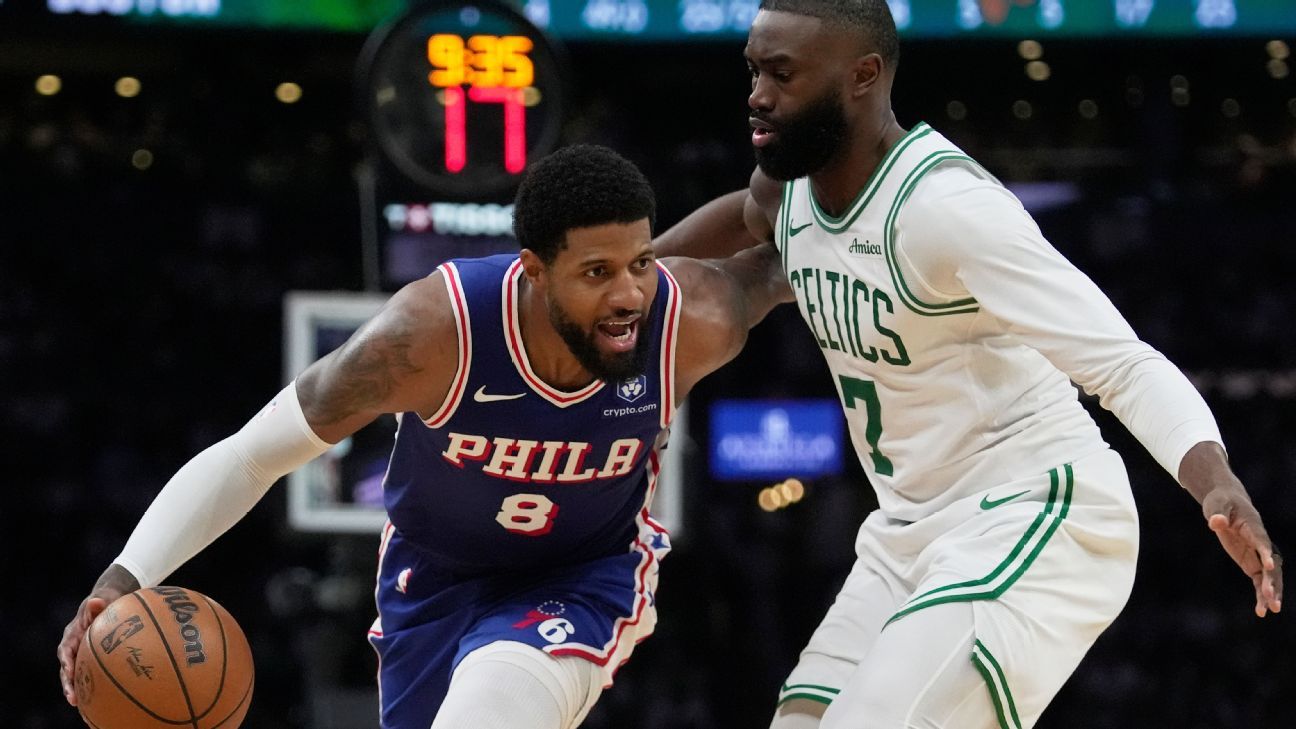
The Boston Celtics traded Jaylen Brown to the Philadelphia 76ers on Wednesday in exchange for Paul George, two first-round picks and two second-round selections. The deal unwinds the partnership that produced Boston's 18th championship last year and immediately redistributes two of the East's most productive two-way wings to different rosters.
Brown leaves Boston as a 28.7 PPG, 6.9 RPG, 5.1 APG player who finished sixth in MVP voting and landed second-team All-NBA honors last season. He departs after 142 playoff appearances—more than any peer since 2016—and a decade-long pairing with Jayson Tatum that became the foundation of the Celtics' contention cycle. The 29-year-old now enters a Philadelphia offense already centered on Joel Embiid and Tyrese Maxey, the latter a 25.9 PPG scorer who emerged as a co-star during the season.
Paul George, the other wing in this exchange, moves to Boston after a Clippers tenure marked by availability concerns. At 34, George brings championship experience and two-way credibility, though his scoring load (15.2 PPG last season, down from his career 21.1 average) reflects both age and the presence of Kawhi Leonard and James Harden in LA's backcourt. The Celtics essentially trade a 28-point scorer at his peak for a 15-point contributor entering his mid-30s, plus future assets, a transaction that signals Boston's confidence in Tatum's ability to sustain the offense without Brown's creation volume.
For betting purposes, Brown's introduction to Philadelphia's Embiid-Maxey trio introduces a role compression puzzle. Brown's 5.1 assists per game served as a secondary creation channel in Boston; Maxey already operates as Embiid's primary off-ball scoring target. In the playoffs, when the 76ers faced Boston this past spring, their half-court offense relied on Embiid's post gravity and Maxey's three-point range. Brown's midrange and transition scoring will add dimensionality, but his touch-rate will shrink. His points projection likely falls to the 24-26 range depending on role definition. George's Boston insertion, conversely, could depress Tatum's assists (as George's arrival means one fewer player feeding into rim-attack lanes) while stabilizing total offensive rating. Expect Tatum's scoring to remain high but his playmaking volume to tick down by 1-1.5 assists per game, a subtle shift that makes unders on Tatum 8.5 assists viable if George handles more isolation creation.
The trade's broader 2026-27 implications hinge on role clarity. If Philadelphia constrains Brown to a high-volume scorer role with reduced pick-and-roll burden, his efficiency could spike (he shot 47% FG, 37% three-point in 2025-26). If Boston uses George as a secondary creator in late-game settings, Tatum's assist ceiling rises even as his scoring stability may improve through spacing gains. Neither dynamic fully resolves until preseason rotations solidify, making early-season props on both wings volatile. The adjustments compound in October.