NBA · transaction
Robinson's Retention Signals Knicks' Confidence in Interior D—and Offensive Tolerance
Mitchell Robinson's openness to re-signing suggests New York is willing to live with his free-throw drag if it means anchoring perimeter defense and rim protection.
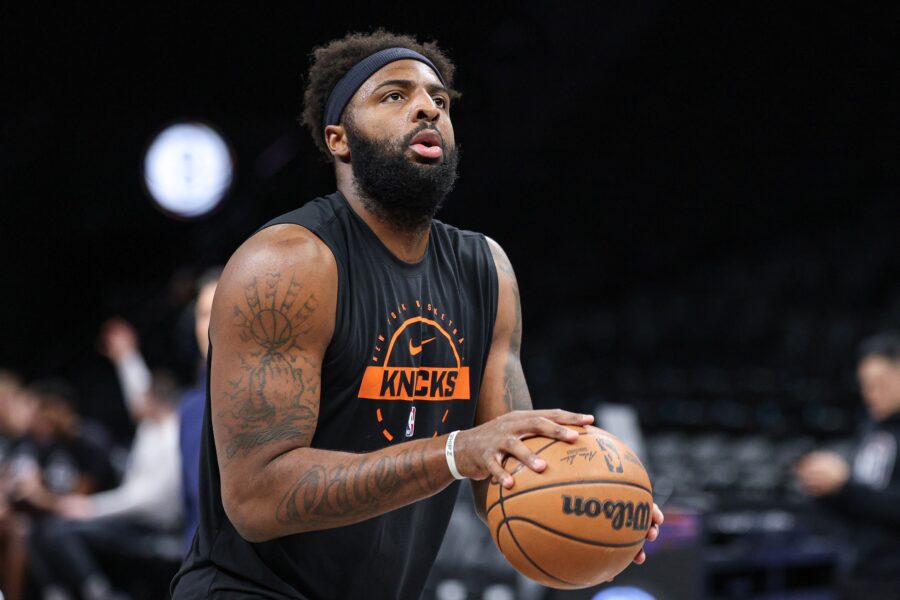
Mitchell Robinson is signaling willingness to remain with the Knicks, according to league sources cited by Jake Fischer. The timing matters: Robinson hits free agency at a moment when New York's front office must decide whether a defensive anchor with chronic offensive limitations fits a roster built around perimeter creation. His openness simplifies the decision—if the Knicks want him back, the negotiation becomes straightforward rather than a competitive auction.
Robinson's value proposition hinges on a narrow calculus. His interior defense and rim protection create ceiling effects on opponent efficiency in the paint. But his free-throw shooting (career 58.3%) and offensive limitations force the Knicks to accept possessions where he becomes a passenger: contested looks, drive-and-kick sequences, or offensive boards turned over before conversion. The offensive drag is real and measurable—his on-court offensive rating typically sits 3-5 points below the team's baseline—yet New York has tolerated it because the defensive work product justifies the tradeoff in a playoff rotation where switching, drop coverage, and perimeter containment demand interior discipline.
Retention also reflects resource allocation. Keeping Robinson at a market rate cheaper than chasing a higher-volume scoring center frees capital for guard depth or wing creation—areas where the Knicks have identified gaps. Robert Williams III's parallel openness to Portland signals the same dynamic: teams value proven rim runners and defenders over offensive volume in an era where perimeter skill drives modern spacing. Robinson's health profile—recurring ankle and foot issues—introduces durability risk, but at a re-sign price point, the Knicks are betting that incremental availability over a full season outweighs the cost of replacing him mid-roster.
For prop bettors, Robinson's retention changes the offensive architecture. If he remains a starter or heavy reserve, his point total becomes a volatility play: games where the Knicks hunt him on offensive boards or face smaller centers (forcing him into pick-and-pop situations) see minor upside, while matchups against shot-blocking bigs compress his scoring opportunities further. His season-long points prop should reflect his offensive baseline (8–10 PPG range depending on minutes) with narrow variance bands—the market will price his limited upside accurately, but may overweight blowout games where garbage time inflates his totals. Early-season Robinson point props at 9.5 or higher represent overs to fade; sub-9 unders carry durability risk given his injury history. The real edge lies in fade-heavy strategy: avoid over-betting his scoring contributions in a lineup where defense, not volume, is his primary function.