Drummond's Fit Tightens Knicks' Rotation—But Role Ambiguity Clouds Prop Value
By PropBetEdge Editorial Team ·
The defending champs add a veteran rim-runner, yet the redundancy with Robinson's absence and Towns' expanded role creates spacing risk that prop markets haven't fully repriced.
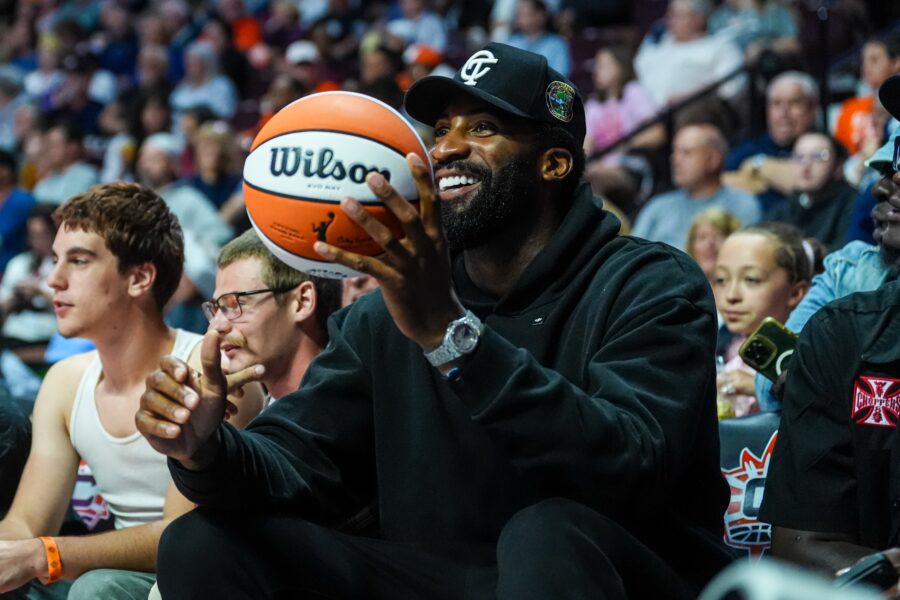
Andre Drummond is joining the Knicks on a veteran deal, the New York native confirming his arrival in his first public remarks since agreeing to sign. Drummond's message was pointed: he positions himself as a replacement for Mitchell Robinson's interior presence, emphasizing veteran experience and familiarity with winning systems. That framing matters less for sentiment and more for what it signals about Knicks roster construction—and what it doesn't.
Robinson's absence created a vacuum the Knicks must fill, but Drummond's arrival doesn't solve it cleanly. Drummond is a rim-runner and putback specialist; Robinson was a drop-coverage anchor and lob target. The skill sets overlap on paper but diverge in execution. More pressing: Karl-Anthony Towns, the Knicks' All-NBA forward, has spent the offseason as a theoretical extension candidate, with team brass quietly preparing for the possibility he walks in 2027 free agency. If Towns stays, the Knicks have two bigs competing for spacing—Drummond's gravity in the pick-and-roll is minimal compared to a stretch five. If Towns leaves, the Knicks would've wasted offseason capital on a veteran center with declining usage in modern spacing systems.
The front office is also navigating cap constraints severe enough to make Pacome Dadiet trade-bait and to temper extension talks with Miles McBride, the ball-handling wing whose market value (if he hits free agency in 2027) will exceed what the Knicks can offer. This isn't roster-building by design; it's triage. Mohamed Diawara, the 2025 second-round prospect, is the real offseason intrigue for summer league projectors, but his four-year deal at $10MM+ is a bet on a kid, not a contention edge.
For prop players, Drummond's role remains murky. His rebounds should tick up in a Knicks uniform, but his minute allocation depends entirely on how Towns is deployed and whether Drummond's defensive shortcomings (he's a foul magnet against mobile bigs) create bench time. In a championship team with a tight playoff rotation, backup center minutes are volatile. Drummond's rebound totals will swing 8-12 PPG based on matchup, and early-season lines will overcorrect to his veteran status. The play isn't "Drummond rebounds over"—it's waiting two weeks for actual minutes data before trusting any Drummond prop slate against a team running Towns as a de facto center.
Ownership transitions rarely affect on-court play, but James Dolan's step back from the Rangers and his son Quentin's assumption of day-to-day Rangers operations is worth noting for one reason: continuity. The Knicks' front office remains untouched. This reduces the noise around management philosophy but also signals the Knicks aren't making splashy moves. Drummond is a filler signing, not a trade deadline reboot. For bettors, that means the Knicks' offensive efficiency—built on Brunson-Towns pick-and-roll and Hart's perimeter gravity—won't radically shift. Team total overs at 115+ remain fairly priced; the risk isn't Drummond's arrival degrading spacing, it's the Knicks' existing cap crunch preventing them from adding a true third star before the trade deadline.