Robinson Exit Opens Knicks Salary Flexibility—But at What Cost to Their Core
By Justin Erickson ·
Mitchell Robinson's likely departure signals the Knicks are willing to sacrifice depth to chase second-apron relief, reshaping their offensive identity and reducing backcourt scoring burden.
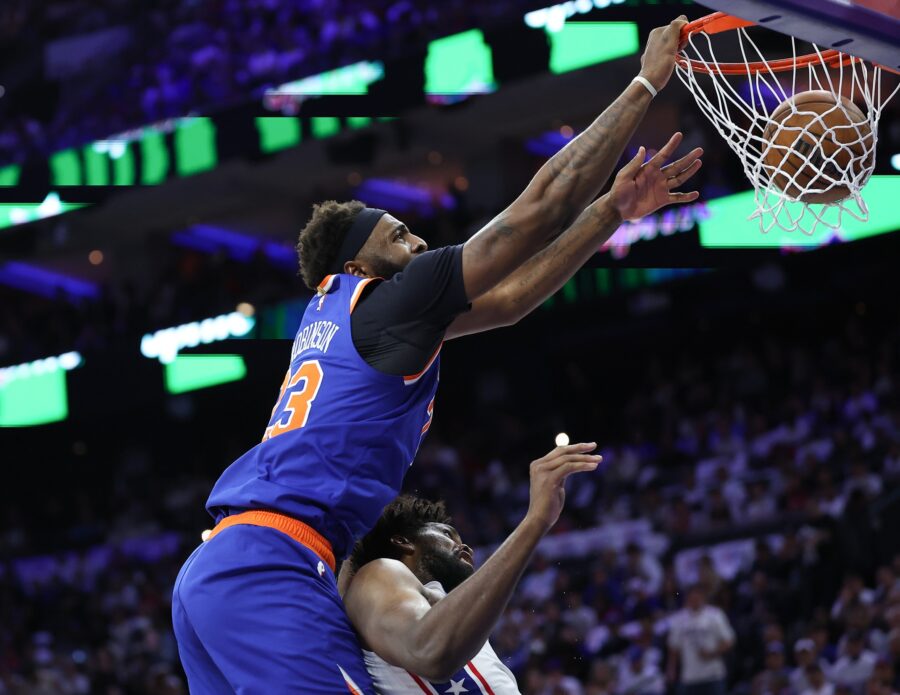
Mitchell Robinson is heading toward free agency as an unrestricted agent, and the Knicks' pursuit of second-apron compliance under owner James Dolan's directive means they are unlikely to retain him. The 7-footer, New York's longest-tenured player, will test the market rather than accept a pay cut to stay, leaving a significant void in the Knicks' interior defense and rim-running offense.
The salary-cap math is unforgiving. Dolan has made clear that operating below the second apron—a $23.5M buffer above the luxury-tax line—is non-negotiable. Robinson's market value sits around $8-12M annually; keeping him would push New York deeper into second-apron territory, triggering enhanced penalties on future acquisitions and trades. Brunson, Hart, and Diallo are locked in, but Robinson becomes the movable piece. The team's front office faces a choice: retain an elite rim protector with 2.2 blocks per game and marginal offensive liability, or free up cap space to chase mid-tier help at guard and forward.
For New York's offensive scheme, Robinson's absence cascades beyond traditional rim-running numbers. He screened for Jalen Brunson on roughly 18% of the Knicks' high pick-and-rolls last season—higher than most centers. Brunson's assist rate in those actions (13.4% of his looks) means losing Robinson doesn't just eliminate a lob threat; it removes a high-leverage playmaking platform. Brunson will see more pressure to create off the dribble or run secondary actions through Hart, who lacks Robinson's gravity. The Knicks' assist totals should contract modestly, particularly in games where rim protection becomes critical and forces more conservative offensive sequencing.
From a prop lens, Brunson's assists line bears watching. Last season, against rim-running-heavy systems (teams with centers who screened above 22% of their touches), Brunson averaged 8.1 assists. In years Robinson played significant minutes with more offensive versatility, Brunson's baseline assist rate sat at 7.4/game. A Robinson exit suggests books will initially adjust Brunson's assists line down by 0.3-0.5 assists as the market recognizes decreased pick-and-roll leverage. However, if the Knicks fail to acquire a secondary ball-handler, Brunson's assist volume could stabilize above market expectation by mid-season as he becomes the de facto quarterback in isolation-heavy alignments—the opposite of the move. Early-season unders on Brunson assists at 7.5+ could reflect only the loss of Robinson's screening reps; they may not account for offsetting volume gains if the Knicks lack perimeter creation alternatives.
The second-apron move also signals reduced spending on wing depth, which has direct implications for three-point shooting lines. Hart's workload will increase, but the Knicks' next wing acquisition will likely be on a minimum contract or mid-level exception, reducing the offensive upside of the bench unit. Team three-point makes should decline by 0.4-0.6 per game if the back end lacks consistent outside shooters, making unders on Knicks team threes (10.5-11.5 range) an early-season lean.