NBA
Brunson's Read on the Knicks' Balance: A Blueprint for Sustained Scoring
The Knicks' 3-0 Eastern Conference Finals lead isn't built on heroics—it's a function of distributed offensive load that rewrites the assist and efficiency calculus for the entire rotation.
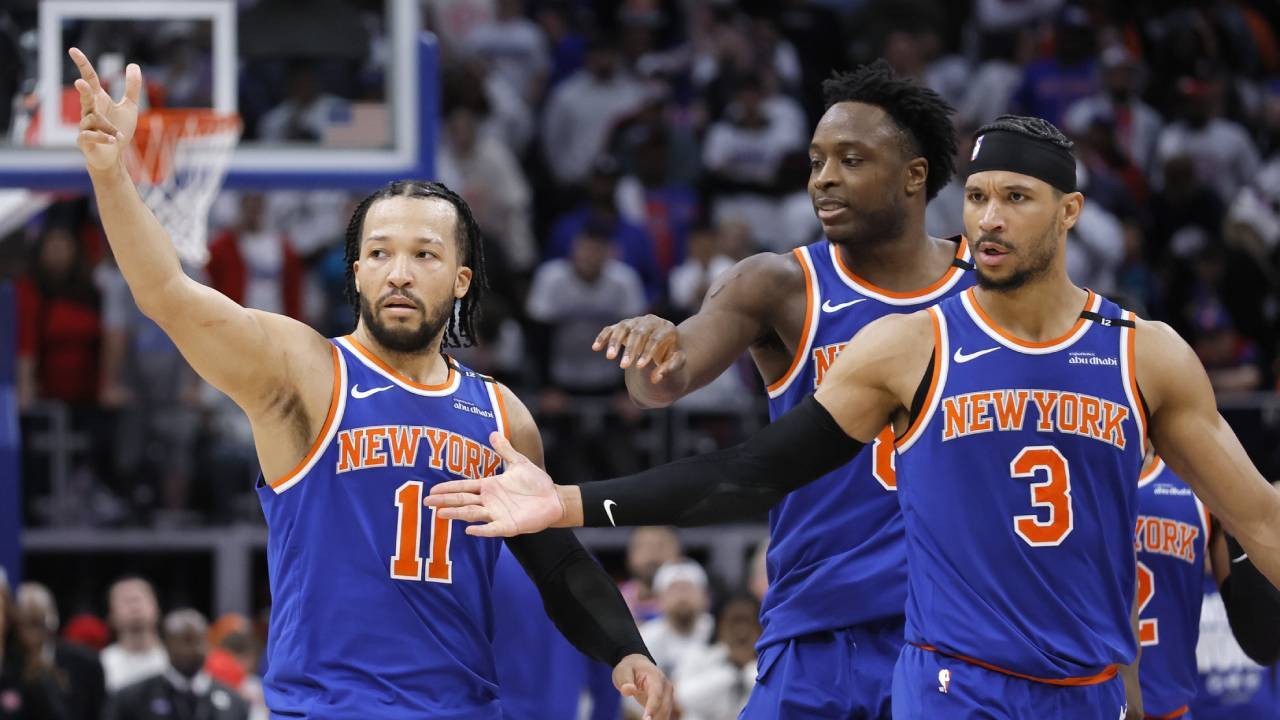
The Knicks dispatched the Cavaliers 121-108 in Game 3 to seize a 3-0 Eastern Conference Finals lead, and Jalen Brunson's postgame framing of the victory centered on a single organizing principle: the team moved the ball with intentional restraint, each player taking what the defense gave rather than forcing isolation looks. This isn't motivational rhetoric—it's a measurable operational shift that fundamentally changes how to model individual scoring and assist prop lines.
Brunson explicitly credited OG Anunoby's two-way discipline as the template: Anunoby doesn't create his own shot volume, but he converts at elite efficiency because the offense funnels him open looks in rhythm. When a starting lineup operates under that constraint, ball movement velocity increases, defensive rotations compress faster, and secondary scoring becomes less dependent on individual creation and more dependent on spacing and opportunity flow. The Knicks have essentially weaponized unselfishness as a defensive countermeasure—fewer isolation plays mean fewer opportunities for Cleveland's defense to load onto a single creator.
This operational choice has direct implications for assist volatility. Brunson's assist line will compress around a narrower band because the offense prioritizes skip passes and weak-side action over pick-and-roll dominance. In Game 3, that meant a lower raw assist total but higher efficiency on his own shot attempts because secondary creators (Julius Randle, Anunoby, Mikal Bridges) got cleaner looks rather than relying on Brunson to manufacture offense in tight spaces. The market will likely price Brunson's assists assuming historical averaging, but the structural shift toward distributed shot-taking means his unders carry an edge that persists across the remainder of the series.
Anunoby's role amplifies this effect. As a non-creator thrust into a high-usage environment, his scoring floor is defined by corner threes and transition buckets—high-variance events but ones that don't require playmaking overhead. His steals-plus-blocks line benefits from the team's defensive intensity when it's not hunting isolation matchups, and his total rebounds stabilize because the Knicks aren't forcing pace to generate second-chance opportunities. This is not a player likely to explode for 25 points; it's a player whose 12-15 point range carries much higher probability than public perception would suggest, because the offense is architected to feed him volume in optimal spots.
For bettors, the takeaway is structural: avoid overs on Brunson's assists in subsequent games (look for 7.5 or higher and fade), and view Anunoby's scoring unders as undervalued when his line exceeds 13.5 points. The Knicks' stated philosophy of collective ball movement is not a temporary motivational framing—it's the offensive identity they've activated in the postseason, and it reshapes how to price individual shot volume across the rotation.