MLB · transaction
Harper's Outfield Gamble: Conditioning Crunch or Durability Red Flag
Bryce Harper's left knee soreness has resurfaced four weeks into his return to right field, forcing the Phillies into a cautious load-management calculus with the playoffs seven weeks away.
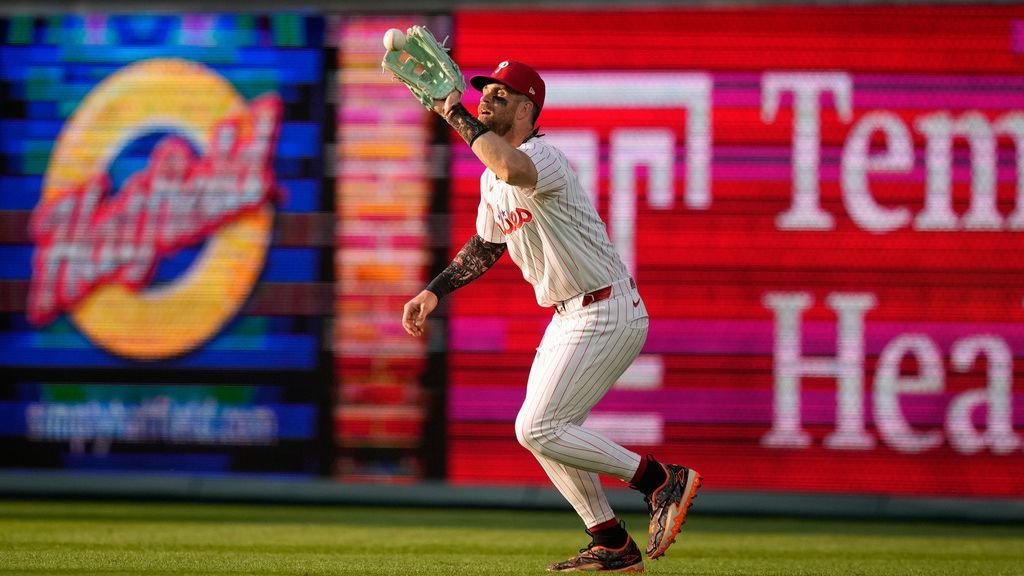
Bryce Harper initially tweaked his left knee during a July 11 game but the discomfort subsided after the All-Star break. That reprieve ended roughly one week ago when the Phillies pivoted him back to right field following the Luis Arraez trade deadline acquisition—his first sustained outfield assignment in four years. The pain, Harper acknowledged Tuesday, fires up during explosive directional cuts but remains quiet in the batter's box and on the basepaths.
The Phillies' response has been textbook caution-meets-pragmatism. Over the past four games, Harper has drawn the DH role three times. He returned to right field Tuesday against the Cardinals. Harper's own framing—"I feel like I'm in spring training again"—points to a deconditioning issue rather than structural damage. Four years as a first baseman and full-time DH means his lateral stabilizers and explosive-movement tolerance have atrophied. Every additional game in the outfield theoretically builds tolerance. But there's a window. Seven weeks remain until the postseason. A sharp club doesn't gamble its cleanup hitter's availability on a conditioning ramp that could derail in Week 3.
The underlying mechanics matter for prop construction. Harper's absence or reduced availability in right field (forcing him toward DH slots) shrinks his walk rate and steals his stolen-base exposure—he hasn't run much in four years, and DH slots kill that entirely. His batting average and HR power remain untouched by position; those don't swing with rest. But run-scoring opportunity and secondary-stat volume sink when a player spends half his games as a DH. The Phillies face a binary choice: use the next month to requalify Harper's outfield legs and risk a flare-up during the playoff push, or accept a DH-heavy role and concede some counting-stat ceiling.
Bettors should treat Harper props as position-dependent for the next 4–6 weeks. Any projection built on his historical full-game baseline will overshoot if he's slotted as DH. Conversely, if the soreness fades faster than expected—and Harper's own optimism suggests he believes it will—then full-game totals could catch value once the market reprices downward after extended rest stalls his PT. The smart move is to fade his team total and runs props until the Phillies either clear him fully or settle him into a routine (70% DH, 30% RF, for example). Single-game line fluctuation based on the day's lineup card will dominate signal. The durability question, not current performance, is the edge.
MLB Intelligence — Baseball intelligence beyond the box score. Open MLB Intelligence →