MLB · milestone
Left-Handed Bats Meet Vulnerable Right-Handed Starters: HR Props on Friday's Slate
Three matchups pit lefty power against pitchers bleeding home runs to same-side hitters—the mechanical edge sits in platoon splits and recent velocity drops.
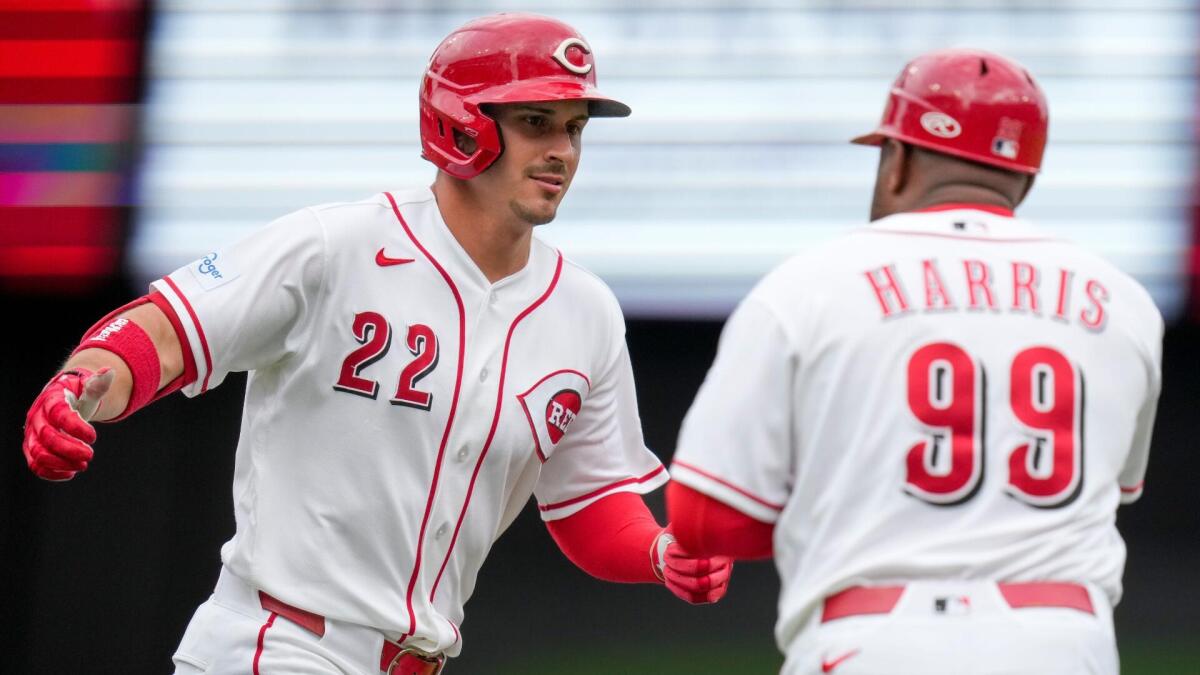
Friday's MLB slate opens with a trio of home run props built on a single structural advantage: left-handed bats facing right-handed starters who surrender home runs to that exact handedness at elevated rates. The matchups are Bleday (Reds) vs. Cardinals RHP Kyle Leahy, Massey (Royals) vs. Twins RHP Zebby Matthews, and Aranda (Rays) vs. Marlins RHP Ryan Gusto. Each presents the same profile: a hitter crushing RHP pitching paired with a starter bleeding HRs to lefties.
Bleday enters with a .279 average and 1.008 OPS against right-handed pitchers across 100 plate appearances, with seven of his nine homers coming off RHPs. Against Leahy specifically, the platoon math favors him: left-handed hitters carry a .977 OPS in 136 PAs against the Cardinals starter. Massey has hit .286 with a .848 OPS against RHPs this season, notching five of his six homers off that handedness. More immediate: he's 4-for-10 in homers over his last 10 road games and carried a .419 average into Friday. Matthews, his Friday opponent, has given up 12 of 17 homers to left-handed batters over the past year and allowed six homers across his last three starts while surrendering 17 earned runs in 14.2 innings—a velocity or command leak that persists. Aranda mirrors the profile: .276 with .903 OPS against RHPs, 10 of 11 homers off that handedness. Gusto has yielded 14 of 17 homers to left-handed hitters over the past year; lefties carry a .324 average and .966 OPS against him since last season.
The edge here lives in pitcher decomposition, not batter hot streaks. Matthews and Gusto aren't merely giving up homers—they're giving them up to a specific handedness at rates that diverge from their overall home run volume. When a starter allows 70% of his homers to one side, it signals a mechanical vulnerability (likely a fastball location, a repeating out-pitch miss, or deteriorated secondary stuff) rather than random variance. Massey's recent run (four HRs in 10 road games) matters less than the fact that Matthews has imploded in his last three outings; the recent performance compounds an existing split disadvantage. Bleday's 1.008 OPS against RHPs spans 100 PAs—large enough to treat as repeatable rather than noise.
The downside: home run props are volatile even with clean splits. A single strikeout, a well-placed sinker, or an off-day approach erases the edge. These are directional bets on a three-pitch window, not locks. The market has priced Bleday at +450, Massey at +670, and Aranda at +475—odds that reflect difficulty but not extreme juice. The value sits in the multi-game parlays (240-to-1 returns cited) where the correlation between matchups amplifies return, though correlation also amplifies risk if any leg misses. For single-leg bets, the mechanical advantage (platoon + pitcher recent decline) is real, but the conversion rate stays below 40% even with clean setups. This is a fade-unders/overs framework applied to home run props: the pitcher vulnerability is concrete, the batter advantage is repeatable, but execution remains in the hitter's hands.
Fetner's track record—up 50 units on HR picks last year, multiple hits already this week—suggests his selection process is filtering for matchups with measurable splits rather than chasing hot hands. That said, published picks fade quickly once the market sees them. These lines may have already baked in some wisdom, especially if the piece circulated to sportsbooks before Friday's first pitch. The strongest case is Massey, where the pitcher's recent collapse (six HRs in three starts, 17 ER in 14.2 IP) is the freshest data point and may not be fully priced into a +670 line if the bet shops are slow to adjust mid-week.
MLB Intelligence — Baseball intelligence beyond the box score. Open MLB Intelligence →