MLB · milestone
Brewers' 98-Win Franchise Record Masks a Grinding Reality: No Explosive Runs, but Still Elite
Milwaukee shattered its single-season wins mark without ever stringing together five consecutive victories—a contradiction that reshapes how you should view their postseason depth.
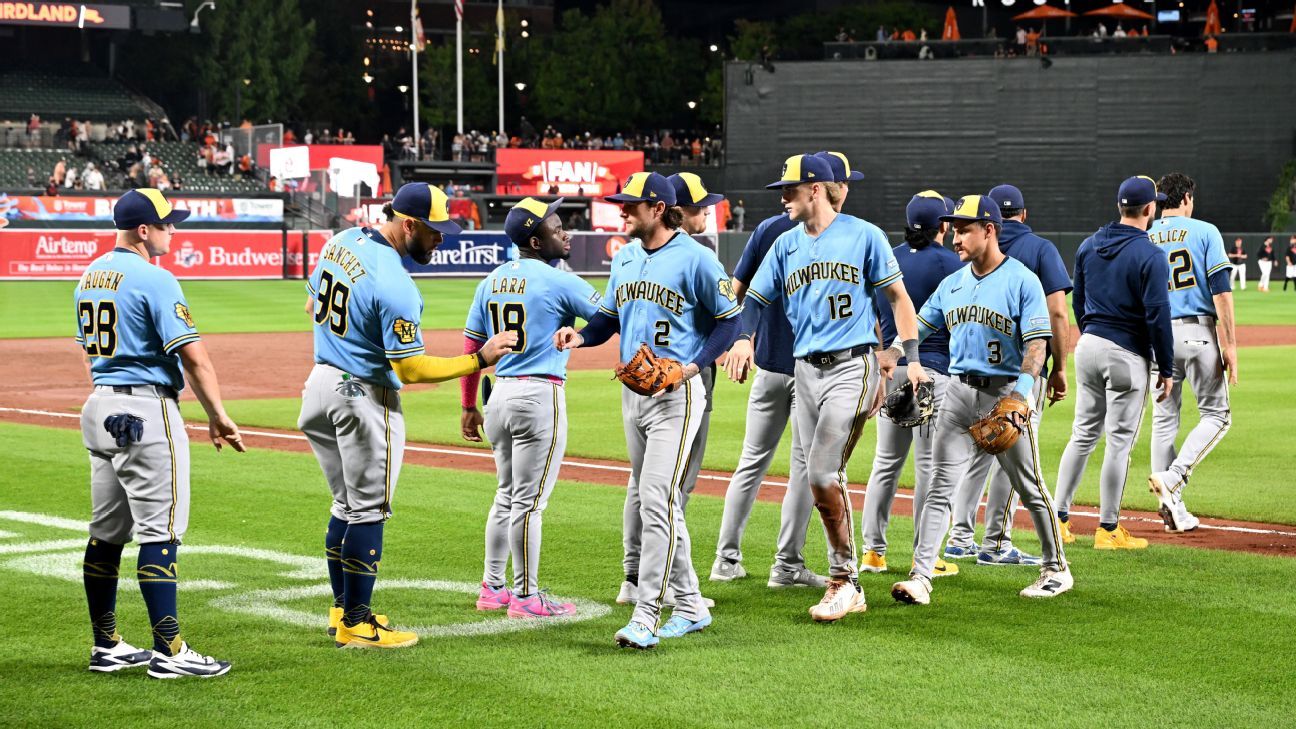
The Milwaukee Brewers set a franchise record for single-season wins on Sunday night, beating Baltimore 3-0 to reach 98 victories and break the mark they established last year. The achievement carries an unusual signature: manager Pat Murphy explicitly noted the team has not won more than five games in a row all season. That paradox—elite record-setting production without dominant stretches—tells you something crucial about how this roster manufactures wins and what to expect when October pressure amplifies.
Milwaukee's structural advantage centers on depth and consistency rather than star power or explosive offensive nights. The Brewers swept Baltimore with contributions scattered across their roster: four stolen bases, a diving catch from Garrett Mitchell, and a four-hit shutout pieced together by seven different pitchers. Jacob Misiorowski, their most dominant starter (15-5, 1.86 ERA), threw just three innings in a managed workload. This is a team designed to grind out advantages in marginal areas—base running, defense, bullpen management—and convert them into wins across 162 games. Murphy's own assessment validates that reading: "We're not the oldest team, we're not the most experienced, we're not the most talented." Translation: they're succeeding through system execution and plate discipline, not through unpredictable star performances.
The betting implication flows directly from that mechanism. With six games remaining, the Brewers sit two wins ahead of the Dodgers for the best NL record and are nearly certain to secure a bye into the division series. Their path to the World Series—stalled since 1982—now depends on postseason performance where those grinding, low-variance wins may face higher-leverage, higher-variance opponents. In the regular season, their consistency has flattened variance. In a best-of-five or best-of-seven series against the Mets, Padres, or Diamondbacks, the team's inability to generate explosive offensive runs or multi-game winning streaks becomes a tactical vulnerability, not a strength.
For prop bettors, this profile suggests caution on Brewers team totals in playoff matchups. Oddsmakers will price Milwaukee as a slight favorite in most series—warranted by their regular-season record—but will likely overweight that record-setting wins total without adjusting for the structure of how those wins were accumulated. A team that clinches division titles through defense and bullpen management, not through run-heavy performances, should trade at modest team total discounts in high-leverage spots. Their regular-season 98-win pace translates poorly to concentrated playoff series. Fade Brewers team totals in early playoff rounds if the market prices them as a team that won 98 games; buy the discrepancy against a team that won 98 games through marginal-area execution and will face opponents with more explosive offensive upside.