MLB
Lombard's Five-Game Launch Rewrites Yankees Shortstop Trajectory
George Lombard Jr. is combining elite speed, defensive range, and surprising power as a 21-year-old in his first MLB stint—reframing the timeline for New York's infield construction.
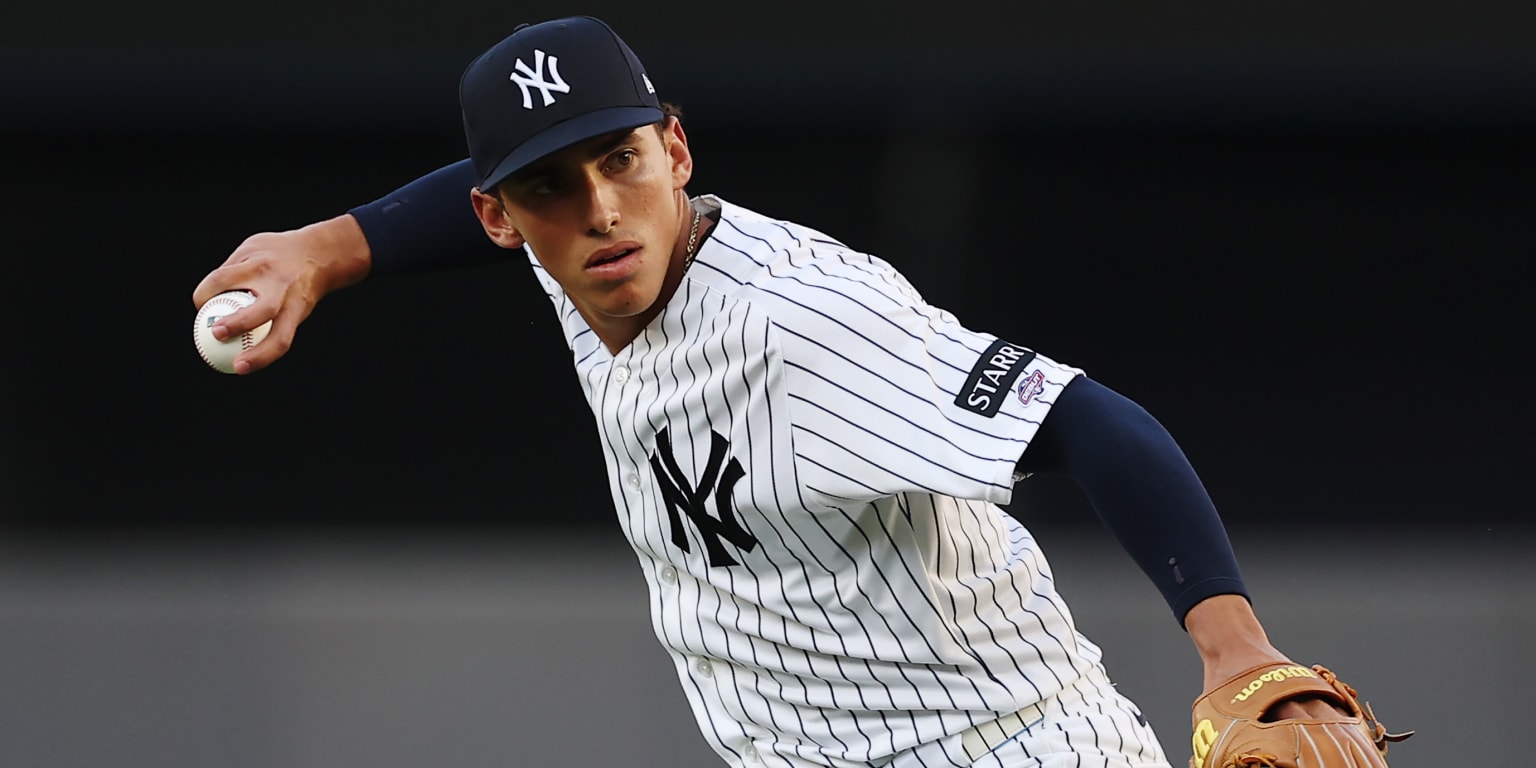
George Lombard Jr. has played five games for the Yankees and already forced a conversation about whether the organization's shortstop problem has an actual solution. The 21-year-old top prospect arrived with prospect pedigree and exit-velo promise, but five games into his MLB debut, he's demonstrating the full toolkit at once: power to both fields, elite-range defense, and sprinting ability that sits at the 99th percentile.
Start with the contact quality. In 20 plate appearances and 12 balls in play, Lombard has posted a 42% hard-hit rate, a 42% sweet-spot rate, and a 17% barrel rate. Neither of those home runs came on fastballs in his wheelhouse—his debut shot was a 100.2 mph laser off an 0-2 breaking ball; his second cleared the short porch on the opposite field. The hit tool is real, and the power distribution (one pulled, one opposite) suggests he's not guessing. The sample is genuinely tiny, but the quality of contact is not noise. At this stage of a prospect's pro career, hard-hit rate and barrel rate are more predictive of future power than raw home run totals because they isolate approach and bat control, not luck.
Defense and speed push the narrative further. Lombard's average sprint speed sits at 29.7 feet per second, a tick below the 30 ft/sec elite threshold but he's already registered a 30.5 ft/sec sprint on his first at-bat and repeated 29.9 ft/sec on the infield single Friday against Atlanta. That's not variance—that's his true baseline. On the field, his range into the hole and his arm strength (133 feet in 0.77 seconds) are replicating what Aaron Boone called shortstop defense "like a puma." For a team that has cycled through Isiah Kiner-Falefa, Anthony Volpe, and other stopgap solutions, a 21-year-old who can field, run, and hit is not standard prospect theater.
For bettors tracking Yankees construction, the prop implications ripple outward immediately. Lombard's presence compresses the offensive ceiling of replacement-level innings and shrinks ground-ball dependency on the infield. In five games, he's forced a comeback win on speed and defensive ability, meaning his value isn't bet-dependent on home-run variance. His speed is already at elite tiers (29.7+ average sprint speed), his defensive range is major-league ready, and his hard-hit rate is sustainable if his approach discipline holds. The market has not yet priced in a full season of Lombard at this contact quality. Early-week Yankees team totals and run-line props should account for his baserunning upside—a 30 ft/sec runner on first is not the same arithmetic as a 27 ft/sec runner.
The risk is that five games is five games. His 17% barrel rate could compress back to 12–15% baseline for a rookie. His sprint speed average could settle at 28.5 instead of 29.7. But the directional vector is set: the Yankees are no longer playing tactical baseball at shortstop. They're playing a legitimate prospect. Books will adjust to Lombard's presence within the next two weeks as sample size builds and the trade desk recognizes the infield floor has risen. Early runs on Yankees team totals and Lombard individual props (runs, hits, stolen bases) are available at opening numbers that don't reflect his elite-speed baseline.
MLB Intelligence — Baseball intelligence beyond the box score. Open MLB Intelligence →