NHL
The Sharks' Defensive Gamble Won't Save Askarov: Why San Jose's Goaltending Bet Is Underfunded
San Jose spent aggressively on defense this summer but punted on goaltending, betting a rebuilt blue line will fix Yaroslav Askarov's ugly first season—a theory that props don't fully support.
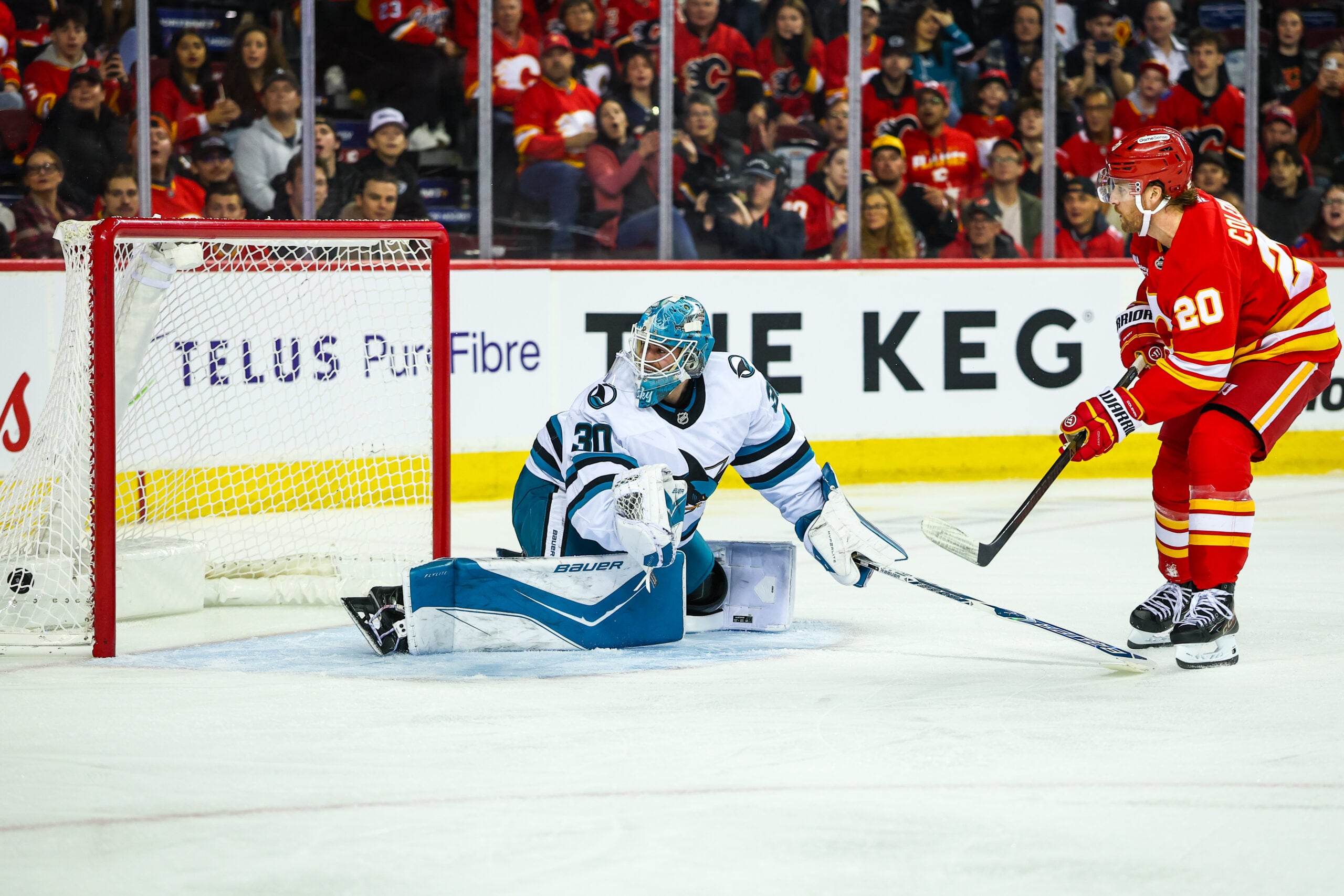
Mike Grier's offseason spending tells a clear story: the Sharks are terrified of defense but indifferent to goaltending. San Jose allowed the third-most goals in the NHL in 2025-26, and Grier responded by trading for Darnell Nurse ($9.25M), signing Jacob Trouba, and adding Michael Kesselring as a defensive reclamation project. Every dollar went to the blue line. None went to a proven starter. The only notable addition in net was Eric Comrie—a journeyman backup on a modest deal—while Alex Nedeljkovic remains the veteran safety net. The organizational bet is explicit: fix the circumstances, and the goaltender fixes himself.
Yaroslav Askarov's 2025-26 debut as the full-time starter offers little comfort. Across 47 games, he posted a .884 save percentage and 3.63 goals-against average, both well below league average. His goals saved above expected ranked among the worst in the entire league. Yes, he played behind one of the youngest and most porous defensive units in hockey—a group that surrendered high-danger chances at an alarming rate—but even with that context, a franchise cornerstone inherited by Nashville (at a premium cost) cannot post .884 SV% and expect to command credibility. The team nearly made the playoffs anyway, a testament to Macklin Celebrini's offensive carry, not Askarov's goaltending recovery.
The defensive overhaul is real, but defensemen alone cannot erase a .884 SV%. Nurse, Trouba, and Kesselring should reduce chaos in front of the net—fewer high-danger looks, better positioning, cleaner exits. That's the theory. Goaltending improvement scales with defensive volume; a calmer game does make any netminder look incrementally better. But Askarov's hole is deeper than circumstance. His AHL track record (.913 SV% across three seasons) is respectable, not elite, and his first NHL season produced historic-level save percentage weakness. Goaltenders often need adjustment time, but they also need foundational skill. Betting on Askarov without a credible backup plan is betting on youth and upside in a position where the Sharks have already burned a full year.
For prop bettors, this shapes San Jose's ceiling. Goals-against totals on Sharks games should trade rich. Even with a sharper defense, Askarov will leak goals at above-average rates—the mechanism isn't a defense overhaul erasing a .884 SV%, it's a defense overhaul reducing the volume of looks. If the Sharks face 28 high-danger chances instead of 35, a .900 SV% still yields 2.5-2.7 goals conceded (assuming 3-4 of those are low-danger). The market will price Askarov as if Nurse and Trouba have solved goaltending; they have solved defensibility, not performance. That's a durable edge, because it reflects a structural mispricing: the public conflates "better team defense" with "better goaltending," but they're not the same thing.
The Sharks' window is now. Celebrini is in year one of a long arc, and the offense is loaded. Wasting it on a goaltender who may never stabilize is organizational malpractice. Grier's summer moves scream confidence in the young core and a willingness to mortgage depth for star talent in front. Behind the crease, there's only hope.
NHL Intelligence — Hockey intelligence beyond the scoreboard. Open NHL Intelligence →