San Jose Just Anchored Its Core—What That Means for Celebrini's Scoring Path
By PropBetEdge Editorial Team ·
Macklin Celebrini's record contract isn't about the AAV; it's about the Sharks finally committing to a foundation, and that stability has direct implications for his offensive consistency.
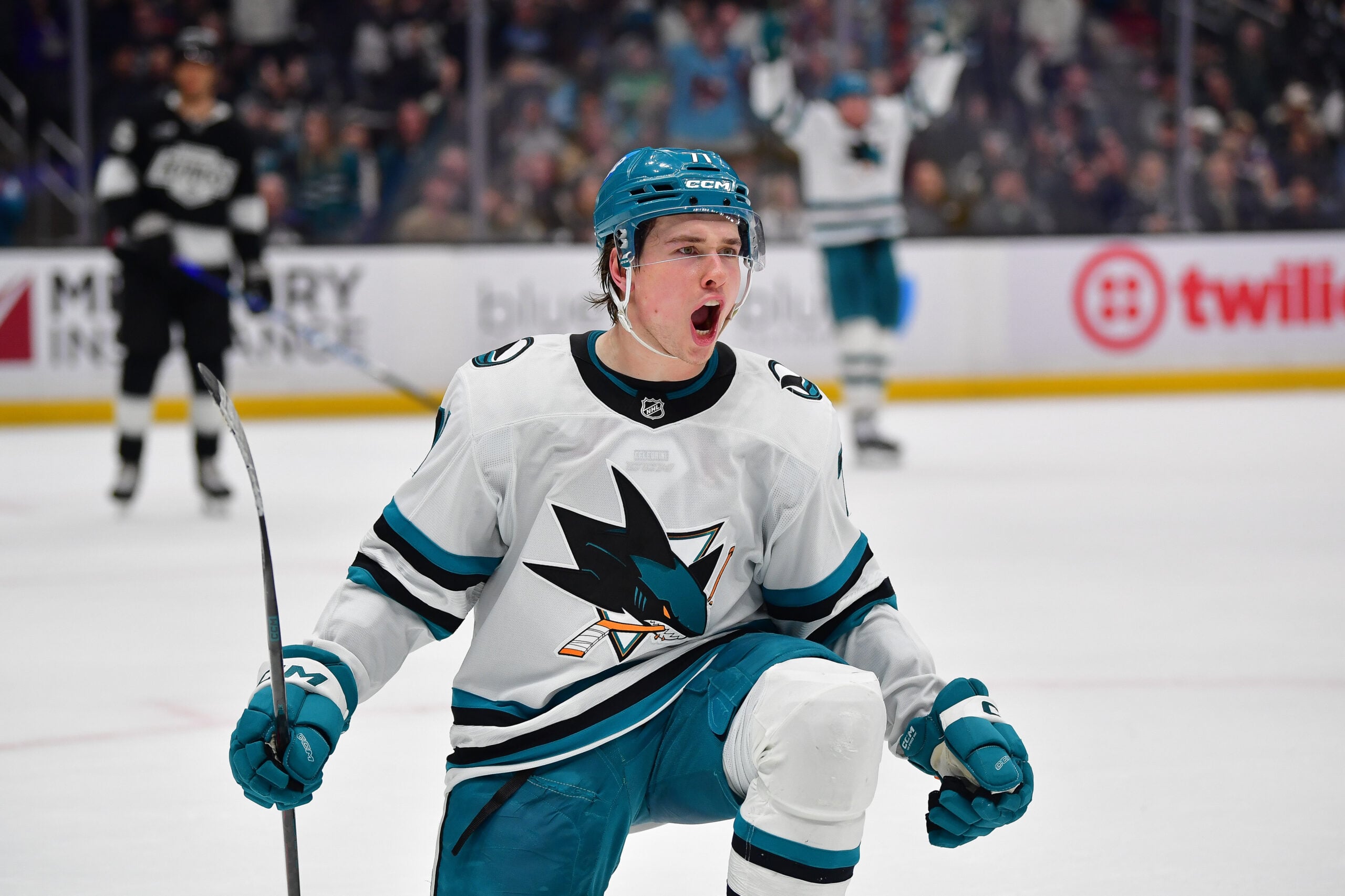
The San Jose Sharks signed Macklin Celebrini to a five-year, $94 million extension on July 29, making the 20-year-old the NHL's highest-paid player at $18.8 million average annual value. The contract runs from 2027-28 through 2031-32, edging past Leo Carlsson's $18 million mark set earlier this summer. On paper, it's a record-setting haul for a player with two professional seasons under his belt. But that framing misses the actual story: Celebrini took a discount—turning down roughly $20.8 million per year to provide the Sharks roster flexibility. That willingness to leave money on the table signals something rare in modern hockey: a young superstar aligned with franchise-building rather than self-maximization.
The statistical foundation beneath this bet is clean. Last season, Celebrini tied for fourth in the NHL with 45 goals and ranked fourth overall with 115 points across 82 games, becoming the first teenager since Sidney Crosby to eclipse 100 points in a single season. Add his international output—139 total points across all competitions last season, including Olympic and World Championship contributions for Canada—and the production already justifies the investment. He's not a prospect anymore; he's a 20-year-old operating at established-superstar efficiency levels. That performance tier, at that age, almost never walks out the door.
From a salary-cap perspective, the Sharks maintain roughly $34 million in projected cap space for 2027-28, the first year Celebrini's extension kicks in. His cap hit will consume roughly 16.6 percent of the projected $113.5 million ceiling that year, a manageable anchor. The structure—$89.1 million of the $94 million total arriving as lockout-proof signing bonuses—shows how serious ownership was about security. Next come the harder extensions: Will Smith is eligible soon, and Michael Misa's raise looms. But those are problems born of depth, not scarcity.
For prop betting, the Celebrini deal creates a stable offensive ecosystem. When a franchise core knows it's built to contend and its star is committed to the process, shooting volume and assist opportunity tend to consolidate around that player. Celebrini averaged 4.3 shots per game last season; with a locked-in roster framework, that baseline should hold or increase, especially if the Sharks add complementary talent in the next two years. His assist rate (1.40 per game last season) ties directly to ice time deployment and linemate consistency—both of which improve when management has locked in its forward architecture. The Sharks aren't tanking anymore. They're investing. That mindset shift flows into nightly shooting and opportunity allocation.
The real edge isn't a single-game spike—it's the multi-year stability premium. Celebrini's prop lines over 2027-28 and 2028-29 will be priced assuming regression from a 115-point pace or volatility around a young player. But this contract signals that the Sharks are doubling down on his volume and opportunity, not scaling it back. A player of his caliber, on a willing-partner contract, in an organization that just committed publicly to him, typically sees assist and shot opportunities consolidate upward, not drift. The market will price caution into his season-long props; the real angle is in recognizing that organizational stability and star alignment historically produce floor elevation, not ceiling anxiety.