NHL · transaction
Jost Returns to Nashville on Waiver-Eligible Deal as MacFarland Deepens Forward Depth
The Predators lock down a depth forward on a two-way contract after a forgettable 2025-26 season, but his limited offensive ceiling keeps line-game props in check.
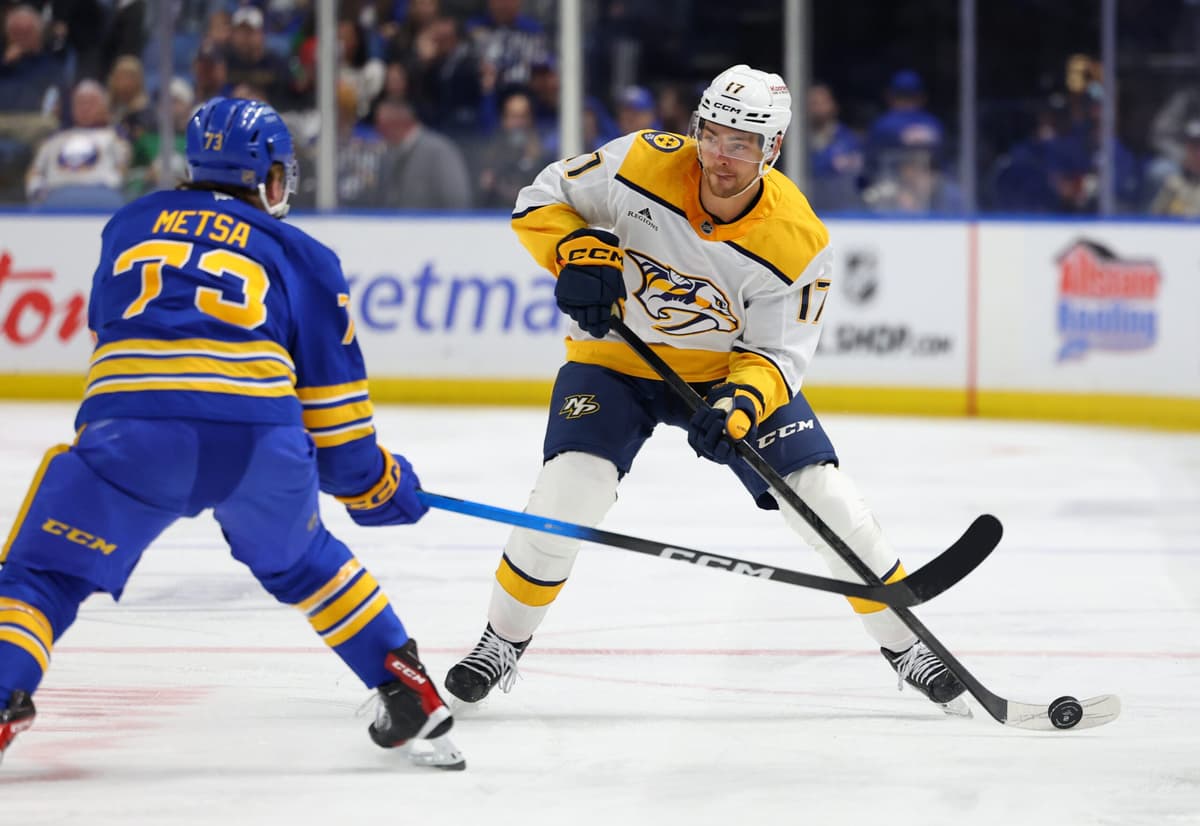
The Nashville Predators signed Tyson Jost to a one-year, two-way contract on Monday, bringing back the 28-year-old forward for the 2026-27 season after he spent the majority of last year in their lineup. Jost compiled 16 points across 69 games during the 2025-26 campaign—eight goals and eight assists—while averaging 12:25 of ice time per night and finishing at minus-21, marking a career-low offensive contribution for a player who was drafted 10th overall by Colorado a decade ago. The deal carries an $850,000 NHL salary-cap hit and places Jost on waivers, signaling that Nashville views him as organizational depth rather than a core rotation piece.
The signing reflects new president of hockey operations Chris MacFarland's philosophy of adding veteran ballast to complement his marquee acquisitions. Alongside Ross Colton and Jack Drury—both acquired from his former Avalanche organization—Jost slots into a forward group that also features Mavrik Bourque, Adam Edstrom, Nils Hoglander, and Alex Kerfoot. That roster surgery comes after Nashville missed the playoffs in consecutive seasons, including a historically disappointing 2024-25 before a late-season surge nearly salvaged 2025-26. MacFarland's mandate is clear: build organizational depth and stability around the core of Filip Forsberg, Ryan O'Reilly, Steven Stamkos, and Jonathan Marchessault.
For prop bettors, Jost's return profile warrants caution on any individual game totals. His 16 points across 69 games last season translates to a 0.23-point-per-game average—among the lowest of his career—and his 12:25 average ice time suggests limited usage in leverage situations. Over his 564 regular-season games, Jost has posted 69 goals and 96 assists, a 0.29 point-per-game pace that hasn't materialized in recent seasons. The waiver designation reinforces that he's a reserve-depth option, not a regular three-ring contributor.
The mechanical constraint is straightforward: Jost's usage won't support his career-long prop volume. His assists line, if offered, will hinge on whether MacFarland slots him into a second-unit power-play role or pairs him with higher-volume scorers like Forsberg or Marchessault. Without that structural assignment—which the depth-focused roster construction suggests is unlikely—his game-to-game assist or shot totals will track below typical season averages. Any offer on Jost assists or points under a 0.5 or 0.75 total represents fair or better value, since his 2025-26 floor has already been established and the waiver-eligible status signals minimal organizational priority for fourth-line or power-play deployment.
Nashville's forward core is now better equipped to challenge for a playoff return, but Jost remains a check-mark signing—the kind of veteran anchor that doesn't move markets but doesn't sink rosters either. His presence should be treated as margin-of-error depth, not a catalyst for offensive prop leverage.
NHL Intelligence — Hockey intelligence beyond the scoreboard. Open NHL Intelligence →