NHL · transaction
The Rantanen Trade Wasn't About Rantanen—It Was About What Carolina Built Around Him
A year after the failed Rantanen experiment, the pieces the Hurricanes kept are carrying them deeper into the playoffs than the star they traded for.
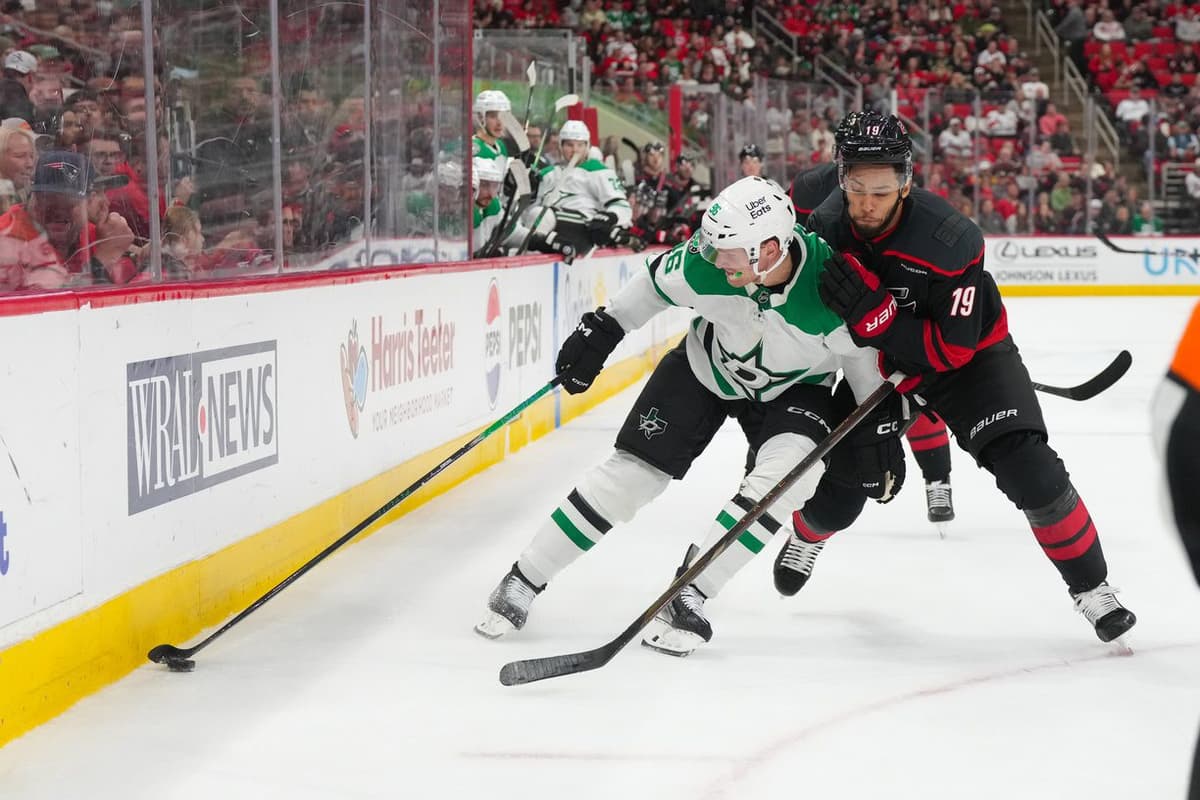
The Mikko Rantanen trade looked like a capitulation when Dallas claimed him at the deadline last season. Carolina had mortgaged futures—Martin Necas, Jack Drury, three picks spanning 2025-2026—for a rental that fizzled in the regular season, and the market immediately priced that failure into the narrative. A team chasing its first Stanley Cup in franchise history had swung for a superstar and whiffed. But as the Hurricanes sit up 2-1 in the Eastern Conference Final, the frame has inverted. The question isn't whether Carolina won the Rantanen trade. It's whether the Avalanche, who parlayed those assets into Necas and a deeper bench, are now regretting their side of it.
Necas has transformed into exactly what Colorado hoped when they accepted the gamble on an unproven talent showing 16 goals in 49 games. He's posted 49 goals and 128 points in 108 games since the deal, and carries 18 points through 20 playoff contests—a primary driver alongside Nathan MacKinnon in Denver's offense. The Avalanche didn't just replace Rantanen's production; they tethered Necas to a long-term deal and got a cheaper, younger version of the same ceiling. Drury, meanwhile, provides Colorado exactly what Carolina lacked: a reliable defensive anchor in the third line who keeps matchups manageable when the superstar pair is resting. The pick haul—Liam Pettersson and Nathan Behm (both likely non-factors per prospect analysis), plus an unresolved 2026 fourth—amounts to organizational depth Carolina could afford to surrender but Denver couldn't.
For Carolina, though, the real edge lies not in what they gave up but in what they kept. The Hurricanes roster entering the playoffs carried no Rantanen, no Necas, no inflated expectations tied to a single name. Instead, they advanced through the bracket on balanced scoring, goaltender stability, and depth pieces that remained healthy. Without Rantanen's contract occupying cap space, Carolina maintained roster flexibility through the trade deadline and into the postseason. That flexibility paid dividends: the Canes didn't overextend chasing wins; they built on their existing framework.
From a prop betting lens, this reshuffles how to evaluate Carolina's offensive output in remaining Eastern Conference Final games. The Hurricanes' scoring profile doesn't rest on any single forward hitting 50+ shot totals or 3+ assists per game—the markers that typically signal star-dependent teams. Instead, their playoff success has hinged on balanced distribution: multiple forwards hitting 1-2 assists per night, secondary scorers converting off-cycle opportunities, and opportunistic play generation when the top line draws defensive pressure. This distributional ceiling is both more predictable and more durable under variance than star-dependent structures. If a Carolina forward hits 5+ shots in a game, it's a sign of elevated engagement; if two of their depth centers each log 3+ shots, it's baseline functionality. That stability should anchor team totals lower than historical playoff matchups, and individual forward assist lines should remain modest (under 1.5 assists for most Carolina forwards not named Aho) because the offense is engineered for volume, not concentration.
The Avalanche, by contrast, now carry Necas and MacKinnon as a two-man offense with thinner depth. That structure creates volatility: if Necas logs 6+ shots, the Avs' shot total sways upward; if he's held to 2-3, their overall generation clips lower. Colorado's team totals in the playoffs should carry wider spreads than Carolina's, and individual prop lines for Necas in particular should see sharper movements week-to-week because they reflect a more top-heavy dependency. The Hurricanes' asset distribution gamble has positioned them to sustain offensive output through injury or matchup difficulty; the Avalanche's reconstruction gamble has left them talent-rich but structurally brittle.
NHL Intelligence — Hockey intelligence beyond the scoreboard. Open NHL Intelligence →