NHL
Flames' 6-1 Loss to Kraken Exposes Offensive Void as Season-Long Problem
Calgary's anemic even-strength play and power-play collapse in their home opener forecast a difficult rebuild season with clear implications for team total and goal props.
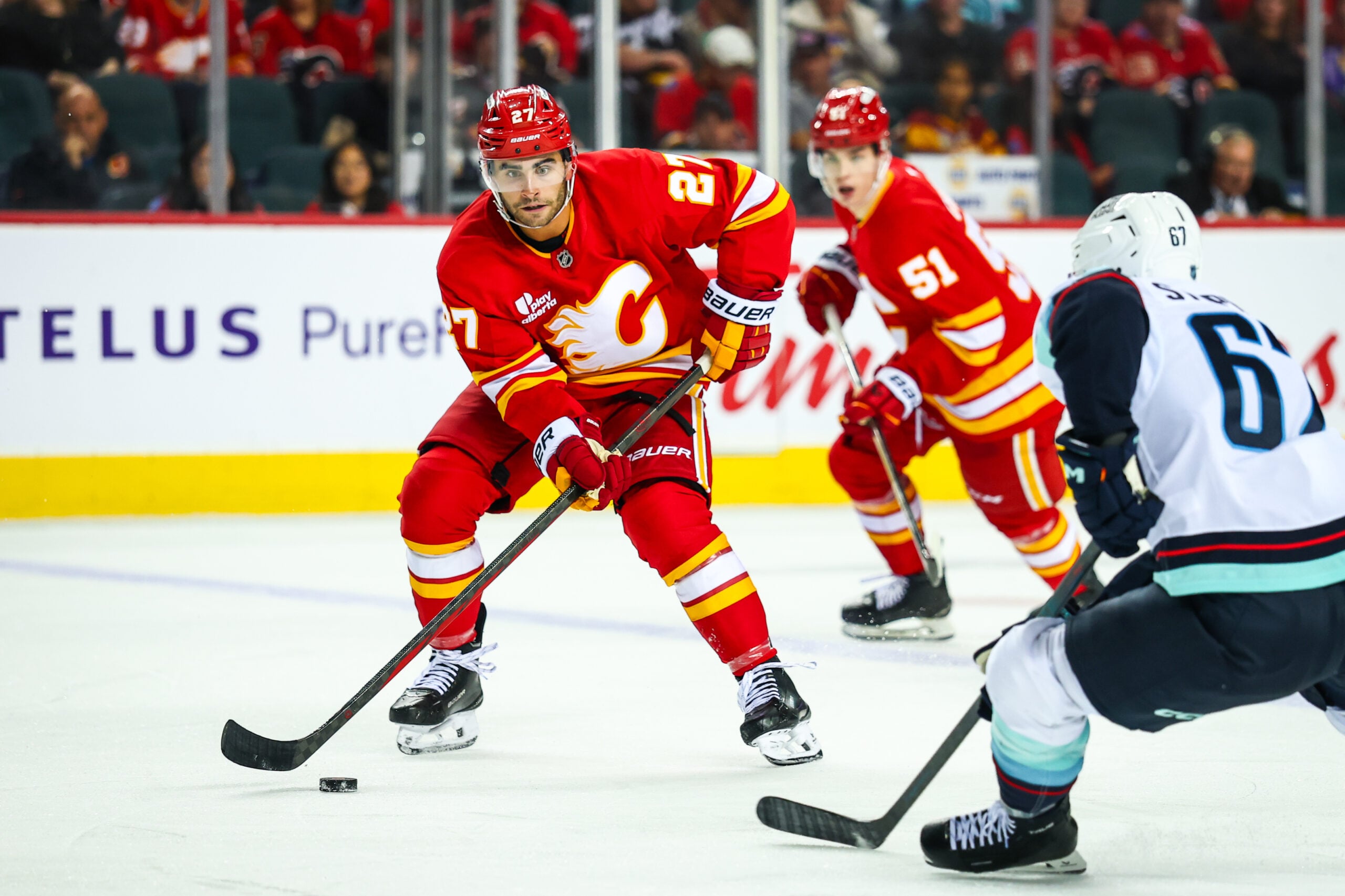
The Calgary Flames' inaugural game at the Saddledome under the 2026-27 rebuild ended in a 6-1 defeat to the Seattle Kraken on Thursday, and the final scoreline understated how thoroughly outmatched they looked at even strength. Ryan Strome's late goal provided the sole consolation for a home crowd that turned out in force to witness what may be the venue's final season. The Flames managed just 25 shots and generated virtually nothing in high-danger areas, a performance that distilled the roster's fundamental offensive poverty into one brutal evening.
The underlying mechanics of Calgary's collapse trace directly to roster composition. The team failed to produce a single 50-point scorer in 2025-26 and made no meaningful acquisitions to address the front-line weakness. Without secondary scoring or depth playmaking, even-strength possession translates into perimeter chances rather than Grade A attempts. Against Seattle's structured neutral-zone defense, the Flames lacked the individual skill or system sophistication to create space—they peppered Daccord with quantity but not quality. This isn't a coaching failure or a one-night variance spike; it's architectural.
The power-play flatline compounds the problem. Zayne Parekh's presence atop the first unit carried preseason optimism, yet on Thursday's lone five-on-four look, Calgary couldn't generate sustained offensive-zone possession, let alone high-danger chances. When a team's even-strength game is suffocated, special-teams efficiency becomes a pressure relief valve. Thursday showed no sign of relief. Ryan Huska's penalty-management challenge—five shorthanded situations—masked an even darker reality: Calgary's indiscipline forced the penalty kill into rotation, but the underlying issue is that the Flames lack the offensive weapons to punish a Seattle team that was efficient with its chances.
From a prop standpoint, Thursday's data point crystallizes a season-long edge. Calgary's 25 shots on goal against a team with a modest defensive profile signals a depth-chart problem that will persist across 82 games. The Flames' team total over/under for season openers typically price in league-average offensive output—roughly 2.9 goals per game. Calgary's actual generation profile, evident in their 25-shot, 1-goal night, suggests they're operating closer to 2.4–2.6 goals per game when adjusted for opponent strength. Seattle's defense ranked middle-of-the-pack last season; Calgary's collapse wasn't a matchup anomaly, it was a roster statement. Books will likely move Flames team totals down marginally after Thursday, but the market tends to overcorrect toward recency on season openers. The sharper angle is fading Flames team overs for the next 10–15 games—until the market fully internalizes that this rebuild cohort lacks the finesse to generate offense at league rate.
Discipline also factors into the under thesis. Calgary's five penalties created a rhythm-killing powerplay environment that benefited a Seattle team strong in penalty conversion. As Strome acknowledged postgame, the NHL officiates tightly in October, but the Flames' inability to move their feet and generate chances even at even strength suggests this squad will live on the penalty kill throughout the season. That structural disadvantage—more frequent trips to the box, compounded by weak special-teams play—depresses goal totals both for Calgary and for totals involving their opponents. Early Flames unders in the 4.5–5.5 range carry higher-than-normal reliability over the season's first three weeks.
NHL Intelligence — Hockey intelligence beyond the scoreboard. Open NHL Intelligence →