Hughes' Bounce-Back Blueprint: Why Montreal's Trade Targets Matter for Depth Scoring
By Erik Schwartz ·
Kent Hughes is shopping for undervalued forward depth ahead of next season, and the market timing reveals what Montreal's offensive ceiling really looks like.
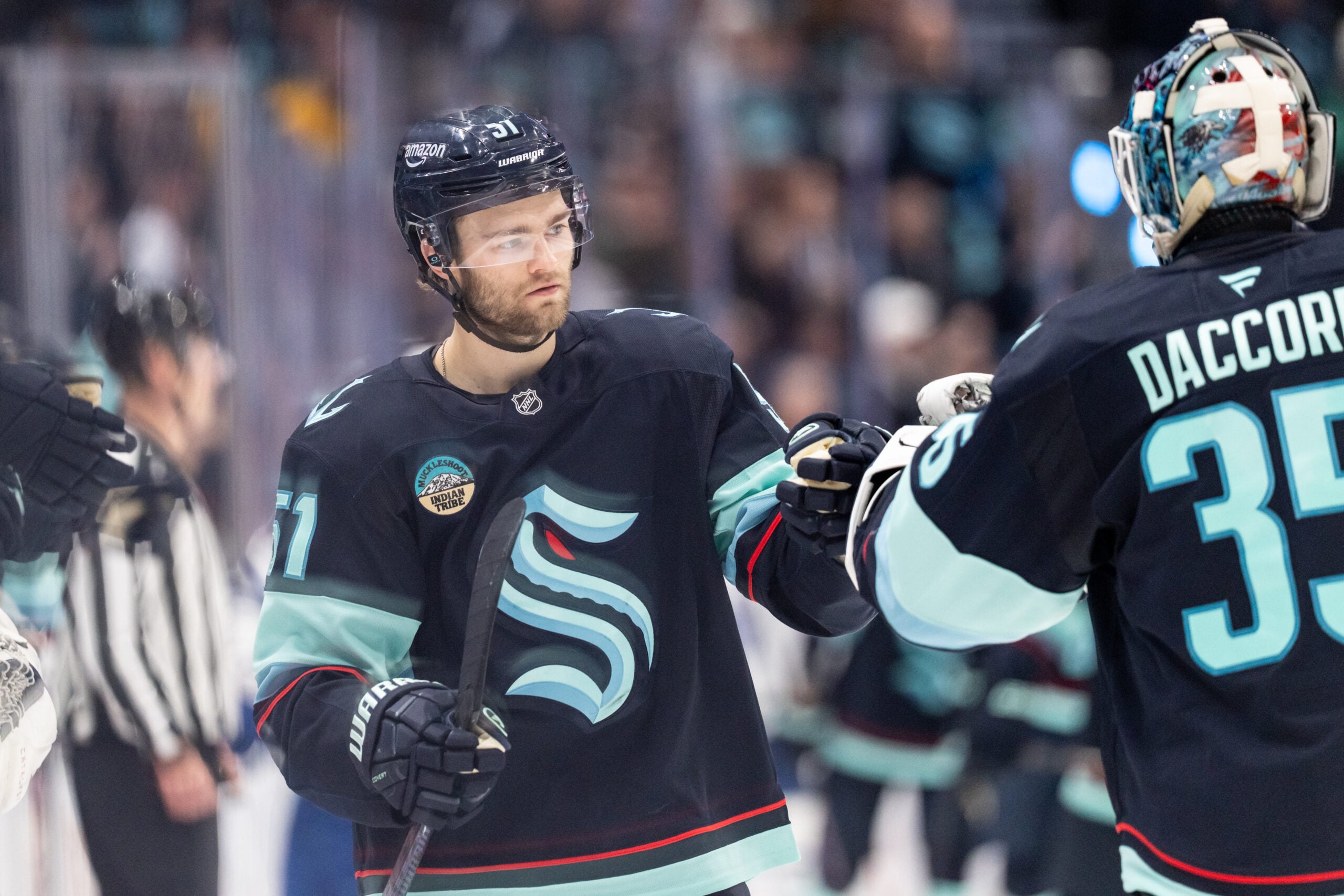
Kent Hughes has built his Montreal tenure on a simple thesis: grab talented players when their market value crashes, then let coaching and circumstance do the repair work. The Kirby Dach trade in 2022 set the template—a former high pick struggling elsewhere gets a fresh start in a lower-pressure environment. Now, with three specific targets on the Canadiens' radar (Connor Zary, Shane Wright, and Kent Johnson), that same philosophy is shaping how Montreal will compete next season.
Each candidate carries a distinct profile. Zary, 24, was the 24th overall pick in 2020 and posted 34 points in his NHL rookie season—a legitimately promising start—but has stalled since. Calgary is listening to offers. Wright, 22, went second overall in 2022 (after Montreal took Slafkovsky) and put up 44 points last season while developing into a reliable two-way centre. Johnson, meanwhile, had the steepest fall: 57 points in 2024-25, then just 22 points in 2025-26, a regression that either signals injury, deployment mismatch, or genuine offensive decline. The common thread isn't talent—it's uncertainty. The market has priced each of these forwards as question marks rather than core pieces, which is where Hughes typically finds his edge.
From a roster-construction standpoint, Montreal needs to know whether its top-six depth can generate consistent secondary scoring. The Canadiens' win total and season-long goals projections hinge entirely on whether one of these three stabilizes as a second-line contributor or power-play facilitator. If Zary finds consistency, Montreal's team-total goals could carry more confidence. If Wright develops into the 50-point centre the Kraken haven't unlocked, Montreal's assist distribution deepens. If Johnson rebounds—and this is the high-variance play—the Canadiens suddenly have lottery-ticket upside in their middle six. Hughes knows these aren't slam-dunk acquisitions; they're optionality bets on player development.
The prop implication is granular but real. None of these moves happen in isolation—each impacts how Montreal distributes ice time and touches in the attacking zone. Zary's value centers on his two-year, $3.775M cap hit and demonstrated power-play instincts; if acquired, his anytime-goal and assist lines should reflect immediate responsibility on first-unit PP. Wright's floor is high (defensive responsibility, reliable battle-winner) which suppresses his ceiling; expect conservative point projections until he proves 44 points wasn't noise. Johnson is the trap: a 22-point season screams trade bait, but if Columbus is willing to move him at a discount, it's because they've given up on a 25-year-old who broke 57 points two seasons ago. That kind of flip—from 57 to 22—either means structural injury, complete scheme mismatch, or a player in freefall. The betting market will price Johnson's totals conservatively until he plays, and rightfully so.
Montreal's rebuild timeline now has a clearer shape. These aren't marquee signings; they're depth corrections that either unlock the Canadiens' second-line scoring or they don't. The edge for bettors isn't in the trades themselves—it's in understanding that Hughes' willingness to acquire undervalued talent means Montreal is optimizing for floor, not ceiling. Team totals and spread expectations should reflect cautious efficiency rather than offensive explosion. The Canadiens are building a team designed to win close games with solid goaltending and depth defense, not one that outguns opponents through middle-six firepower.