NHL
Toronto's Goalie Depth Bet: Why Akhtyamov's Ascent Matters for Save Rate Props
Bobrovsky's statistical decline and Stolarz's injury history make Akhtyamov the hidden operator in Toronto's crease—a reality that reshapes how to price Leafs goalie performance this season.
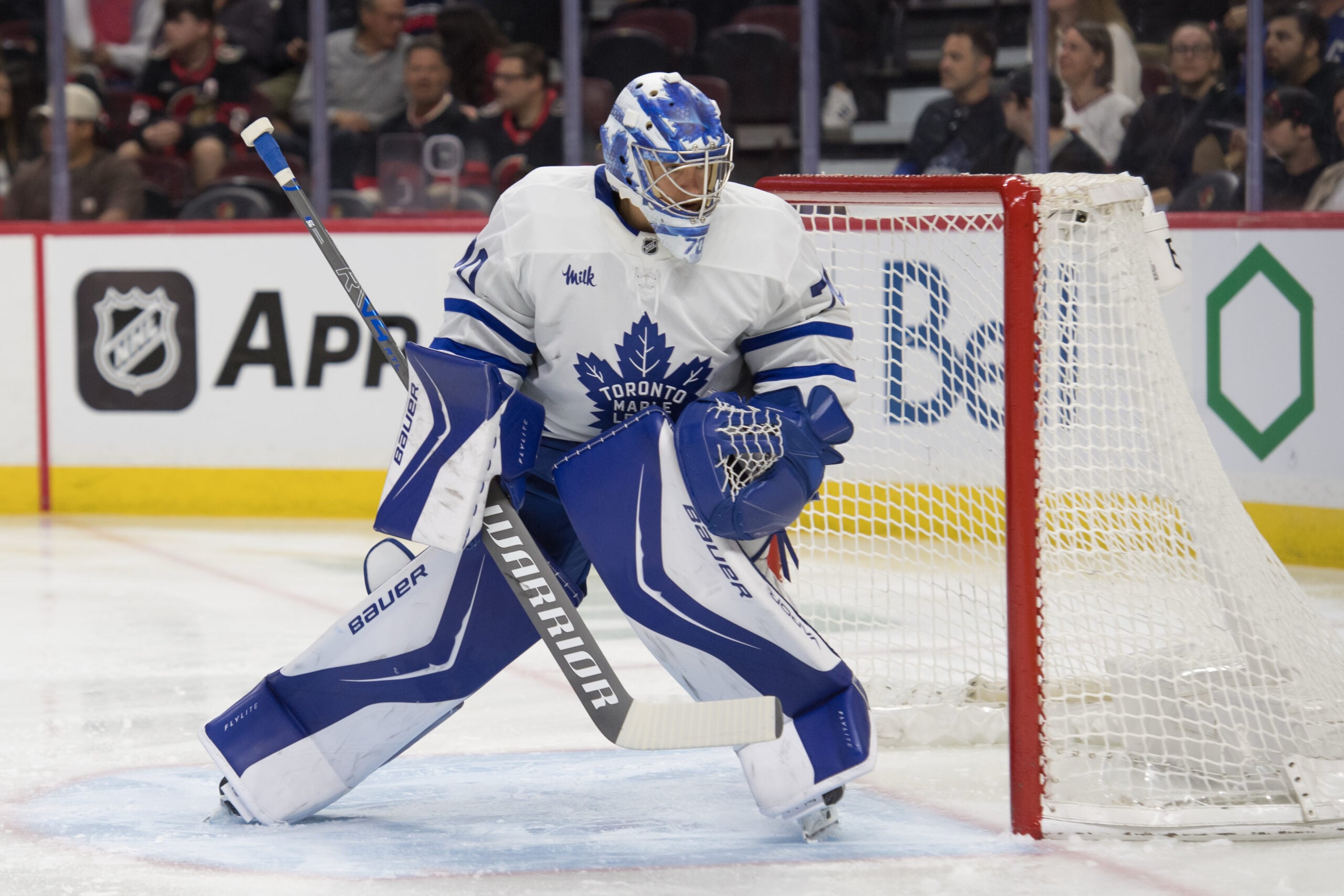
Sergei Bobrovsky arrived in Toronto as a franchise centerpiece: a 38-year-old Stanley Cup champion and multiple Vezina winner who'd made three consecutive Finals trips. Anthony Stolarz was supposed to be the capable co-pilot. On paper last summer, it looked like one of the league's deepest goalie tandems. The 2025-26 season dismantled that narrative. Bobrovsky posted a career-low .877 save percentage and 3.07 goals-against average—both well below the NHL average of .896 and 2.85 respectively. Stolarz wasn't meaningfully better at .893 and 3.28. Age and durability compound the problem: Bobrovsky turns 38 when the 2026-27 season opens, and Stolarz has spent roughly 200 days on injured reserve or long-term injured reserve over the past four seasons. The math is straightforward—at least one of them will miss significant time before the calendar flips to 2027.
Artur Akhtyamov isn't waiting on the sideline as an afterthought. Last spring, the young goalie beat out highly regarded prospect Dennis Hildeby for Toronto's AHL affiliate's playoff starter job, then led the Marlies to a Calder Cup championship while winning the Jack A. Butterfield Trophy as MVP. That performance wasn't just impressive—it was organizational validation. The team ranked Akhtyamov high enough that they shipped Hildeby out as part of the Nick Paul acquisition, a trade decision that speaks to how management actually values the depth chart, not what the preseason narrative claims. When an organization trades away a 6-foot-7 prospect for a veteran forward, they're saying the replacement behind him has earned trust.
This matters directly for how to model Toronto's goalie performance. Bobrovsky and Stolarz will start the season, but the third arm in the rotation isn't a placeholder—it's a probable 10-25 start player who performed at an elite level in restricted competition. The market will price Leafs goalie props (saves, save percentage, goals against) assuming Bobrovsky or Stolarz handles the bulk of the workload throughout October and November. That's technically correct for the immediate term. But any serious injury or prolonged slump flips the script faster than usual because Akhtyamov has already proven he can win in pressure situations. Teams with legitimate third-option confidence tend to rotate goalies earlier and more aggressively than teams with liability issues behind the main two.
For prop bettors, this creates a timing edge: Bobrovsky's save percentage and GAA lines for the first half of the season will likely be priced as if he's guaranteed heavy workload volume. The market isn't yet calibrating for the elevated probability that he gets pulled for rest or injury relief sooner than a typical 38-year-old starter would. Conversely, if Akhtyamov actually does see 15-20 starts before year's end—a scenario Toronto's organizational confidence makes more likely than consensus public models—his save percentage and goals-against lines for the season could offer value because he won't be viewed as a reliable play until mid-November or later, if at all. The edge exists in the gap between market assumption (Bobrovsky carries the load all season) and organizational reality (Akhtyamov is actively trusted and will get meaningful run).
The durability angle is single-event dependent—Stolarz or Bobrovsky getting hurt in October would crystallize the thesis instantly—but the organizational validation is multi-season persistent. Akhtyamov's Marlies performance, the Hildeby trade, and management's public confidence suggest Toronto is genuinely prepared for rotation depth this year, not just hoping it doesn't matter. Sportsbooks will price the first few weeks assuming traditional starter hierarchy. Smart money prices the first few months knowing the backup isn't a warm body.