NHL
Nikishin's Market Reset Signals Blues' Defensive Bottleneck—and a Cap Crunch Coming
Carolina's Stanley Cup champion defenseman is drawing multiple suitors at a $7.5–8.5M ask, forcing St. Louis to choose between a top-four anchor and future flexibility.
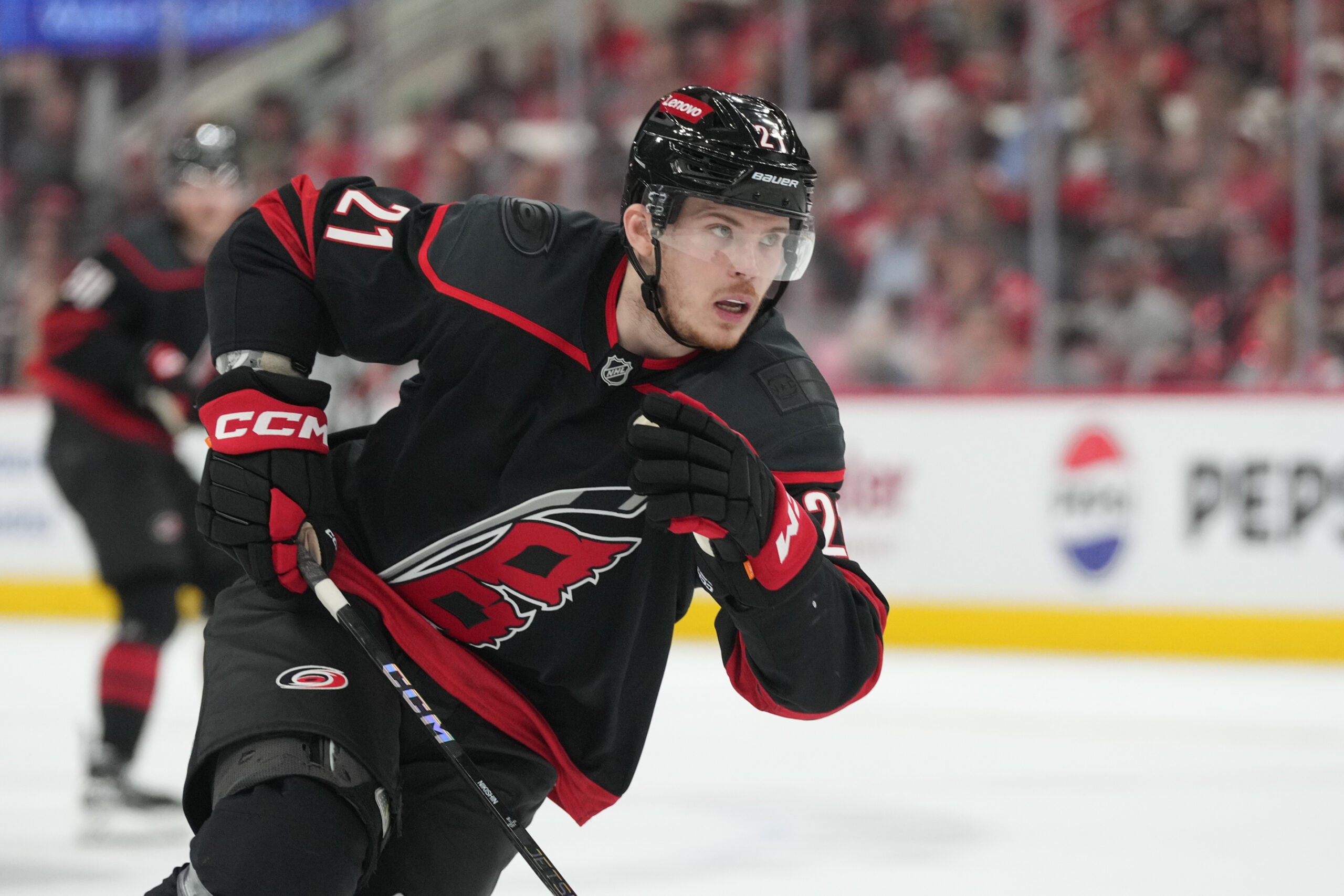
The St. Louis Blues have begun serious inquiries on Carolina Hurricanes defenseman Alexander Nikishin, per Elliotte Friedman, as the 24-year-old restricted free agent approaches extension talks with a market value climbing into the $7.5–8.5 million annual range. Nikishin just completed his first full 81-game season for the Stanley Cup champion Hurricanes, posting 11 goals and 22 assists while averaging 18+ minutes per night and finishing plus-18. At 6-foot-3 with proven mobility and top-four credentials already in place, he represents exactly the kind of young defensive architecture that contending teams covet—and exactly what St. Louis lacks.
But this trade makes sense only if you understand what's actually driving it: cap pressure, not desperation. Carolina won the Cup and remains a contender, but committing $7.5–8.5M to a third or fourth defenseman forces hard choices on depth spending elsewhere. St. Louis, meanwhile, faces its own looming arithmetic. Connor McMichael is headed to salary arbitration and will need a long-term deal before the Blues can map out remaining cap room. If McMichael lands north of expectations—a real possibility for a young player with his trajectory—St. Louis' ability to absorb Nikishin's ask shrinks fast. The Blues' forward group is finally solidifying with a genuine young core; their defense still lacks a long-term partner for Colton Parayko or Logan Mailloux. That mismatch is why Nikishin fits. That tension is why the deal is hard.
From a roster construction lens, the Blues' pursuit reflects their confidence in offensive development and desperation to avoid another season of defensive volatility bleeding into late-game situations. A defenseman who can handle 20+ minutes in playoff hockey and generate offense from the blue line—even at modest rates—shields a young goaltending investment and lets the forward group attack without constant backcheck strain. That's not a luxury; it's structural necessity for a team trying to exit the second-round ceiling.
For betting purposes, any trade completion would reshape St. Louis' on-ice profile in subtle but measurable ways. If the Blues land Nikishin, expect modest uptick in team totals and lower spreads in games where they play at home—not because he's a goal scorer, but because his presence on the backend allows the forward group to operate with higher risk tolerance and fewer third-period defensive retreats. A defenseman who finishes plus-18 in a championship environment and logs 18+ minutes straight across an 81-game sample doesn't move the needle on shots-for volume, but he stabilizes possession long enough for the offense to find rhythm. Conversely, if St. Louis walks away (either due to cap constraints or Carolina's asking price holding firm), watch for their team unders to become slightly more attractive in the second half of 2026–27, as defensive shortcomings force periodic coaching adjustments that compress offensive output. The Blues' forward core is talented enough to warrant plus money in most matchups, but without anchor defense, that money works only if the goalie wins three or four games per series on his own.