Neighbours' Rebound Path Hinges on Line Assignment—and Shot Volume
By Erik Schwartz ·
Jake Neighbours' 36-point 2025-26 season masked a fixable problem: opportunity drought, not conversion failure.
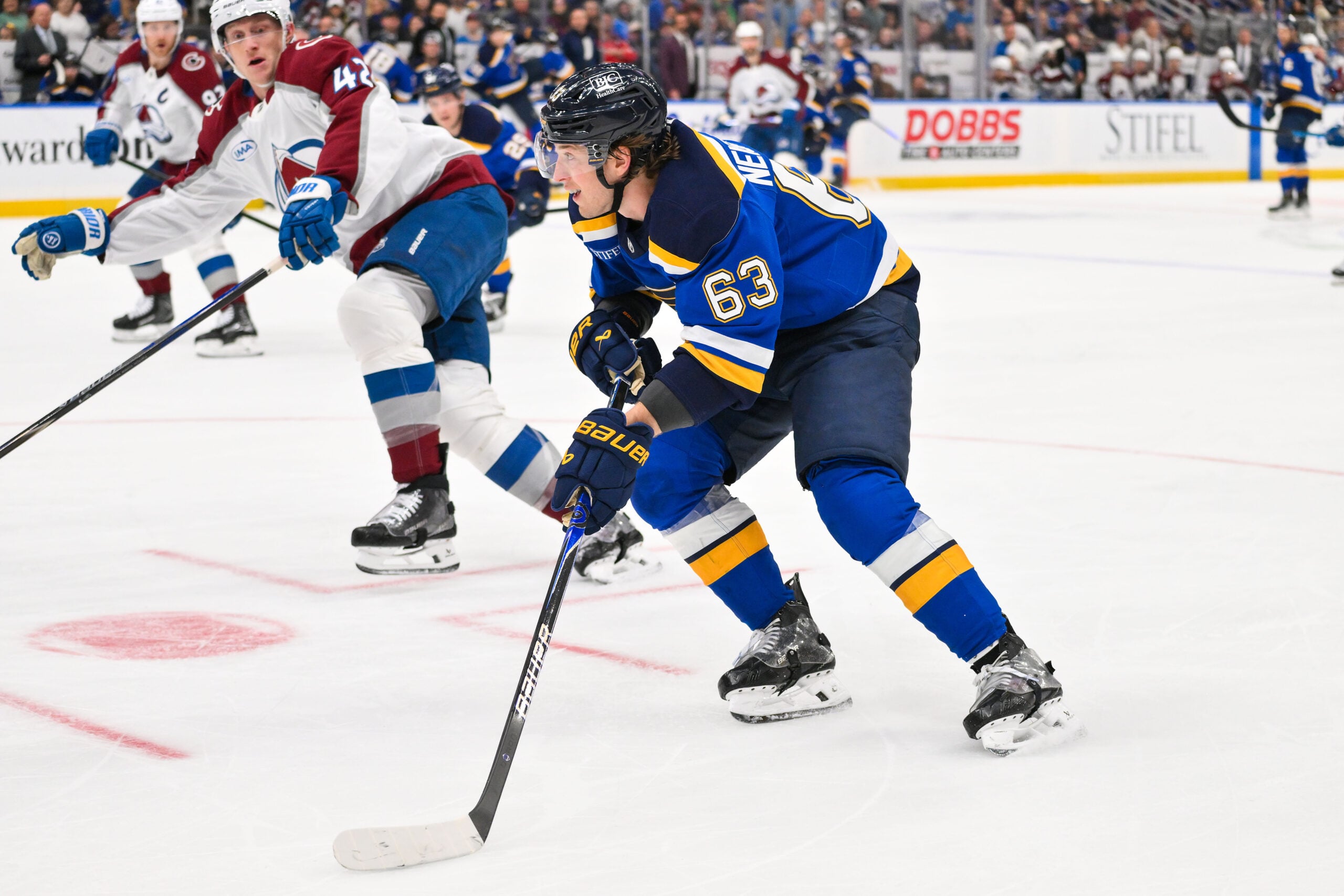
Jake Neighbours faces a critical 2026-27 season with the Blues, and the reset button is more accessible than his 2025-26 collapse suggests. After posting a career-high 46 points in 2024-25, the Alberta native crashed to 15 goals and 36 points last season—a 10-point drop that raised questions about durability and ceiling. But the underlying mechanics tell a different story. Neighbours missed 13 games due to injury, yes, but the real issue was shot starvation: he fired just 86 attempts compared to 122 the prior year and 145 in 2023-24. His 17.4% shooting percentage last season remained respectable, suggesting the conversion engine still works. The problem was volume, not touch.
Neighbours has legitimate scoreboard evidence across his three-year arc. In 2023-24, he buried 27 goals on 145 shots (18.6% clip) while adding 11 assists. Last season he upped his playmaking to 21 assists despite reduced ice time, signaling flexibility in his scoring profile. He's not a one-tool player. The question now is whether the Blues' depth chart gives him the minutes and linemate quality to rebuild his shot diet back toward the 120-140 range that powered his best seasons.
Line placement is the swing variable. If Neighbours lands on the second line alongside Mason McTavish and Connor McMichael, the math works in his favor. McTavish provides interior presence and playmaking gravity; McMichael offers complementary finishing and rush attack. That trio's offensive architecture could push Neighbours back to 20+ goals—even 30 is plausible given his 27-goal ceiling—because he'd accumulate 110-130 shots in a stable, high-touch environment. If he stays on the third line, as early reports suggest, with rotating partners like Dalibor Dvorsky or Pius Suter, the opportunity gap narrows. Inconsistent chemistry flattens shot generation, and reduced power-play exposure compounds the drag. A third-line role would cap his ceiling at 18-22 goals barring a dramatic efficiency spike.
For prop bettors, this creates a line-assignment bet wrapped inside a season-long performance bet. Neighbours' shots-on-goal prop and goals total will both move sharply once the Blues release their opening roster arrangement and confirm ice-time allocation. If Vegas opens his season-long goals line at 20.5, that's fairly priced only if he lands on the second line with stable minutes; third-line placement at similar or reduced ice time makes the under an edge play because his 2025-26 injury-adjusted baseline (15 goals in 69 games ≈ 18 goals per 82) already accounts for some decline, and a third-line role would further compress his shot-to-goal conversion opportunity. The market is likely to price in a modest rebound from last season's 15 goals but may not fully weight the lineup-assignment risk. Monitor Blues depth-chart news closely—once that crystallizes, the prop line will follow within 24 hours, but early action on Neighbours before assignment confirmation could lock in softer numbers on the under if a third-line scenario materializes.
The bounce-back narrative is defensible, but it's not destiny. Neighbours has shown he can score and assist at NHL-caliber rates. The 2025-26 trough was driven by two controllable variables—injury absence and reduced shot volume—not a sudden skill cliff. If McTavish and McMichael pull him onto the second line, he's a lean to the over on season goals at reasonable numbers (19.5-21.5). If he's locked into the third line, the under becomes the play, and the market will likely take several weeks to price that discount in. The edge is asymmetric right now because the Blues haven't finalized their forward depth chart, and early bettors could still catch the pre-assignment line.